
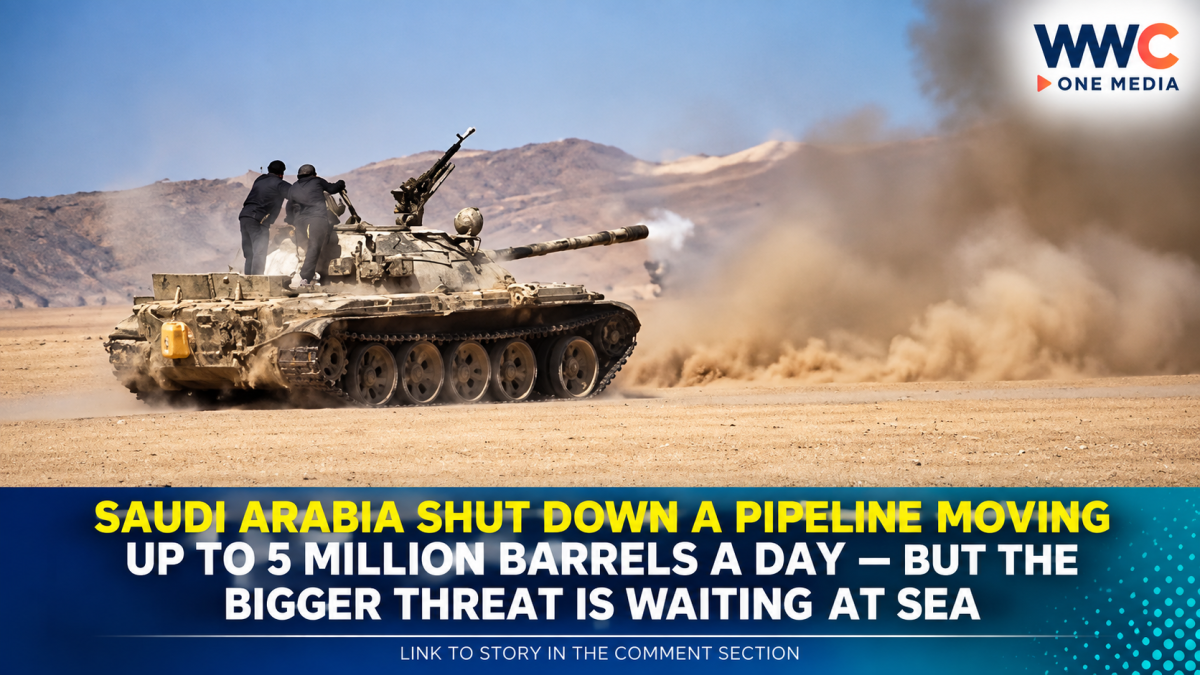
RIYADH/ADEN — Saudi Arabia built its East-West oil pipeline to give the world’s biggest crude exporter something most Gulf producers do not have: a way to move huge volumes of oil without relying on the Strait of Hormuz.
Now that escape route has been hit too.
Saudi Arabia temporarily shut the 1,200-kilometre East-West Pipeline after several drones struck facilities in the Riyadh and Madinah regions, causing injuries and damage, according to Saudi authorities. Riyadh and Baghdad said the aircraft were launched from Iraqi territory, although responsibility for the attack had not been established publicly at the time of reporting.
The immediate shutdown is significant enough. But the wider danger is what is happening hundreds of kilometres away in Yemen.
Iran-aligned Houthi forces have advanced along Yemen’s Red Sea coast and seized Perim, also known as Mayun Island, a strategically positioned island inside the Bab el-Mandeb Strait — the narrow gateway linking the Red Sea with the Gulf of Aden and Indian Ocean.
That leaves Saudi Arabia facing pressure on both ends of an oil-export system that had become increasingly important as traffic through Hormuz was disrupted.
The pipeline was carrying 4 million to 5 million barrels every day
The scale of the East-West Pipeline helps explain why the attack immediately attracted global attention.
Reuters reported that the line had recently been transporting about 4 million to 5 million barrels per day, equivalent to roughly 4% to 5% of global oil supply. It carries crude westward across Saudi Arabia toward the Red Sea, allowing exports to bypass the Strait of Hormuz.
Its technical capacity is even larger.
Saudi Aramco said in May that the system had been ramped up to its maximum capacity of 7 million barrels per day during the first quarter of 2026 as the company responded to shipping disruptions around Hormuz.
The U.S. Energy Information Administration gives further context: roughly 5 million barrels per day of that capacity can support exports, with the remainder serving domestic requirements.
That distinction matters. The pipeline was not necessarily moving seven million barrels every day when it was attacked; current reporting puts recent throughput at around four million to five million barrels daily.
It was Saudi Arabia’s answer to the Hormuz crisis
Normally, the Strait of Hormuz is one of the most important energy corridors on Earth.
But severe disruption there during the current Middle East conflict forced Saudi Arabia to rely much more heavily on its route across the peninsula to Yanbu on the Red Sea.
The EIA said Saudi Arabia had rerouted crude away from Hormuz through the East-West Pipeline, helping push oil flows through Bab el-Mandeb to an average 8.1 million barrels per day in the second quarter of 2026, up sharply from 5.4 million barrels per day in the final quarter of 2025.
That made the western route a crucial pressure valve.
But there was always a catch.
Oil reaching Yanbu still needs a secure sea route if it is heading toward many international markets — and the Red Sea’s southern entrance passes through Bab el-Mandeb.
Now that route is under renewed pressure.
Why tiny Perim Island matters so much
Perim is small, but its location is strategically enormous.
The island sits in the Bab el-Mandeb, whose name is often translated as the “Gate of Tears.” The strait connects the Gulf of Aden with the Red Sea, giving vessels access toward the Suez Canal and the Mediterranean.
Reuters reported that Houthi forces reached and seized the island after Saudi-backed Yemeni government forces withdrew. The Houthis also advanced through locations on Yemen’s western coast, including areas facing the island.
That does not automatically mean the Houthis have closed or exercise uncontested control over the entire Bab el-Mandeb Strait.
But possession of territory beside such a narrow shipping route strengthens their ability to threaten vessels moving through it and increases the risk calculations for shipowners and insurers.
AP reported that the Houthi advance has intensified concerns over the security of the chokepoint and could force more ships onto longer, more expensive routes.
The Houthis’ military spokesman, Yahya Saree, has said navigation remains safe for vessels other than Saudi ships covered by the group’s announced restrictions.
For Riyadh, that distinction offers little comfort.
Saudi Arabia says the drones came from Iraq — but attribution remains sensitive
Saudi Arabia’s Foreign Ministry said several drones launched from Iraq targeted its pipeline in the Riyadh and Madinah regions.
The kingdom reported injuries and infrastructure damage and said repair work was under way.
Iraq subsequently said the attacks had originated from its territory and removed the commander responsible for military operations in Maysan province, near the Iranian border. Baghdad also launched an investigation.
Maysan has long been an area where Iran-aligned Shiite armed groups wield influence.
But that is not the same thing as proving responsibility.
No group had immediately claimed the pipeline attack. U.S. President Donald Trump said he believed Iran was “probably” responsible, but that was an assessment rather than publicly presented evidence establishing attribution.
Saudi Arabia, meanwhile, said it had chosen not to retaliate for now after Iraq’s prime minister asked Riyadh to give Baghdad time to act against those responsible.
The kingdom nevertheless warned that it retained the right to take measures needed to defend its territory, people and infrastructure.
Mohammed bin Salman reportedly asked Trump for military help
The crisis has also reopened a much larger question: how far Washington is prepared to go to protect Saudi Arabia and Red Sea shipping.
Axios first reported that Crown Prince Mohammed bin Salman called Trump twice and urged the United States to strike the Houthis as their forces advanced toward the Bab el-Mandeb. Reuters later reported, citing sources, that Riyadh had sought U.S. military assistance.
For now, Washington appears reluctant to open another direct military front.
Sources told Reuters that the U.S. would provide intelligence assistance but was not prepared to intervene directly against the Houthis at that point.
That calculation matters because Saudi Arabia spent years fighting the Houthis after intervening in Yemen’s civil war in 2015, only for hostilities to decline substantially following the 2022 truce.
The group’s rapid new territorial gains therefore risk pulling Riyadh back toward a conflict it had spent years trying to contain.
Oil markets are already feeling the pressure
This is no longer simply a theoretical risk for commodity markets.
Oil prices climbed back above US$100 a barrel amid escalating threats to supply, while Reuters reported that U.S. diesel prices passed a record US$6 a gallon as traders reacted to attacks on tankers, pipeline infrastructure and Houthi territorial gains.
The International Energy Agency said Saudi crude supply had already fallen by about 2.3 million barrels per day in August to roughly 6 million barrels per day, its lowest level in more than three decades.
The latest disruption therefore comes at a particularly difficult moment.
Saudi Arabia’s giant pipeline was supposed to mitigate problems in Hormuz. If its infrastructure becomes vulnerable at the same time that shipping through the Red Sea is threatened, traders have fewer easy alternatives.
And there was fresh evidence Sunday that the danger around Hormuz itself had not disappeared: maritime authorities received a report that a vessel had been struck by a projectile in the strait, adding another layer of uncertainty to already strained energy routes.
The real risk is two chokepoints under pressure at once
The most important part of this story is not simply that one Saudi pipeline was attacked.
It is that the Middle East’s oil transport system increasingly resembles a chain in which several of the strongest links are being tested simultaneously.
Hormuz normally carries vast quantities of Gulf crude.
Saudi Arabia’s East-West Pipeline offered a way around Hormuz.
That pipeline ends on the Red Sea.
And the route from the Red Sea toward Asian markets depends heavily on safe navigation around Bab el-Mandeb, where Houthi forces have just made strategically significant territorial gains.
In the second quarter of 2026 alone, the EIA estimates 8.1 million barrels a day of crude and petroleum liquids passed through Bab el-Mandeb.
That is why a small island in Yemen and damage to a pipeline deep inside Saudi Arabia are suddenly part of the same global energy story.
For months, Saudi Arabia’s East-West Pipeline helped keep oil moving when Hormuz could not.
Now the question confronting markets is what happens if the escape route itself — and the sea lane waiting at the other end — can no longer be taken for granted.


Leave a Reply