
The global car industry is reaching a point where the electric-vehicle transition is no longer simply about replacing petrol engines with batteries. It is starting to reshape which companies build cars, where they build them — and whether millions of people will need to own a car at all.
Several developments unfolding almost simultaneously in Australia, China, Japan, Germany and the United States are exposing just how quickly that transformation is accelerating.
Australia has just recorded a landmark month for electric vehicles. China’s BYD is attacking one of Japan’s most protected automotive segments. Volkswagen is embarking on the biggest restructuring in its history. And Tesla has put a purpose-built car without a steering wheel or pedals into commercial robotaxi service.
Taken separately, each story is significant.
Put together, they suggest the century-old business model of the traditional carmaker is coming under pressure from several directions at once.
Australia just crossed an EV threshold few expected this soon
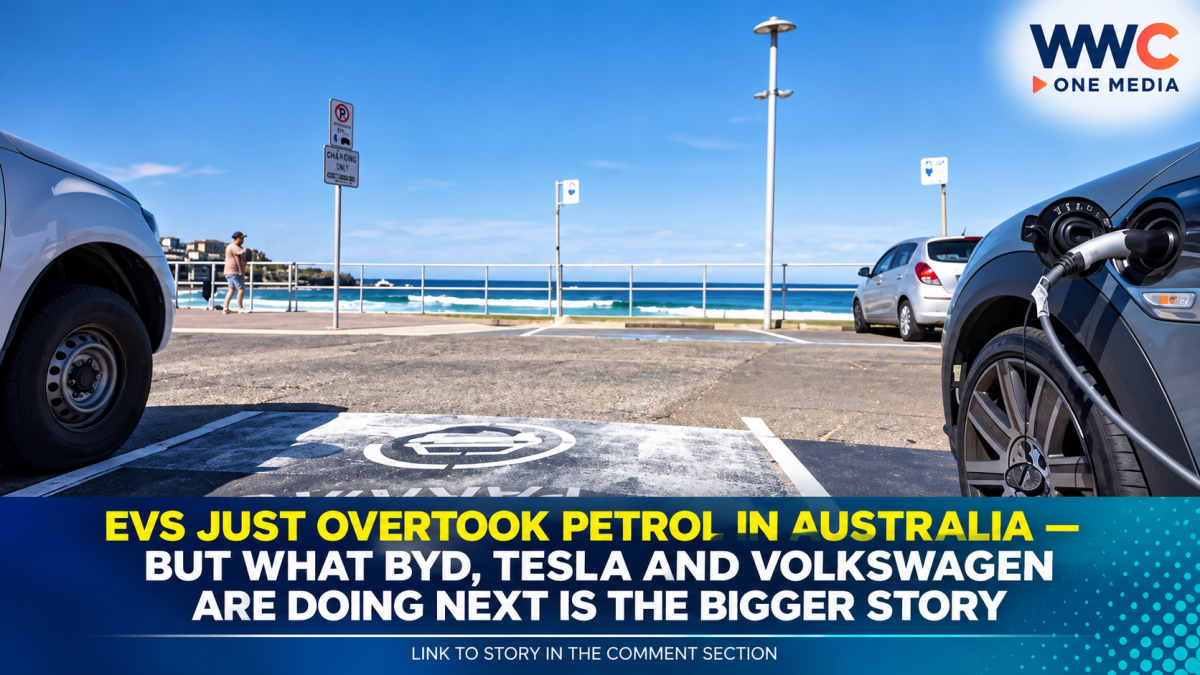
August 2026 marked a first for Australia: battery-electric vehicles became the country’s biggest individual powertrain category for new-car sales.
About 27,078 battery EVs were delivered, representing 24.9 per cent of the market, ahead of petrol at 23.7 per cent and diesel at 21.7 per cent. When battery EVs, plug-in hybrids and conventional hybrids are combined, electrified vehicles accounted for more than half of new vehicles delivered during the month.
The numbers are striking because Australia has historically lagged several European and Asian markets in EV adoption.
The best-selling vehicle of the month was not a petrol ute or Japanese SUV either.
It was the Tesla Model Y, with 6,414 deliveries, ahead of the Toyota RAV4 and Toyota HiLux. Chinese-made vehicles also occupied a growing share of Australia’s bestseller rankings.
That does not mean petrol cars are suddenly disappearing from Australian roads. One record month is not the same as permanent market dominance.
But it does show how rapidly consumer preferences can change once EV prices fall, model choice expands and fuel costs become more painful.
The Chinese competition is becoming impossible to ignore
The more worrying development for traditional manufacturers may be who is supplying that demand.
Chinese automakers are expanding overseas at extraordinary speed.
China exported 894,000 passenger vehicles in August, up 77.5 per cent from a year earlier, while exports of electric and plug-in hybrid vehicles surged 154.7 per cent, according to China Passenger Car Association figures cited by Reuters.
BYD is at the centre of that expansion.
The company sold 440,293 vehicles globally in August, while overseas shipments jumped 134.5 per cent to 189,466 units.
Its international business has become so important that BYD generated more revenue outside China than inside China during the first half of 2026, according to Reuters.
That is a remarkable reversal for a company that only a few years ago depended overwhelmingly on its home market.
BYD Chairman Wang Chuanfu has gone even further, saying the company aims to become the world’s biggest automaker within five years.
BYD sold about 4.6 million vehicles in 2025. Toyota, by comparison, sold around 11.3 million.
Closing that gap would require enormous growth — but BYD’s rise from roughly 400,000 annual sales in 2020 explains why established carmakers are taking the ambition seriously.
BYD is now challenging Japan on its home turf
One of the clearest signs of that confidence is happening in Japan.
BYD has launched the Racco, an electric kei car specifically developed to compete in Japan’s enormously important mini-car segment.
The Racco starts at about 1.95 million yen before tax, offers up to 320km of claimed range and includes sliding rear doors — a feature particularly popular among Japanese kei-car buyers.
BYD wants to secure 10,000 Racco orders by the end of 2026.
That number alone will not overturn Japan’s car industry.
BYD had sold only a little more than 7,400 passenger vehicles in Japan since entering the market in 2023, according to Reuters.
But the symbolic importance is much larger.
Japan created the kei-car category. Domestic manufacturers such as Honda, Suzuki, Daihatsu, Mitsubishi and Nissan have spent decades refining vehicles specifically for it.
A Chinese manufacturer designing a dedicated EV to attack that market is therefore much more than another foreign-model launch.
It is a test of whether Chinese automakers can compete with Japanese brands inside one of their strongest home-market niches.
Volkswagen’s crisis shows how painful the transition can become
Europe provides the other side of the story.
Volkswagen is undertaking the most significant restructuring in its 89-year history as it confronts high costs, excess capacity, tariffs and intensifying competition from Chinese manufacturers.
Its supervisory board has approved plans involving another 50,000 potential job reductions globally, on top of roughly 50,000 cuts already under way, according to Reuters.
Four German factories — Emden, Zwickau, Neckarsulm and Hanover — are facing uncertain futures as production models are phased out or shifted over the coming years. Volkswagen is examining alternative uses for those plants rather than having definitively announced that all four will close.
That distinction matters.
The situation is severe, but saying Volkswagen has already decided to close four factories and eliminate 100,000 jobs would overstate what has actually been confirmed.
The turmoil nevertheless demonstrates the scale of the industrial problem confronting old-line manufacturers.
Electric vehicles generally require different supply chains and fewer mechanical components than combustion-engine vehicles, while carmakers must simultaneously invest billions in batteries, software and autonomous-driving systems.
Companies therefore face the expensive task of funding tomorrow’s technology while maintaining factories and workforces built around yesterday’s vehicles.
Yet Volkswagen is hardly finished
There is another reason not to declare traditional manufacturers dead too quickly.
Volkswagen itself overtook Tesla to become Europe’s biggest seller of battery-electric cars in 2025.
Its European BEV sales rose 56 per cent to 274,278 vehicles, while Tesla registrations fell 27 per cent to 236,357, according to JATO Dynamics data reported by Reuters.
That makes the industry transformation more complicated than a simple “China and Tesla win, old carmakers lose” narrative.
Legacy manufacturers still possess enormous advantages: factories, dealer networks, brand recognition, engineering expertise and millions of existing customers.
The question is whether those advantages can compensate for higher costs and slower decision-making.
Tesla is trying to change something even bigger than the engine
While BYD is challenging traditional companies on manufacturing scale and price, Tesla is attacking the very concept of the privately driven automobile.
Its new Cybercab is a purpose-built two-seat robotaxi with no steering wheel, accelerator pedal or brake pedal.
Tesla began offering limited Cybercab rides in Austin, Texas, in early September. Reuters reported that around 45 Cybercabs were registered in Texas at launch, making the rollout real but still small relative to conventional taxi or ride-hailing fleets.
Tesla says the vehicle is designed for full autonomy and uses its camera-based autonomous-driving system rather than depending on a human driver.
That matters because if robotaxis eventually become inexpensive and reliable enough, the competitive question changes.
It is no longer:
Which car should I buy?
It becomes:
Do I need to buy a car at all?
For manufacturers whose economics depend on selling tens of millions of privately owned vehicles every year, that is potentially a much bigger disruption than replacing engines with batteries.
There is one big catch: regulators are not convinced yet
Tesla’s vision is far from guaranteed.
The US National Highway Traffic Safety Administration opened an investigation on September 4 into Tesla’s self-certification of the Cybercab.
The regulator is examining how a vehicle without conventional controls complies with federal motor-vehicle safety standards originally written around cars driven by humans.
So while the Cybercab has entered commercial deployment, describing fully autonomous robotaxis as an inevitable replacement for private cars would go far beyond the evidence.
Tesla still has to prove its technology can operate safely, reliably and economically at huge scale.
Amazon-owned Zoox is also competing in this field and in July became the first company to receive a US federal exemption allowing paid robotaxi rides in purpose-built vehicles without conventional human controls.
The autonomous-vehicle race therefore remains very much open.
Even the health argument around combustion engines is becoming stronger
The shift away from traditional engines is not being driven only by technology and economics.
A major study published in The Lancet Public Health in August examined thousands of children in London and Luton over five years.
Researchers found improvements in children’s lung growth associated with reductions in traffic-related air pollution following the introduction of London’s Ultra Low Emission Zone. The study included 3,414 children aged six to nine at enrollment.
That adds another layer to the debate confronting governments.
The policy question is no longer simply whether EVs reduce carbon emissions.
It increasingly includes public health, energy security, industrial jobs, trade policy and national competitiveness.
The world’s car industry could be heading toward a brutal shakeout
None of this proves that Volkswagen, Toyota, Ford, General Motors or other long-established automakers are about to disappear.
In fact, several legacy manufacturers are successfully selling EVs, hybrids or both.
But evidence of industrial stress is piling up.
Honda is pursuing more than $9 billion in cost reductions through 2030 as Chinese manufacturers take market share in Southeast Asia, Latin America and Europe. Reuters reported that the Japanese manufacturer expects EV-related losses eventually to exceed $12 billion.
Volkswagen is preparing tens of billions of euros for restructuring.
Chinese manufacturers are exporting vehicles at record levels.
BYD is entering markets once considered extraordinarily difficult for foreign automakers.
And Tesla is now attempting to sell transportation as a service using cars designed without drivers.
These are not isolated developments.
They are different pieces of the same industrial upheaval.
The real battle may no longer be BYD versus Tesla
Much of the EV story has been framed as a contest between China’s BYD and Elon Musk’s Tesla.
That rivalry matters.
BYD has already overtaken Tesla in global battery-EV sales, while Tesla continues to wield enormous influence in charging infrastructure, software and autonomy.
But the bigger contest may be between two different versions of the automobile industry.
On one side is the 20th-century model: enormous factories, combustion engines, huge supplier networks, dealerships and privately owned cars.
On the other is an emerging model built around batteries, software, Chinese-scale manufacturing and — potentially — autonomous fleets.
Australia’s record EV month is one sign of that transition.
BYD’s tiny Racco entering Japan is another.
Volkswagen’s restructuring is another.
And Tesla’s strange-looking two-seat Cybercab with no steering wheel may be the most radical sign of all.
The question is no longer whether the car industry is changing.
It is whether some of the companies that dominated the last century can change quickly enough to dominate the next one.




Leave a Reply