
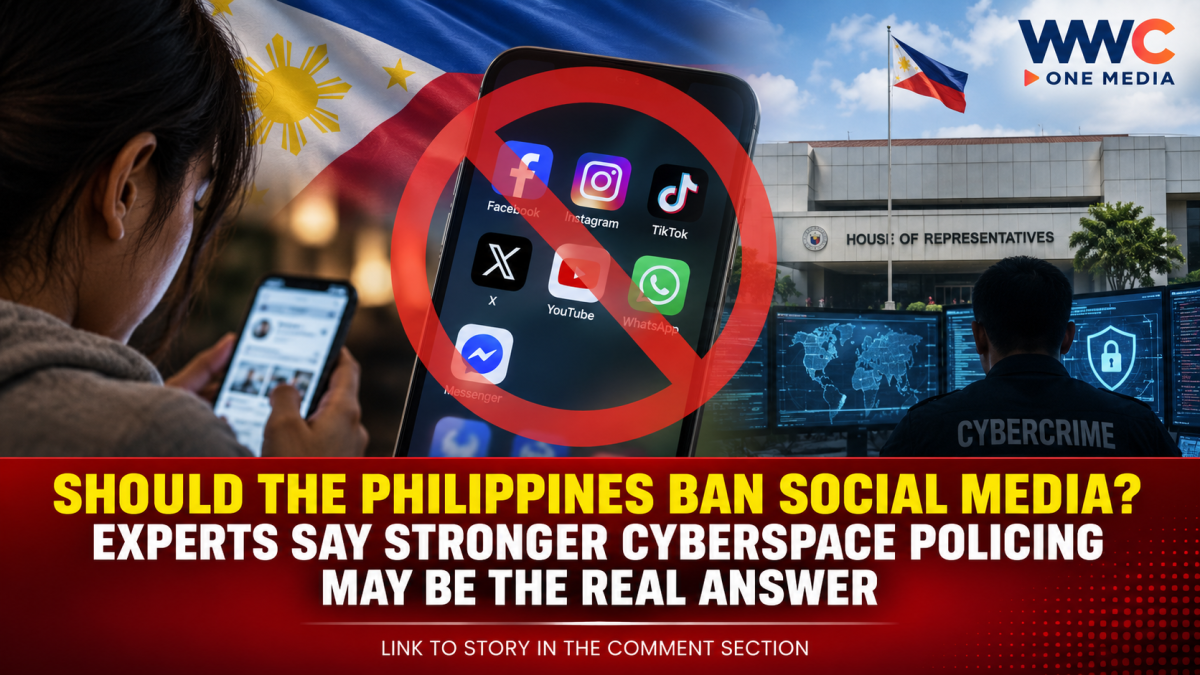
MANILA, Philippines — As calls grow louder for tougher action against harmful social media content, cybercrime and online violence, a key argument is emerging: instead of simply banning social media platforms, the Philippines may need stronger and more effective policing of cyberspace.
The debate has gained urgency following recent concerns over crimes and harmful activities involving young people online. According to a report by The Manila Times, experts emphasized the importance of effective cyberspace policing in preventing cybercrime among the youth, warning that blanket social media bans may not address the deeper problems driving online harm.
The issue comes as Philippine lawmakers, cybersecurity authorities and the Palace continue to examine how far the government should go in regulating major digital platforms.
The Real Problem May Go Beyond Social Media
The growing debate raises a difficult question: Would banning Facebook or other social media platforms actually stop cybercrime?
Critics of blanket bans argue that harmful behavior can simply migrate to other apps, websites, gaming platforms or encrypted messaging services. This means that removing access to one major platform may not automatically eliminate cyberbullying, online grooming, fraud, disinformation or other forms of cybercrime.
Instead, the focus is increasingly shifting toward stronger enforcement, better digital investigations, improved monitoring of criminal activity and greater accountability for technology companies.
In the Philippines, the Cybercrime Investigation and Coordinating Center has already been studying stronger systems for online safety. The agency recently said it would examine privacy safeguards for proposed online age-verification systems covering social media and gaming platforms. A technical working group involving stakeholders, including Meta and Roblox, is also expected to examine stricter measures against online child grooming, fraud and anonymous malicious activities.
The challenge, however, is finding a balance between identifying harmful users and protecting the privacy and rights of legitimate internet users.
Palace Has Not Ruled Out Stronger Restrictions
The national debate intensified in August when Malacañang said it was open to considering broader restrictions on digital platforms found to be contributing to harmful content or risks to the public.
However, the Palace also stressed the need to carefully study the consequences and accountability of social media companies before taking drastic action, including possible platform restrictions.
This means a total social media ban is not necessarily the government’s immediate position. But officials are clearly under pressure to find stronger ways to respond to online threats.
The question now facing policymakers is whether the Philippines should target the platforms themselves — or focus more heavily on the criminals, networks and harmful activities operating through them.
Congress Is Considering Tougher Rules for Minors
Several proposals are already moving through the House of Representatives to regulate how children and minors access social media.
Lawmakers have filed multiple bills proposing different approaches, including minimum age requirements, age verification, parental consent, privacy-preserving age assurance and stronger obligations for social media companies. Some measures would restrict access for younger users, while others focus on safety-by-design requirements rather than outright bans.
One major proposal, House Bill 9965 or the proposed Children’s Social Media Safety Act, seeks to establish comprehensive child online safety standards.
According to the House of Representatives, the proposal could impose penalties of up to P50 million on social media platforms that fail to comply with mandatory child safety requirements, including age verification, parental controls and protections against harmful content. In cases involving repeated and serious violations, platforms could also face temporary access restrictions or possible prohibition from operating in the Philippines, subject to due process.
The proposals show that Congress is not looking at just one solution.
Instead, lawmakers are weighing several models — from age restrictions and parental controls to direct platform accountability and stronger regulatory enforcement.
Children Are Becoming the Center of the Online Safety Debate
The protection of minors has become one of the strongest arguments for tighter regulation.
The Department of Labor and Employment recently expanded protections for children appearing in monetized digital content, including vlogs, livestreams, podcasts and online endorsements.
Under Labor Advisory No. 12, Series of 2026, the government requires safeguards for children below 15 who participate in monetized online content, with officials emphasizing the need to prevent exploitation and protect their education, health and welfare.
This reflects a broader shift in government policy.
The debate is no longer limited to how much time children spend online. It now includes questions about online exploitation, grooming, harmful content, data privacy, digital addiction, anonymous criminal activity and the responsibility of companies that operate major online platforms.
Other Countries Are Also Moving Against Online Harm
The Philippines is not alone in reconsidering how social media should be regulated.
Australia recently proposed new rules that would give users greater control over social media algorithms while requiring platforms to take stronger steps in addressing online harm. The reforms are designed to increase platform accountability and give users more choices over what appears in their feeds.
In Ireland, regulators recently opened an investigation into X over concerns involving children’s access to harmful material and the effectiveness of parental controls and age assurance.
The developments show that governments around the world are increasingly moving beyond a simple choice between “ban social media” and “do nothing.”
Instead, policymakers are experimenting with age assurance, algorithm transparency, content moderation, parental controls, platform accountability and stronger law enforcement.
Why Stronger Cyberspace Policing Matters
For advocates of stronger cyberspace policing, the main argument is straightforward: technology platforms can be regulated, but criminal behavior must also be actively investigated and stopped.
Effective cyberspace policing could involve:
- Faster investigation of cybercrime and online threats;
- Stronger coordination among law enforcement and cybersecurity agencies;
- Improved reporting and response systems for victims;
- Better detection of online grooming, fraud and exploitation;
- Greater accountability for platforms that fail to address serious threats;
- Privacy-conscious age verification and child protection systems; and
- Digital literacy programs for children, parents and educators.
The challenge will be ensuring that stronger enforcement does not become excessive surveillance or unnecessarily restrict legitimate online expression.
That is why privacy protections and due process are becoming central issues in the discussion.
The Bigger Question for the Philippines
The social media debate is now reaching a critical point.
Filipinos rely heavily on digital platforms for communication, education, business, entertainment and access to information. A blanket ban could therefore have major consequences for millions of ordinary users.
But the risks are also becoming harder to ignore.
Cybercrime, online fraud, child exploitation, harmful content and other digital threats are putting increasing pressure on the government to act.
The emerging argument is that the Philippines may not need to choose between protecting the public and preserving access to the internet.
The stronger solution could be a combination of effective cyberspace policing, tougher enforcement against criminals, clear rules for technology companies, stronger protection for children and safeguards for privacy and legitimate online activity.
The real battle, therefore, may not be over whether social media should disappear.
It may be over whether the Philippines can finally build a system strong enough to police the dangers of cyberspace without taking away the digital spaces millions of Filipinos depend on every day.



Leave a Reply