
The devastating MV June Aster ferry fire off Coron, Palawan, has entered an even more painful phase as authorities work to identify dozens of victims recovered from the charred vessel, while families continue waiting for answers about loved ones who remain unaccounted for.
The Philippine Coast Guard (PCG) said the death toll had climbed to 76 after 41 additional human remains were recovered, on top of the 35 fatalities previously confirmed. Forty-three people survived, while 13 remain unaccounted for, although authorities warned that the figures could still change as recovery and identification operations continue.
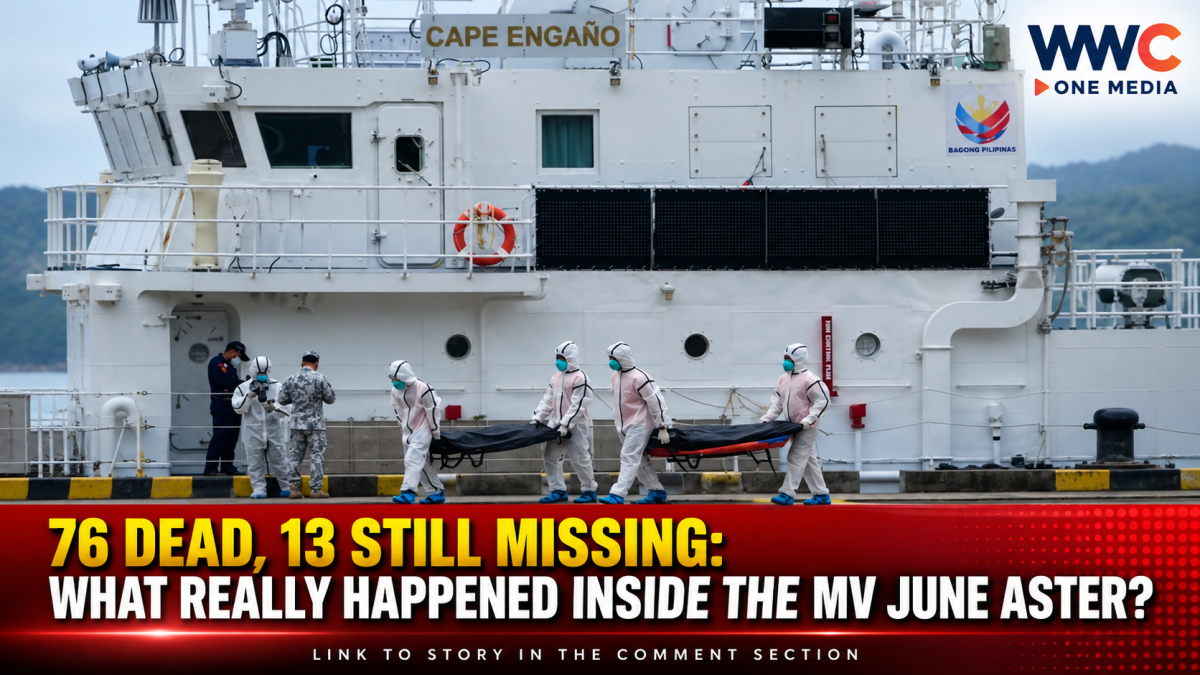
The identification process began after the first batch of remains was brought ashore in Coron. Temporary facilities were established at the Port of Borac, where forensic personnel began examining the bodies and working to establish their identities.
Reuters reported that relatives gathered near the port as responders in protective suits carried black body bags into the temporary forensic area. For families still waiting for word, the recovery operation has become an agonizing search for certainty.
The fire spread within seconds
The MV June Aster was traveling from Manila to Coron when the disaster struck on the evening of Sept. 9.
Survivors reportedly heard a loud explosion, believed to have originated near the cargo area, before smoke and flames rapidly spread through the vessel. Strong winds were also reported to have contributed to the rapid spread of the blaze. The exact cause of the fire, however, has not yet been established.
The vessel was carrying 132 people who actually boarded, based on the latest accounting. The original manifest listed 134 people, but authorities subsequently determined that two listed passengers had not boarded the ferry.
That distinction is important because earlier reports had listed significantly higher numbers of missing people. As authorities reconciled the manifest with survivors and passengers who never boarded, the missing figure was revised.
Heat and smoke delayed recovery
The scale of the tragedy became clearer only after rescuers were finally able to gain access to the badly damaged vessel.
For hours, thick smoke, extreme heat and the risk posed by the damaged ship prevented rescuers from safely entering some areas. When authorities were eventually able to inspect the vessel, remains were found in the economy accommodation area, according to the Coast Guard.
The recovery operation has since expanded as teams search the vessel for additional victims and evidence that could help investigators determine exactly how the fire began and why it spread so quickly.
Families face another agonizing wait
For families, the recovery of bodies has brought both devastating grief and the possibility of finally knowing what happened to missing relatives.
Reuters reported that relatives were waiting near the temporary forensic facilities as remains were transported from the vessel. Some had traveled to Palawan specifically to search for missing family members and to await official confirmation.
The identification process is particularly difficult because of the condition of the remains. Authorities are relying on forensic procedures and, where necessary, identification through personal belongings and other evidence.
Officials have stressed that the current numbers remain subject to change as recovery and identification operations continue.
Captain remains missing as investigation widens
Another major question has emerged alongside the victim-identification effort: Where is the MV June Aster’s captain?
GMA News reported on Sept. 13 that the captain remains unaccounted for, although the Coast Guard said it received initial information that he may have gone with surviving crew members to a barangay evacuation area after the incident. Authorities are trying to locate him and obtain his statement.
The Maritime Industry Authority is also looking for the captain as part of its investigation. Depending on the findings, authorities said administrative liability could arise if maritime safety regulations were violated.
The Coast Guard has also said that the vessel had passed previous safety and emergency-readiness inspections. Investigators will therefore have to determine whether the tragedy resulted from an unforeseen failure, an operational problem, inadequate emergency procedures, or other circumstances.
Shipping company faces scrutiny
The operator, Atienza Interisland Ferries Inc., has said it is cooperating with authorities and has pledged transportation and burial assistance for victims.
But the Coast Guard has acknowledged that the company or its personnel could potentially face liability depending on what the investigation establishes regarding actions taken before, during and after the fire.
Authorities have not yet assigned blame, and the cause of the fire remains under investigation.
A tragedy that echoes the Philippines’ long maritime-safety history
The MV June Aster disaster has once again drawn attention to the Philippines’ long-running maritime safety concerns.
The country depends heavily on ferries and other vessels to connect its thousands of islands. Recent maritime disasters—including the sinking of the M/V Trisha Kerstin 3 earlier this year and the 2023 Lady Mary Joy 3 ferry fire—have renewed questions about vessel safety, emergency preparedness and enforcement.
The MV June Aster investigation is now likely to focus not only on what caused the blaze, but also on how quickly it spread, how passengers were alerted, how evacuation procedures were carried out and whether all required safety measures were followed.
For now, however, authorities remain focused on the most immediate task: recovering the missing, identifying the dead and returning victims to their families.
And as investigators piece together what happened aboard the doomed ferry, one question remains at the center of the tragedy:
How did a routine voyage from Manila to Coron turn into one of the Philippines’ deadliest ferry disasters in years?




Leave a Reply