
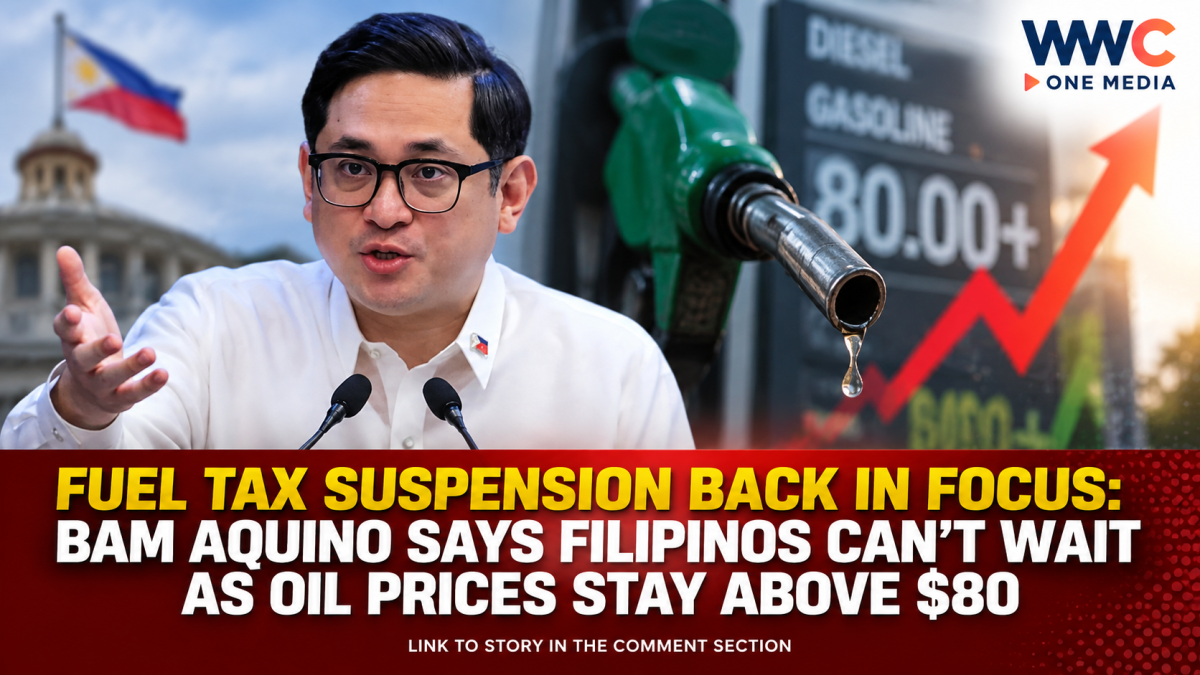
MANILA, Philippines — Sen. Bam Aquino has renewed his call for the government to suspend excise taxes on petroleum products, arguing that Filipinos need immediate relief as global oil prices remain elevated and the threat of another surge in transportation and commodity costs continues to loom.
Aquino’s renewed appeal came as Dubai crude oil prices stayed above the $80-per-barrel threshold for more than a month, a key benchmark under Philippine law that can allow the government to temporarily suspend or reduce fuel excise taxes.
The senator’s call adds fresh pressure on the government to use powers now available under Republic Act No. 12316, which authorizes the President, upon the recommendation of the Development Budget Coordination Committee and in coordination with the Department of Energy, to suspend or reduce excise taxes when the required oil-price conditions are met.
The $80 Question: Is Fuel Tax Relief Finally Coming?
Under RA 12316, the President may suspend or reduce excise taxes on petroleum products when the average Dubai crude oil price, based on the Mean of Platts Singapore, reaches or exceeds $80 per barrel for one month immediately before a suspension order is issued. The relief can be applied to specific fuel products and may take the form of either a full suspension or partial reduction.
Just days before Aquino renewed his appeal, the Department of Finance said it was awaiting certification from the Department of Energy on whether the crude-price threshold had been breached, after which it could propose the suspension of excise taxes on LPG and kerosene.
That means the debate is no longer simply about whether fuel taxes should be suspended — but whether the government will expand or accelerate relief as high oil prices continue to affect ordinary consumers.
Aquino Pushes for Broader Relief
Aquino has long opposed higher fuel excise taxes, arguing that they ultimately contribute to rising prices because fuel costs affect almost every part of the economy — from public transportation and food deliveries to farming, manufacturing and consumer goods.
His latest appeal comes amid continuing concerns that sustained global oil prices could trigger another round of increases in fuel, transport and basic commodity costs.
The Philippines remains highly dependent on imported petroleum products, making domestic fuel prices vulnerable to international supply disruptions and geopolitical tensions.
Government Has Already Used Emergency Powers
The government has already demonstrated that the fuel-tax suspension mechanism can be activated.
In April 2026, President Ferdinand Marcos Jr. issued Executive Order No. 114, temporarily suspending excise taxes on specific petroleum products after the Department of Energy certified that the average Dubai crude oil price had reached $93.71 per barrel over the preceding 30 days.
However, the order specifically covered:
- LPG, except when used for certain industrial purposes or as motive power
- Kerosene, except when used as aviation fuel
The suspension was initially set for three months and subject to monthly government review.
This has now raised a bigger question: Should fuel tax relief be expanded to cover more petroleum products that directly affect motorists, public transportation and the wider economy?
What the Law Allows — and What It Doesn’t Automatically Do
The law does not automatically eliminate fuel excise taxes the moment crude prices cross $80 per barrel.
Instead, several steps are involved:
- The oil-price threshold must be met.
- The Department of Energy must provide the necessary certification.
- The Development Budget Coordination Committee must make a recommendation.
- The President may then authorize a suspension or reduction.
Any suspension or reduction can last for up to three months at a time, with the aggregate period limited under the law. Fuel taxes automatically revert once the legal conditions for the relief no longer apply.
Why Fuel Taxes Matter to Every Filipino
A reduction in fuel taxes could provide immediate relief at the pump, but its wider impact could be even more significant.
Higher fuel costs can increase expenses for:
- Public utility vehicles and commuters
- Delivery riders and logistics companies
- Farmers and fishermen
- Food producers and retailers
- Small businesses
- Manufacturers
- Households using LPG and petroleum-based products
For Aquino and other advocates of tax relief, suspending or reducing excise taxes could help prevent global oil-price shocks from being fully passed on to Filipino consumers.
But the government also faces a difficult balancing act.
Fuel excise taxes generate substantial public revenue, meaning any broad suspension could affect government collections and spending. Previous administrations have faced the same dilemma: provide immediate consumer relief or preserve revenues needed for public programs and infrastructure.
Global Oil Crisis Adds Pressure
The Philippines is not alone in looking for ways to shield consumers from volatile energy prices.
Brazil, for example, recently introduced additional diesel subsidies and tax cuts on certain fuels as global oil prices surged amid geopolitical tensions. The measures highlight how governments around the world are being forced to weigh fiscal costs against the immediate economic burden on consumers.
For the Philippines, the challenge is especially sensitive because higher fuel prices can quickly feed into inflation.
Even a relatively short period of expensive oil can affect transport fares, food prices and household expenses — putting additional pressure on families already struggling with the rising cost of living.
The Bigger Question: Will Relief Reach Motorists Next?
Aquino’s renewed call places the spotlight back on the government’s next move.
With the legal framework already in place, previous emergency tax suspensions already implemented, and oil prices once again remaining above the critical benchmark, pressure is growing for officials to explain whether broader relief is now possible.
The immediate issue is whether the government will limit any action to selected products such as LPG and kerosene or consider wider tax relief for other petroleum products.
For millions of Filipino motorists and commuters, the answer could determine whether the next oil-price shock becomes another painful increase at the pump — or whether the government steps in before the full impact reaches consumers.
As global oil prices remain volatile, Aquino’s message is clear: Filipinos need relief now. But the biggest question remains — will the government suspend more fuel taxes before another wave of price increases hits?


Leave a Reply