
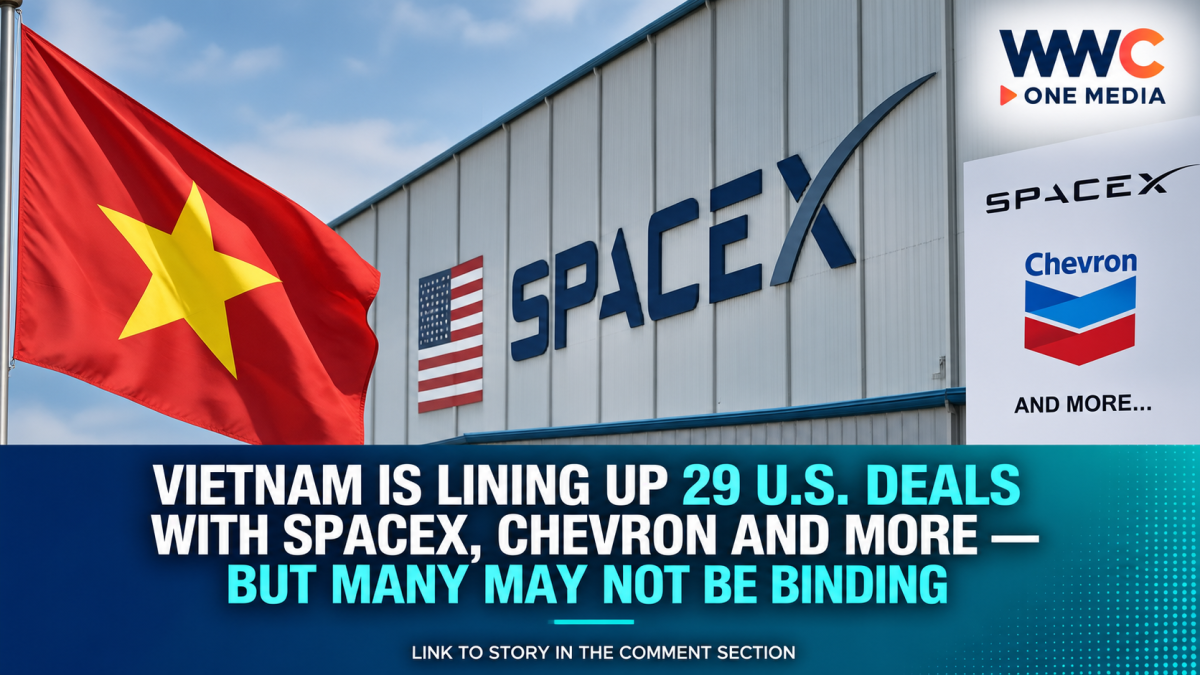
HANOI — Vietnam is preparing a major commercial push in New York that could bring together some of America’s biggest names in oil, technology, aviation and finance — from SpaceX and Chevron to ExxonMobil, Qualcomm, Meta, Visa, Mastercard and Citibank.
An internal planning document reviewed by Reuters lists 29 agreements that could be announced on September 23 at a business conference expected to be attended by Vietnamese leader To Lam, who is traveling to New York around the United Nations General Assembly.
The proposed agreements span industries that are critical to Vietnam’s next stage of growth: energy, aircraft, satellite connectivity, semiconductors, telecommunications, payments and banking.
Among the most eye-catching plans: Vietjet could put SpaceX’s Starlink internet service on 120 aircraft and lease as many as 22 additional planes, while Petrovietnam is expected to unveil agreements involving U.S. energy giants Chevron and Murphy Oil. ExxonMobil, meanwhile, is listed for a proposed accord with Vietnamese refinery operator Binh Son Refining and Petrochemical.
But there is a crucial qualification.
Reuters reported that many of the agreements are expected to be non-binding, and the provisional list could still change. The documents do not provide the financial value or detailed terms of most of the proposed deals.
That means Vietnam’s New York showcase could produce a long list of corporate announcements without immediately producing an equally large wave of finalized investment.
And behind the business deals sits an even bigger issue: Vietnam and the United States are still negotiating their broader trade relationship as Hanoi tries to reduce the threat of additional American tariffs.
29 Agreements Could Be Announced in One Day
According to the internal planning note seen by Reuters, the agreements could be unveiled during a September 23 business conference in New York.
To Lam, who is both General Secretary of the Communist Party of Vietnam and President of Vietnam, is expected to be in the United States for the UN General Assembly before traveling to Canada for a state visit. Vietnam had not yet formally published his full U.S. itinerary when Reuters reported the plans.
Officials told Reuters that Lam is expected to address the UN General Assembly on September 22 and meet representatives of several U.S. corporations.
Whether he will also meet U.S. President Donald Trump remains uncertain. A White House official told Reuters that Trump’s schedule had not yet been confirmed.
That uncertainty matters because the commercial announcements and the trade negotiations are running in parallel.
The corporate deals can demonstrate that Vietnamese companies are willing to buy American goods and services.
But they do not themselves settle the wider tariff dispute.
Vietjet Could Put Starlink on 120 Aircraft
The aviation component may produce some of the most immediately recognizable announcements.
A separate Vietjet document reviewed by Reuters says Vietnam’s largest private airline expects to sign a contract with SpaceX to provide Starlink satellite internet aboard 120 Vietjet aircraft.
If finalized and implemented, the arrangement would potentially give passengers satellite-based in-flight connectivity across a substantial part of Vietjet’s rapidly expanding fleet.
The airline is simultaneously preparing another fleet expansion.
Reuters reported that Vietjet could announce plans to lease as many as 22 aircraft from four leasing companies:
17 Boeing 737 aircraft and five Airbus A321neo jets.
Vietjet is already operating an extensive domestic and international network. Its own August schedule showed more than 4,400 flights planned between August 26 and September 5 alone during Vietnam’s National Day travel period.
The airline also plans memoranda of understanding with U.S. companies involved in aircraft-engine maintenance, according to the documents reviewed by Reuters.
Again, those MOUs should not be confused with completed procurement contracts.
Chevron and Murphy Oil Are Expected to Deal With Petrovietnam
Energy is another major piece of the New York package.
Reuters says Chevron and Murphy Oil are expected to announce agreements with state-owned Petrovietnam, Vietnam’s national energy group.
Those relationships are not starting from scratch.
Murphy Oil already has active exploration and development interests in Vietnam. Petrovietnam-linked reporting said in June that the two sides were working toward first oil from the Lac Da Vang field, with offshore infrastructure and commissioning work progressing through 2026.
Vietnamese Industry and Trade officials had also met Murphy Oil CEO Eric Hambly in June and encouraged the U.S. company to expand investment in the country’s petroleum sector.
Chevron, meanwhile, recently met Petrovietnam executives at the APPEC 2026 energy conference in Singapore as Vietnam looked to broaden relationships with international crude suppliers and energy companies.
Chevron Already Signed One Oil MOU — But No Purchase Followed
This history also shows why the word “agreement” requires caution.
In February, Binh Son Refining and Petrochemical signed memoranda with Chevron and other U.S. companies covering potential purchases of American crude oil, ethanol and corn.
Reuters noted that the Chevron arrangement was non-binding and that no subsequent crude purchase had been announced by the time of this week’s New York report.
That provides an important lesson for interpreting the coming announcements.
An MOU can establish intentions, frameworks or areas for future cooperation.
It does not necessarily mean money has changed hands, an order has been placed or a project is guaranteed to proceed.
ExxonMobil Could Sign With Vietnam’s No. 2 Refinery
The provisional list also includes ExxonMobil.
Reuters says the U.S. energy giant is expected to unveil an agreement with Binh Son Refining and Petrochemical, the operator of the Dung Quat refinery and Vietnam’s second-largest refinery business.
ExxonMobil already has a much larger strategic history in Vietnam through its involvement in the country’s offshore gas sector.
Reuters noted that the company operates Vietnam’s largest gas field, although development remains stalled.
For Hanoi, strengthening relationships with additional U.S. energy suppliers also fits a broader attempt to diversify fuel sources at a time when international energy markets have become unusually volatile.
Only days before the planned U.S. trip, Vietnam signed a separate framework deal with Russia’s Zarubezhneft to explore the creation of a strategic oil reserve. That agreement did not disclose its size, timetable or financial terms.
The sequence underlines Vietnam’s longstanding approach of maintaining economic relationships with multiple major powers rather than relying exclusively on one partner.
Qualcomm and VNPT Are Also on the List
Technology could be almost as important as energy.
The internal document reviewed by Reuters includes a planned agreement between Qualcomm and Vietnam Posts and Telecommunications Group, or VNPT.
Details were not disclosed.
Qualcomm already participates in Vietnam’s expansion of 5G telecommunications infrastructure, making the potential VNPT agreement part of an existing technology relationship rather than an entirely new entry into the market.
Vietnam has been trying to move beyond its role as a major electronics assembly base and develop more domestic capabilities in semiconductors, artificial intelligence, digital infrastructure and higher-value technology production.
That makes U.S. semiconductor and telecom companies particularly significant partners.
Meta Could Sign an Agreement With Vietnam’s Culture Ministry
Another entry on the provisional list pairs Meta with Vietnam’s Ministry of Culture.
Reuters said the nature of that agreement was not specified in the planning document.
That lack of detail is important because Meta’s relationship with Vietnam extends well beyond straightforward technology investment.
Facebook is the country’s dominant social-media platform, according to Reuters, meaning any government-company agreement involving Meta could potentially touch on areas ranging from digital development and online commerce to content and communications.
Without the text of the proposed agreement, however, its purpose should not be assumed.
Visa, Mastercard and Citi Are Part of the Financial Push
The September 23 list also contains proposed deals involving Visa, Mastercard and Citibank, paired with Vietnamese financial and hospitality partners.
The documents cited by Reuters did not identify the full commercial terms.
Their inclusion nevertheless illustrates how broad Vietnam wants the New York event to be.
This is not simply an aircraft-order event or an energy conference.
The expected announcements stretch from oil fields and refineries to aircraft Wi-Fi, chips, telecommunications networks, credit cards and banking.
That breadth appears designed to present the U.S.-Vietnam commercial relationship as much larger than the trade dispute currently dominating negotiations.
Why Vietnam Wants Big U.S. Commercial Deals Now
The timing is not accidental.
Vietnam depends heavily on exports and has become one of the most important manufacturing bases serving American consumers.
According to the U.S. Trade Representative, total U.S.-Vietnam goods and services trade reached about $215.4 billion in 2025.
U.S. goods imports from Vietnam totaled $193.9 billion, while American goods exports to Vietnam were just $15.6 billion.
That left the United States with a $178.3-billion goods trade deficit with Vietnam in 2025.
That imbalance has made Vietnam particularly exposed to Washington’s increasingly aggressive tariff policy.
Vietnamese purchases from American companies — aircraft, crude oil, technology or other goods — can therefore carry diplomatic as well as commercial significance.
They provide evidence that the bilateral relationship is not simply a one-way flow of Vietnamese exports into the U.S. market.
The Trade Deal Is Still Unfinished
Washington and Hanoi announced a broad framework for a reciprocal trade agreement in October 2025.
Under that framework, Vietnam committed to improve market access for U.S. goods and address various non-tariff barriers, while Washington said it would maintain a 20 percent reciprocal tariff on Vietnamese goods, with some products potentially qualifying for zero rates.
But the tariff environment changed dramatically afterward.
The U.S. Supreme Court struck down the Trump administration’s earlier emergency-power tariffs in February 2026, forcing Washington to rebuild parts of its tariff strategy using other legal authorities.
Vietnam and the United States consequently remain in negotiations.
In July, Washington imposed a 12.5 percent Section 301 tariff on Vietnamese goods over alleged weaknesses in enforcement against forced-labor imports, a rate higher than the 10 percent applied to several Southeast Asian competitors.
The United States is also conducting another Section 301 investigation involving alleged excess industrial capacity in 16 major trading partners, including Vietnam, which could create additional tariff risk.
Those developments help explain why the New York corporate announcements carry significance beyond individual transactions.
Transshipment Has Become Another Flashpoint
Washington has also been pressing Hanoi over illegal transshipment — the practice of routing products through another country to disguise their real origin and avoid tariffs.
U.S. officials have estimated that Washington could be losing between $19 billion and $26 billion a year in tariff revenue from goods, many originating in China, that are transshipped through third countries including Vietnam.
Vietnam’s Foreign Ministry said in August that Hanoi would continue addressing U.S. concerns constructively and through bilateral dialogue.
U.S. and Vietnamese officials have already held joint workshops aimed at combating trade fraud and illegal transshipment.
The issue is particularly sensitive because Vietnam has been one of the principal beneficiaries of companies moving or diversifying manufacturing away from China.
American policymakers want to distinguish genuine Vietnamese production from Chinese products that are merely rerouted through the country.
To Lam’s New York Stop Comes After Russia and France
The U.S. trip is also part of an unusually busy diplomatic month for To Lam.
Earlier in September, he visited Russia, where Vietnam signed multiple agreements and deepened cooperation in areas including energy and investment.
He then traveled to France, where Vietnamese and French companies and government agencies announced a series of agreements.
Among them was a memorandum for Vietnam Airlines to acquire five Airbus A350-900 aircraft, with deliveries planned for 2033 and 2034. Vietravel Airlines also signed a letter of intent involving 20 Airbus A220s and 30 A321s.
The succession of visits illustrates Hanoi’s continuing effort to expand economic relationships across competing global power centers rather than align its commercial future entirely with one.
To Lam is expected to leave New York after the September 23 business conference and travel to Canada for a state visit.
The Biggest Number May Not Be the Most Important One
Twenty-nine agreements sounds like an enormous commercial package.
But the number alone can be misleading.
Some could become binding contracts.
Others may remain memoranda of understanding.
Some may lead to billions of dollars in future purchases or investment.
Others could ultimately result in little or no commercial activity.
Reuters specifically reported that the planning document may change and does not disclose the contents of most proposed agreements.
The Chevron-Binh Son example demonstrates why that distinction matters: an MOU can be signed without subsequently producing an announced purchase.
So September 23 will provide an impressive scoreboard of U.S.-Vietnam corporate relationships.
The more meaningful scoreboard will come later:
How many planes are actually leased?
Does Starlink ultimately go live on 120 Vietjet aircraft?
Do the energy agreements generate actual crude purchases or projects?
Does Qualcomm’s proposed VNPT cooperation translate into additional telecom investment?
And, most consequentially for Vietnam’s export economy, do the commercial deals help accompany a durable resolution of the still-unfinished U.S.-Vietnam trade negotiations?
The announcements could be numerous. The binding contracts — and the tariff outcome — will determine how much they ultimately matter.


Leave a Reply