
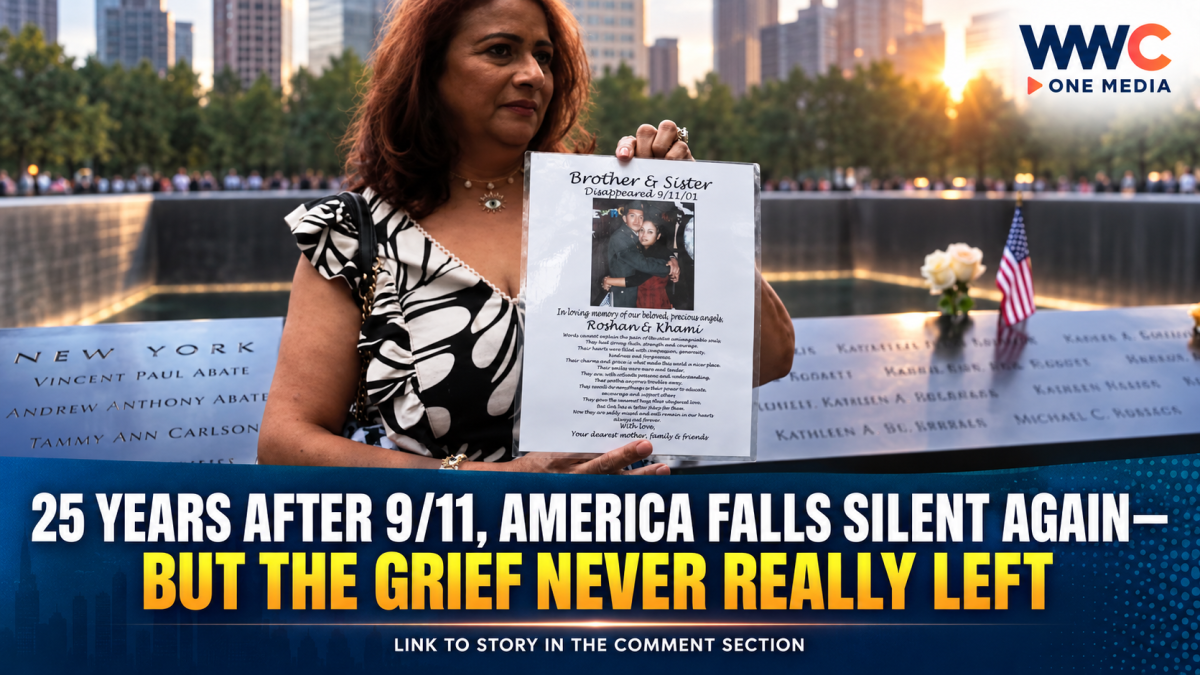
NEW YORK — Twenty-five years after the September 11 attacks changed the United States and the world forever, Americans gathered once again at Ground Zero, the Pentagon and Shanksville, Pennsylvania, to remember the nearly 3,000 people killed in one of the deadliest terrorist attacks in modern history.
But as the United States marked the quarter-century anniversary on September 11, 2026, the ceremonies carried a painful reminder: for thousands of families, first responders and survivors, the consequences of 9/11 did not end when the smoke cleared.
At the National September 11 Memorial in Lower Manhattan, relatives of victims read the names of those killed as the ceremony paused for moments of silence marking the devastating sequence of attacks that unfolded on September 11, 2001. Vice President JD Vance and four former U.S. presidents attended the Ground Zero commemoration, underscoring the continued national significance of the tragedy.
A Nation Pauses at the Places Where History Changed
The attacks began when hijacked American Airlines Flight 11 crashed into the North Tower of the World Trade Center at 8:46 a.m. Within minutes, another hijacked plane struck the South Tower.
Both towers eventually collapsed.
A third hijacked aircraft struck the Pentagon in Virginia, while United Airlines Flight 93 crashed in a field near Shanksville, Pennsylvania, after passengers fought back against the hijackers.
In all, 2,977 victims were killed in the attacks, while countless others were injured or traumatized by the events of that morning. The attacks were carried out by 19 al-Qaida hijackers and triggered consequences that would reshape global security, U.S. foreign policy and everyday life for generations.
On the 25th anniversary, ceremonies were again held at all three major attack sites — New York, the Pentagon and Shanksville — bringing together victims’ families, survivors, first responders and political leaders.
But 9/11’s Death Toll Did Not End in 2001
One of the most emotional elements of this year’s anniversary was the recognition of those who survived the attacks but later died from illnesses linked to toxic exposure.
According to Reuters, the 25th-anniversary observance included an additional moment of silence recognizing people who died from 9/11-related illnesses after exposure to toxic dust and debris.
The New York Fire Department has reported that more than 600 firefighters have died from illnesses connected to the attacks and their aftermath. Thousands of responders, recovery workers and survivors have suffered long-term health consequences.
For many families, that means the tragedy remains a continuing story rather than a closed chapter.
A Generation That Never Saw 9/11 Is Now Carrying Its Memory
Perhaps one of the most striking realities of the 25th anniversary is the passage of time itself.
Millions of Americans alive today were either too young to remember the attacks or were not yet born when the planes struck.
For younger generations, 9/11 is increasingly something learned through classrooms, documentaries, family stories and memorial sites rather than personal memory.
Yet descendants of victims are now stepping forward to preserve those stories. Some children and grandchildren of people killed in the attacks have grown up hearing about loved ones they never had the chance to meet, turning family memories into a new generation’s promise to never forget.
The Attacks That Changed the World
The impact of September 11 stretched far beyond New York, Virginia and Pennsylvania.
The attacks led to the creation of the U.S. Department of Homeland Security, dramatic changes to airport security and surveillance, and military campaigns that would define American foreign policy for decades.
The wars in Afghanistan and Iraq, the expansion of security agencies and surveillance powers, and changing attitudes toward immigration and Muslim communities all became part of the complicated legacy of the post-9/11 era.
The United States eventually killed al-Qaida leader Osama bin Laden in 2011 and withdrew its military forces from Afghanistan in 2021, but the political, social and human consequences of the post-9/11 era continue to be debated today.
From National Unity to a More Complicated Legacy
In the immediate aftermath of the attacks, Americans experienced an extraordinary wave of grief and national unity.
Twenty-five years later, however, the meaning of 9/11 is more complicated.
For families who lost loved ones, the anniversary remains intensely personal.
For firefighters and rescue workers, it is a reminder of colleagues who died on September 11 — and those who died years later from illnesses connected to the recovery effort.
For veterans, 9/11 remains closely linked to the wars that followed.
For Muslim Americans and communities affected by racial or religious profiling, the aftermath brought another kind of trauma.
And for younger Americans, it has become a defining historical event whose consequences shaped the world they were born into.
Twenty-Five Years Later, America Still Remembers
At Ground Zero, the Pentagon and Shanksville, the rituals of remembrance continued: names read aloud, bells tolling, moments of silence and families standing together.
The ceremonies may look familiar after a quarter-century, but the people gathering there continue to change.
Children have become adults. Survivors have become grandparents. First responders have continued to battle illnesses connected to their work at the attack sites.
And an entire generation has grown up in a world shaped by the consequences of a morning they never witnessed.
Twenty-five years after September 11, 2001, America is still asking many of the same questions about loss, security, war, unity and memory.
But perhaps the clearest message from the anniversary was the simplest one:
The attacks happened 25 years ago. The grief, the sacrifice and the consequences are still very much part of the present.
As Americans paused once again to remember the nearly 3,000 people killed that day — and the many others whose lives were forever changed afterward — the anniversary showed that 9/11 is no longer just a memory of one terrible morning.
It is a legacy still being written.



Leave a Reply