
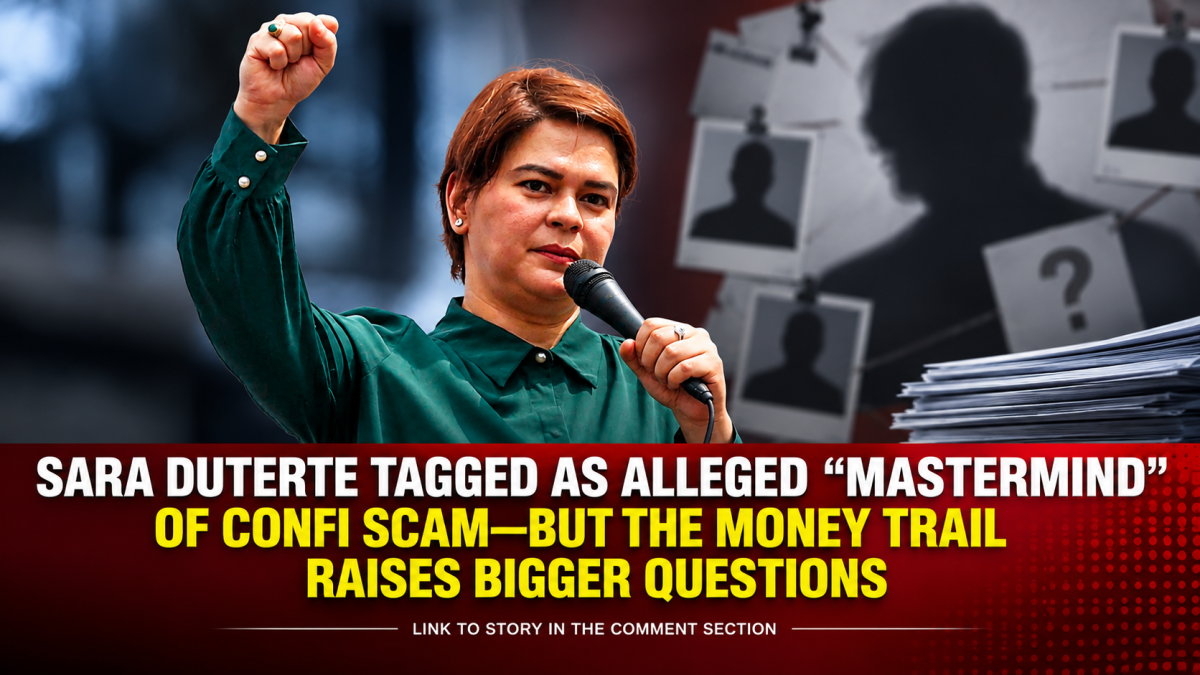
MANILA, Philippines — The House prosecution team has dramatically escalated its case against Vice President Sara Duterte, accusing her of being the alleged mastermind behind what prosecutors have branded a “confi scam” involving ₱612.5 million in confidential funds from the Office of the Vice President (OVP) and the Department of Education (DepEd).
During a presentation on September 11, prosecutors said they had traced what they described as a recurring pattern in the handling of confidential funds—from Duterte’s time as Davao City mayor to her tenure at the OVP and DepEd.
House prosecution adviser and spokesperson Robert “Ace” Barbers said the alleged pattern pointed back to Duterte.
“Different agencies, but the same modus operandi,” the prosecution argued, as it presented its theory of how the funds moved through several officials and offices. The prosecution characterized Duterte as the alleged “mastermind” of the operation.
But the accusation remains an allegation by the House prosecution. It is not a judicial finding that Duterte committed a crime or misused the funds. The Senate impeachment court will ultimately assess the evidence presented by both sides.
The ₱612.5-M confidential fund controversy
The amount at the center of Article I of Duterte’s impeachment trial consists of:
- ₱500 million in confidential funds allocated to the Office of the Vice President in 2022 and 2023; and
- ₱112.5 million in confidential funds allocated to the Department of Education in 2023, when Duterte was education secretary.
The House prosecution alleges that the funds were misused, misappropriated and irregularly liquidated.
The prosecution’s latest presentation attempted to connect the handling of those funds into what it described as a five-stage process:
Request → Cash-out → Turnover → Disbursement → Liquidation
According to the House presentation, OVP special disbursing officer Gina Acosta encashed four checks worth ₱125 million each, while former DepEd special disbursing officer Edward Fajarda encashed three checks worth ₱37.5 million each.
Prosecutors then focused on what happened after the money was withdrawn.
Acosta previously testified that she turned over the OVP cash to then-Vice Presidential Security and Protection Group commander Col. Raymund Dante Lachica, allegedly upon Duterte’s instruction. The prosecution also linked DepEd’s confidential funds handled by Fajarda to Col. Dennis Nolasco.
Why prosecutors are pointing at Duterte
The prosecution’s argument is that identifying the people who physically withdrew or handled the cash is not enough.
Barbers said the investigation should also determine who allegedly directed the entire process.
The prosecution has cited testimony from OVP Assistant Secretary and Assistant Chief of Staff Lemuel Ortonio, who previously told the impeachment court that Duterte knew about and authorized the processes involving the OVP’s confidential funds.
Ortonio testified that, based on his knowledge, Duterte was aware of the confidential activities and how they were implemented. He also said he did not undertake confidential-fund actions that Duterte did not know about or authorize.
However, an important courtroom development came when prosecutors previously used the terms “scam” and “mastermind” during questioning.
Senate impeachment court Presiding Officer Francis “Chiz” Escudero ordered those particular terms stricken from the record during the August 25 proceedings and instructed prosecutors to use more neutral language when questioning witnesses.
That distinction matters: while the House prosecution has now publicly adopted the phrase “confi scam” and called Duterte its alleged mastermind, the Senate impeachment court has not made such a finding.
The names that intensified the controversy
The prosecution’s case gained further attention after Philippine Statistics Authority findings were presented during the impeachment trial.
PSA Assistant National Statistician Marizza Grande testified that the agency examined 2,669 names appearing on OVP and DepEd confidential-fund payee lists.
Of those, 1,685 names—or about 63 percent—had no corresponding birth, marriage or death records in the PSA database. The list also included names matching deceased individuals and minors.
Philstar reported that the PSA found 37 names matching people who were already deceased and 25 names matching minors. Some of the minors were reportedly only months or about a year old when the acknowledgment receipts supposedly showed them receiving confidential funds.
SunStar likewise reported that among the 2,669 names examined, 398 were associated with DepEd and 1,287 with the OVP among those without birth, marriage or death records.
The defense, however, has challenged how the PSA findings should be interpreted. During the proceedings, Duterte’s defense acknowledged that the unusual names appearing on the acknowledgment receipts were aliases, while maintaining that the issue should be addressed at the appropriate stage of the defense presentation.
A trail that prosecutors say began in Davao
The House prosecution’s latest presentation went beyond the OVP and DepEd.
Prosecutors attempted to establish similarities between the handling of confidential funds during Duterte’s time as Davao City mayor and the subsequent handling of confidential funds under the OVP and DepEd.
They pointed to several people who had previously worked with Duterte in Davao and later held positions in her national government offices.
Among those cited were Zuleika Lopez, Lemuel Ortonio and Gina Acosta, while Sunshine Fajarda was also mentioned in connection with her transition from Davao City government work to DepEd.
The prosecution stressed that working previously with Duterte does not, by itself, establish wrongdoing. Its argument is that the similarities in personnel and procedures warrant scrutiny of how the funds were handled.
Prosecutors now want Sara Duterte to answer directly
The controversy is entering another critical phase.
House prosecutors recently abandoned plans to present their remaining 15 witnesses for the confidential-funds article and instead said they intended to call Duterte herself to testify about the alleged misuse of the ₱612.5 million.
The prosecution initially identified 27 witnesses for Article I. Ten had testified and the parties had stipulated to the testimony of two others before prosecutors decided to drop the remaining witnesses.
Prosecutors said Duterte’s testimony could be relevant not only to the confidential-fund allegations but to the other impeachment articles as well.
As of September 12, however, Duterte said she had not received a formal subpoena requiring her to testify. Her camp also said no formal motion had yet been filed seeking to subpoena her.
Duterte continues to reject the allegations
Duterte has rejected the allegations surrounding the impeachment proceedings.
On September 12, House prosecutor Terry Ridon defended the impeachment process after Duterte criticized the proceedings and accused her opponents of filing an impeachment case without evidence and using Congress to build a case for her removal.
Ridon said the prosecution had already presented evidence and maintained that Congress acted within its constitutional mandate.
The dispute now moves toward the next major phase of the impeachment trial.
The prosecution is scheduled to begin presenting evidence on Article II, which concerns allegations of unexplained wealth, on September 14.
What happens next?
The central question surrounding the confidential-fund controversy is no longer simply where the money went.
The House prosecution wants the impeachment court to determine who ultimately directed the system, whether the questioned documents accurately reflected actual transactions, and whether Duterte should be held accountable for the alleged irregularities.
For Duterte’s defense, the challenge will be to explain the questioned records, the role of the officials who handled the funds, and the prosecution’s contention that the chain of responsibility ultimately leads to the Vice President.
For now, the word “mastermind” remains the prosecution’s characterization—not a final finding of guilt.
And with prosecutors seeking to put Duterte herself on the witness stand, the next stage of the impeachment trial could become the most consequential yet.




Leave a Reply