
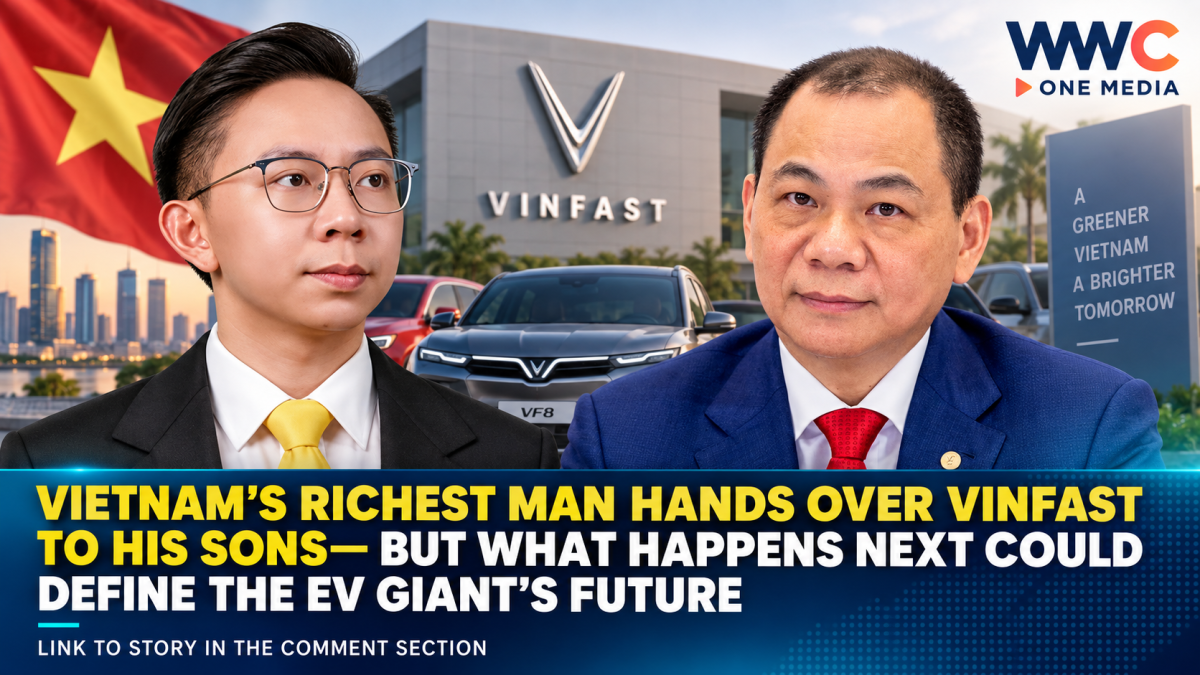
HANOI, Vietnam — Vietnam’s richest man, Pham Nhat Vuong, is handing major leadership responsibilities to the next generation as his business empire enters one of its most critical periods yet.
Vuong, the billionaire founder and chairman of Vingroup and the driving force behind electric vehicle maker VinFast, has transferred key executive roles at VinFast and Green and Smart Mobility (GSM) to his sons, signaling a major generational transition inside one of Southeast Asia’s most closely watched corporate groups.
The move comes as VinFast pushes aggressively into international markets while attempting to reduce costs, restructure its operations and eventually turn its ambitious electric vehicle business profitable.
According to an official announcement from VinFast and Vingroup on September 12, Pham Nhat Quan Anh, Vuong’s eldest son, will become the new global chief executive officer of VinFast. He will also serve as chairman and CEO of VinFast Vietnam, taking over the global CEO role previously held by his father.
Eldest Son Takes the Wheel at VinFast
Quan Anh, 33, was already serving as VinFast’s global chairman after being appointed to the position earlier this year. His promotion now gives him comprehensive responsibility for the company’s global operations.
Vuong will remain involved through VinFast’s board, but the leadership shift places his eldest son directly at the center of the company’s next phase.
The appointment is particularly significant because VinFast is no longer simply a Vietnamese carmaker.
The company has been pursuing expansion across Southeast Asia and India while building its international manufacturing footprint and attempting to establish itself as a global electric vehicle brand.
Reuters reported that VinFast has been restructuring toward a more asset-light model as it seeks to reduce future capital requirements. The company had announced plans involving the transfer of manufacturing assets and billions of dollars in debt as part of that restructuring.
That means Quan Anh is taking control at a difficult but potentially transformative moment.
Second Son Takes Charge of GSM
Vuong’s younger son, Pham Nhat Minh Hoang, has also been given a major leadership role.
Minh Hoang was appointed global CEO of GSM, the VinFast-linked electric mobility company known for operating the Xanh SM electric taxi service. He will also serve as CEO of GSM Vietnam.
Nguyen Quoc Tuan, meanwhile, has been appointed global chairman of GSM, succeeding Vuong’s wife, Pham Thu Huong, in that role.
The leadership changes suggest that Vingroup is increasingly positioning a younger generation to manage some of the group’s fastest-growing and most strategically important businesses.
GSM is particularly important to the wider VinFast ecosystem because it creates major demand for the automaker’s electric vehicles and scooters.
Reuters reported that GSM is planning significant expansion and has ambitions that include a possible Hong Kong listing in 2028. The company also plans to purchase around 1 million electric vehicles and 4 million electric scooters from VinFast between 2026 and 2030, highlighting the scale of the relationship between the two businesses.
A New Generation Takes Over
Vingroup said the leadership transition forms part of a broader effort to develop internal talent and transfer greater responsibility to younger leaders across its business ecosystem.
But the changes also raise a much bigger question:
Is Pham Nhat Vuong beginning to prepare his vast business empire for long-term succession?
Vuong remains chairman of Vingroup and continues to be the central figure behind one of Vietnam’s largest corporate groups.
His empire spans real estate, electric vehicles, tourism, hospitality, technology and infrastructure, with major companies including Vingroup, VinFast, Vinhomes and Vinpearl.
Forbes listed Vuong as Vietnam’s richest person, with a real-time net worth of roughly $37.7 billion as of September 11, 2026, although billionaire fortunes fluctuate with market prices.
His rise has become one of Southeast Asia’s most remarkable business stories. Vuong built his early fortune through an instant noodle business in Ukraine before returning to Vietnam and building Vingroup into a massive conglomerate.
The VinFast Challenge Is Far From Over
The timing of the leadership transition is crucial.
VinFast has rapidly expanded from a domestic Vietnamese carmaker into a global EV contender, but that expansion has come at a huge financial cost.
The company has yet to consistently achieve profitability and has relied heavily on financial backing connected to Vuong and the broader Vingroup ecosystem.
Bloomberg reported in May that Vuong had committed approximately $2.5 billion in additional funding and transactions involving VinFast during the previous year as the company continued investing heavily despite mounting losses.
Reuters also reported that VinFast posted rising revenue but continued to record significant losses, even as it expanded internationally.
The company is now betting heavily on Asian markets.
In India, VinFast is reportedly developing vehicles specifically designed for the local market after changing its earlier production strategy. Reuters reported that the company is targeting India’s highly competitive affordable EV segment and plans to use the country as a manufacturing hub for South Asia, the Middle East and Africa.
More Than a Family Succession
The transfer of executive power to Vuong’s sons is therefore about more than family succession.
It comes at a moment when VinFast must prove that its global ambitions can become a sustainable business.
Quan Anh will now face enormous pressure to expand sales, control costs and guide VinFast toward profitability while competing against established global giants and increasingly aggressive Chinese electric vehicle manufacturers.
At GSM, Minh Hoang will be tasked with scaling one of Southeast Asia’s most ambitious electric mobility businesses while maintaining its close relationship with VinFast.
The stakes are enormous.
Vingroup has continued expanding into new industries, including aviation and space-related ventures. Reuters previously reported that Vuong and his sons also hold stakes in VinSpace, a new company focused on activities ranging from aircraft and spacecraft manufacturing to satellite telecommunications and scientific research.
That broader expansion makes the leadership transition at VinFast and GSM even more significant.
What Happens Next?
For now, Pham Nhat Vuong is not walking away from his empire.
He remains one of the most influential business figures in Vietnam and continues to hold powerful positions within the Vingroup ecosystem.
But by placing his sons in charge of VinFast and GSM, Vuong is giving the next generation control over two businesses that could play a defining role in Vingroup’s future.
The biggest test will be VinFast.
Can Quan Anh turn one of Asia’s boldest EV ambitions into a financially sustainable global car company?
Can GSM continue expanding fast enough to become a major international mobility player?
And perhaps most importantly, can the next generation preserve the momentum of a business empire built by Vietnam’s richest man?
The handover has begun. But the real test for the Vuong family may only be starting now.



Leave a Reply