
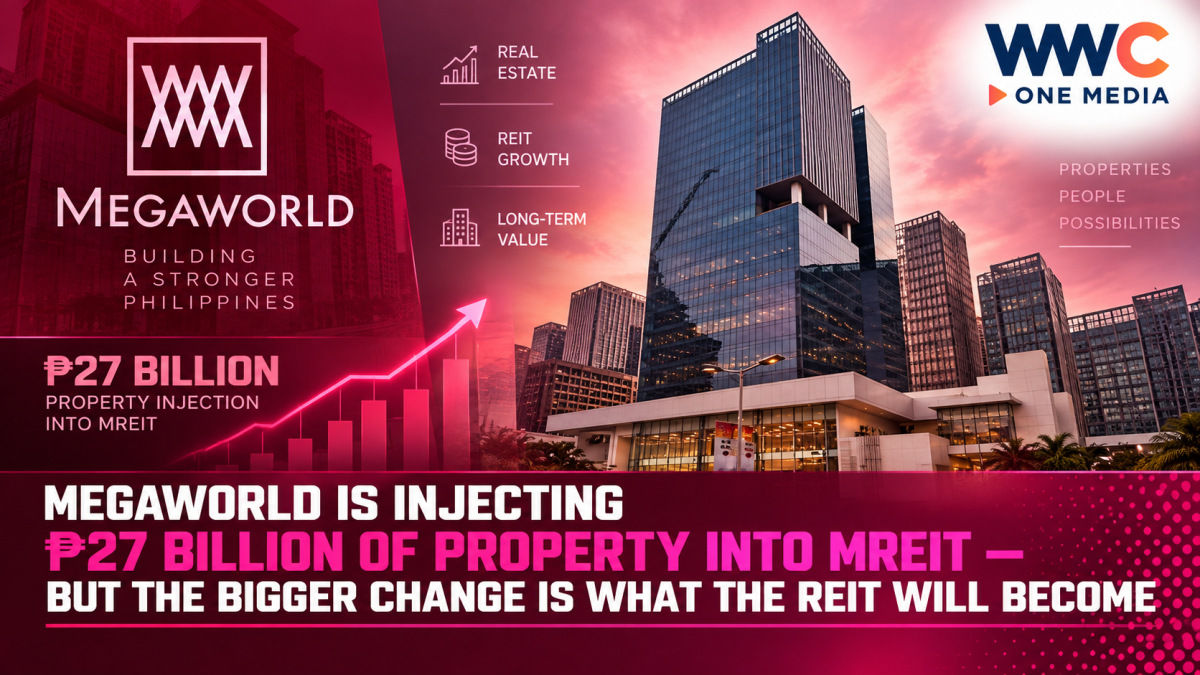
MANILA — Megaworld’s listed real estate investment trust is about to make its biggest transformation since going public.
MREIT has secured regulatory clearance for a ₱27.014-billion property-for-share swap that will bring 12 income-generating properties into its portfolio — including major malls, office buildings and a 737-room hotel — while pushing the REIT much closer to its long-promised one-million-square-meter target.
The transaction is MREIT’s largest acquisition to date and, based on disclosed transaction values, the biggest Philippine REIT asset-infusion deal announced so far in 2026.
But the most important part of the story is not simply the ₱27-billion headline.
Until now, MREIT has essentially been an office REIT.
After this deal closes, it will look very different.
Malls will become a meaningful part of the portfolio.
Hospitality will enter for the first time.
And Megaworld’s ownership stake will increase as it accepts MREIT shares instead of cash for the properties.
That makes Wave 5 much more than another asset transfer.
It is the moment MREIT begins turning itself into a genuinely diversified property platform.
Twelve properties are moving into MREIT
The Securities and Exchange Commission confirmed the valuation of the transaction on Sept. 14, 2026, allowing MREIT to proceed with the swap.
The deal involves an aggregate 303,936 square meters of gross leasable area, or GLA, across office, retail and hotel assets.
The portfolio includes some of Megaworld’s best-known commercial properties:
Festive Walk Mall and Annex in Iloilo;
Lucky Chinatown Mall and Annex in Binondo;
Venice Mall in McKinley Hill;
Eastwood Mall;
Southwoods Mall in Biñan;
Science Hub Tower 2;
Venice Corporate Center;
Six West Campus;
One Paseo in Arcovia City;
Global One in Eastwood City;
Horizon Center in Newport City;
and the Holiday Inn Express Manila Newport City.
Taken together, the assets have a 91% blended occupancy rate and a weighted average lease expiry of 5.3 years, according to MREIT.
Those numbers matter because a REIT does not simply need impressive buildings.
It needs buildings producing recurring rent.
MREIT is not paying ₱27 billion in cash
This is the most important technical detail.
The deal is a property-for-share swap.
Megaworld, Travellers International Hotel Group and Southwoods Mall Inc. will transfer the properties to MREIT.
In exchange, MREIT will issue them 1,637,217,981 new common shares worth a combined ₱27.014 billion.
Megaworld itself will receive roughly 1.21 billion shares.
Travellers International will receive about 309.4 million.
Southwoods Mall will receive about 118 million.
The effective transaction price is ₱16.50 per MREIT share.
That was about 18.6% above MREIT’s 30-day volume-weighted average market price of ₱13.91 used for the transaction.
MREIT argues that issuing shares at a premium reduces the amount of dilution required to acquire the assets and supports dividend-per-share growth.
That is management’s stated expectation.
The actual impact on future dividends will still depend on rental income, expenses, occupancy and the performance of the enlarged portfolio.
Megaworld’s ownership will rise
Because Megaworld is being paid partly in newly issued MREIT shares, its ownership position becomes larger.
PSE disclosures show Megaworld’s direct stake rising from approximately 53.43% to 58.70% after the transaction.
Travellers International would hold roughly 4.87%, while Southwoods Mall would own around 1.86%.
The public float would correspondingly decline from about 45.73% to 33.95%.
MREIT said the enlarged company will continue complying with minimum public ownership requirements applicable to Philippine REITs.
That ownership shift is important for investors.
MREIT becomes larger and more diversified.
But Megaworld and affiliated companies also become more dominant shareholders.
The portfolio is about to stop being 95% offices
This may be the most consequential change.
Before Wave 5, more than 95% of MREIT’s portfolio by GLA was office property.
After completion, MREIT expects the mix to become approximately:
77% offices,
20% retail,
3% hotel.
That reduces its dependence on a single property sector.
For years, Philippine office landlords have had to navigate several uncertainties:
hybrid work;
changes in business-process outsourcing demand;
the Philippine offshore gaming sector’s contraction;
and increasing competition among office districts.
Adding malls and a hotel gives MREIT additional revenue streams that behave differently from office leases.
Retail income depends more heavily on consumer spending and foot traffic.
Hotel income is linked more closely to tourism and travel.
Office rent remains tied to corporate leasing demand.
Diversification does not remove risk.
It changes where the risk comes from.
Five malls make up more than half of the new space
The five retail properties contribute about 160,200 square meters of GLA.
They are Festive Walk, Lucky Chinatown, Venice Grand Canal Mall, Eastwood Mall and Southwoods Mall.
Together, they account for more than half of the total space being added in Wave 5.
That is a major strategic shift for MREIT.
The REIT listed in 2021 primarily as a portfolio of office towers.
Now some of Megaworld’s most recognisable lifestyle and township retail assets will generate income directly for MREIT shareholders.
The move also brings exposure to different consumer markets.
Festive Walk serves Iloilo.
Lucky Chinatown serves Binondo.
Eastwood Mall is tied to Eastwood City.
Venice Grand Canal sits inside McKinley Hill.
Southwoods Mall expands MREIT south of Metro Manila.
This is no longer simply a Metro Manila office-landlord story.
The hotel adds another income source
Wave 5 also includes the 737-room Holiday Inn Express Manila Newport City.
The property contributes roughly 26,500 square meters of GLA.
This represents MREIT’s entry into hospitality.
That exposure may benefit from continued travel, tourism and business activity around Newport City and Ninoy Aquino International Airport.
But hotel economics are also different from conventional office rents.
Occupancy changes daily.
Room rates change.
Tourism cycles matter.
Operating expenses can also be higher and more variable.
MREIT therefore gains diversification, but also a new category of operating exposure.
The remaining six properties are offices
Office assets still account for approximately 117,200 square meters of the incoming portfolio.
They include Science Hub Tower 2, Venice Corporate Center, Six West Campus, One Paseo, Global One and Horizon Center.
Those properties reinforce MREIT’s existing office base while expanding its footprint across Megaworld townships.
After the transaction, MREIT expects to have properties across nine Megaworld townships, up from five.
That geographic spread matters because the performance of a REIT depends not only on property type but also on location.
Demand conditions in Iloilo can differ from Taguig.
Retail foot traffic in Binondo may move differently from office leasing in Pasig.
Hospitality in Newport has different drivers again.
MREIT will jump beyond 950,000 square meters
Before the latest wave, MREIT had around 647,000 square meters of GLA after completing its ₱16.2-billion Wave 4 transaction earlier this year.
Wave 5 adds roughly 303,900 square meters.
That pushes the total above 950,000 square meters.
MREIT has been targeting one million square meters of GLA by the end of 2027.
After Wave 5, it will be within roughly 50,000 square meters of that target.
Management now says it expects eventually to exceed the original goal.
That is striking when compared with where MREIT began.
At its October 2021 listing, the portfolio contained only around 224,000 square meters.
After five waves of asset infusions, it will have more than quadrupled.
This is MREIT’s second huge deal this year
Wave 5 is not happening in isolation.
Earlier in 2026, MREIT completed a ₱16.2-billion Wave 4 infusion involving nine Grade A office buildings in McKinley Hill.
That transaction expanded GLA by roughly 34% to around 647,000 square meters.
Add Wave 5 and MREIT will have received more than ₱43 billion worth of assets in 2026 alone.
That makes 2026 easily the most aggressive expansion year in MREIT’s history.
It also shows how quickly a Philippine REIT can grow when its sponsor owns a deep pool of mature properties.
Why sponsors matter so much to Philippine REITs
A REIT does not typically develop every building itself.
Instead, many Philippine REITs depend heavily on a property developer sponsor.
The sponsor builds properties.
Stabilises occupancy.
Waits until they generate predictable income.
Then transfers mature assets into the listed REIT.
The sponsor receives cash or shares.
The REIT receives additional rent-producing properties.
Investors receive exposure to the larger portfolio.
Megaworld has a particularly large pipeline because it owns office towers, malls, hotels and other properties across numerous townships.
That gives MREIT something important:
a visible supply of potential future acquisitions.
Management is already talking about Wave 6.
Uptown Bonifacio could be next
MREIT says the next infusion is expected to consider selected “crown-jewel” assets in Uptown Bonifacio.
Management cited strong office occupancy, retail traffic and sales in the township.
Any Wave 6 transaction would still require due diligence, valuations, corporate approval and regulatory clearance.
So it should not yet be treated as a completed deal.
But the signal is clear.
Wave 5 is not intended to be the end of the acquisition programme.
Once MREIT passes one million square meters, growth could continue.
The ₱27-billion price has independent valuations behind it
Related-party transactions deserve particular scrutiny because the buyer and seller are connected.
Megaworld sponsors MREIT and controls a majority stake in it.
Travellers International and Southwoods Mall are also within the broader Alliance Global/Megaworld corporate network.
To support the transaction valuation, MREIT obtained independent property appraisal and fairness work.
PSE disclosures identify Cuervo Appraisers and FTI Consulting Philippines in connection with valuation and fairness assessment.
The assets were priced using income-based valuation methods including discounted cash flow and direct capitalisation.
MREIT says the portfolio was acquired at an effective blended capitalisation rate of 7.8%.
That gives investors another way to judge the economics.
A higher acquisition yield can potentially support distributions.
But long-term returns still depend on rents, occupancy, operating costs and future property values.
Why the ₱16.50 issue price matters
The new MREIT shares are being valued at ₱16.50 each even though the 30-day VWAP referenced in the deal was ₱13.91.
That premium matters because MREIT is creating a very large number of new shares.
If a company issues too many shares to buy assets that do not produce enough additional income, earnings and dividends per share can be diluted.
By issuing the shares at a price above the market reference used in the transaction, MREIT needs fewer shares than it would at ₱13.91 to fund the same ₱27-billion valuation.
Management argues this structure supports dividend-per-share accretion.
Investors will ultimately judge that claim from future dividend declarations rather than the transaction announcement alone.
Wave 4 has already provided an early test
There is some evidence behind management’s argument.
After Wave 4, MREIT reported first-quarter 2026 distributable income of ₱1.25 billion, up 34% year on year.
Revenue increased 29% to ₱1.72 billion.
Its net operating income margin improved to 81.6% from 80.3%.
The company also raised its quarterly dividend per share by roughly 5% to a record ₱0.2630 after Wave 4.
For the first half of 2026, MREIT said distributable income reached approximately ₱2.49 billion, up 34%.
Wave 5 therefore arrives at a time when the previous expansion is already contributing to earnings.
The new properties start contributing from July 1
Timing is unusually important here.
MREIT says Wave 5 income will be recognised retroactively from July 1, 2026, now that SEC valuation approval has been secured.
That means shareholders do not have to wait until the final paperwork is completed late in the year before the economic contribution begins.
MREIT expects the assets to contribute to second-half distributable income.
That could make upcoming dividend announcements one of the clearest tests of whether the transaction is genuinely accretive on a per-share basis.
REIT investors ultimately care about dividends
Philippine REIT rules require qualifying REITs to distribute at least 90% of annual distributable income to shareholders.
That is why asset infusions receive so much attention.
Buying a building for its own sake does not necessarily help a REIT investor.
The acquisition needs to generate enough additional distributable income relative to the shares or debt used to fund it.
For MREIT, Wave 5 increases the number of shares outstanding from around 4.72 billion to 6.36 billion.
That is an increase of roughly 35%.
The crucial question is therefore whether the new portfolio increases distributable income by enough to offset the much larger share count — and ideally raise dividend per share.
Management says it will.
The next several quarters will show whether that happens.
Why this is the biggest disclosed Philippine REIT swap of 2026 so far
MREIT’s ₱27.014-billion transaction stands out even in a busy year for Philippine REIT expansion.
Ayala-backed AREIT announced a property-for-share transaction in August worth approximately ₱17.33 billion, involving six properties.
Robinsons Land-backed RCR announced a roughly ₱10.62-billion infusion involving six malls.
Citicore Energy REIT has also announced a major proposed solar and land infusion involving roughly 1.7 million square meters and 860 MWp of generating assets, although its initial May disclosure did not state a final transaction value.
So the most accurate formulation is:
MREIT’s ₱27-billion Wave 5 is the largest disclosed-value Philippine REIT asset-infusion transaction announced so far in 2026.
That is slightly more precise than simply declaring it the largest deal without qualification.
Philippine REITs are becoming more diversified
MREIT’s shift is also part of a bigger industry evolution.
Philippine REITs initially entered the market heavily associated with office buildings.
But the sector has diversified rapidly.
RCR has been adding malls.
AREIT owns offices and other property types.
CREIT introduced renewable-energy land and assets into the REIT market.
Other listed trusts provide exposure to logistics, commercial properties and additional sectors.
That matters because investors are no longer choosing simply among competing office portfolios.
They are increasingly choosing among different types of rental-income exposure.
MREIT’s Wave 5 makes that competition more obvious.
MREIT and RCR are both adding malls this year
The timing is particularly interesting.
RCR’s June transaction brings six Robinsons malls into its portfolio for ₱10.62 billion.
MREIT is now adding five lifestyle malls.
Both REITs are therefore increasing exposure to Philippine consumer activity.
That creates another layer of competition between sponsor groups.
Instead of competing only for office tenants, REIT investors will increasingly compare:
mall occupancy;
rental escalation;
retail tenant sales;
consumer foot traffic;
regional diversification;
and the quality of each sponsor’s future property pipeline.
But shopping malls carry their own risks
Diversification sounds inherently positive.
It is not automatically so.
Retail property depends on consumer confidence and spending.
A weak economy can pressure tenant sales.
E-commerce can change tenant demand.
High inflation can squeeze household budgets.
Vacancies can rise.
Hotels also expose MREIT to tourism cycles and travel demand.
Office buildings can suffer when leasing weakens.
Each sector has its own risks.
The advantage of diversification is that they do not always deteriorate at the same time.
The downside is that management must now operate and evaluate a much more complicated portfolio.
Occupancy is strong — but not perfect
Wave 5’s blended occupancy is 91%.
That means the incoming properties already have substantial tenants and operating activity.
But it also implies roughly 9% of leasable space is unoccupied on a blended basis.
Higher occupancy would provide more rent.
Lower occupancy would weaken the economics.
One of MREIT management’s opportunities after the acquisition will therefore be filling remaining vacancies while controlling expenses.
The 5.3-year weighted average lease expiry helps provide visibility over existing contracts.
Still, WALE is an average.
Individual tenant leases can expire earlier or later.
The deal also changes MREIT’s scale
After Wave 5, management expects assets under management to reach approximately ₱122 billion.
That moves MREIT into a very different category from its early years.
A larger REIT can benefit from scale.
Property-management expenses can be spread across more assets.
The investor base can potentially widen.
Trading liquidity can improve.
Larger portfolios can support larger debt programmes or future acquisitions.
But scale alone does not guarantee superior returns.
The quality and price of each acquisition still matter.
Megaworld also benefits from the transaction
There are two sides to every REIT infusion.
MREIT acquires mature income-generating properties.
Megaworld and its affiliates receive listed REIT shares.
That allows the sponsor group to recycle capital tied up in completed assets while retaining economic exposure through its MREIT ownership.
This is one of the central attractions of the REIT structure for Philippine property developers.
Develop a property.
Lease it.
Stabilise it.
Transfer it into the REIT.
Then redeploy capital into another development project.
Megaworld has already been using proceeds from earlier MREIT share sales to support township expansion.
The cycle can continue as long as the sponsor has attractive assets and investors are willing to fund the REIT.
The ₱27-billion headline hides a bigger strategic shift
When MREIT listed, the investment proposition was relatively simple:
own premium offices inside Megaworld townships and collect rental income.
Five years later, that description is becoming obsolete.
After Wave 5, investors will own exposure to:
corporate offices;
shopping centres;
provincial retail;
Metro Manila lifestyle malls;
and a major hotel.
The portfolio will span nine townships.
GLA will exceed 950,000 square meters.
Assets under management will approach ₱122 billion.
And management is already looking toward another acquisition wave.
That is why Wave 5 matters more than its record transaction value.
Megaworld is not merely putting another ₱27 billion of property into MREIT.
It is changing what MREIT is.
The next question is whether that bigger, more diversified portfolio can deliver the one thing REIT investors ultimately care about most:
a bigger dividend per share — not simply a bigger collection of buildings.




Leave a Reply