
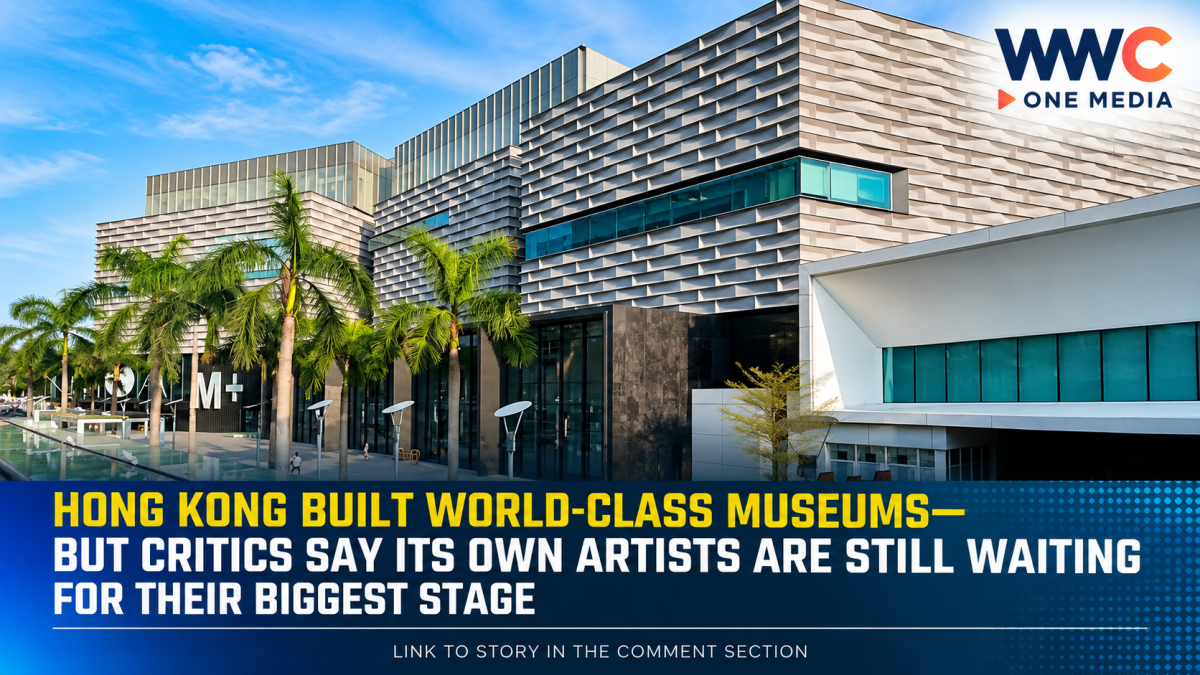
Hong Kong has invested heavily in becoming a global cultural destination, building world-class museums and attracting international galleries and major exhibitions. But a pointed new debate is emerging over a question closer to home:
Are Hong Kong’s own contemporary artists getting enough space on the city’s biggest museum stages?
That question is at the center of a Sept. 12 opinion column by South China Morning Post Arts Editor Enid Tsui, who argues that institutions such as M+ and the Hong Kong Museum of Art (HKMoA) should do more to give living Hong Kong artists major, in-depth solo exhibitions.
Tsui’s argument comes as Hong Kong’s art ecosystem continues to expand, with new galleries opening, international art events drawing global visitors and museums increasingly positioning the city as a cultural hub.
But the criticism is not that Hong Kong lacks contemporary art—or that its museums completely ignore local artists.
The issue is scale, depth and visibility.
The argument: group shows may not be enough
Tsui points to what she describes as a chronic reluctance by M+ and HKMoA to mount major, academically rigorous solo exhibitions dedicated to Hong Kong’s living contemporary artists.
Both museums have presented group exhibitions featuring Hong Kong artists. But Tsui argues that group shows can make it difficult for audiences to fully understand an individual artist’s development, ideas and body of work.
That distinction matters.
A large solo exhibition gives a museum the opportunity to trace an artist’s career, explain the evolution of their ideas and place individual works within a broader historical and cultural context.
It can also help transform an artist from a local name into an internationally recognized figure.
And that is where Tsui believes Hong Kong is falling short.
But Hong Kong’s museums are not ignoring local artists
There is an important qualification to the debate.
The Hong Kong government and its museums have continued to stage exhibitions centered on local artists.
For example, the Hong Kong Museum of Art’s “Live: Hong Kong Art Exhibition” brings together 19 established and emerging artists working across painting, ink art, ceramics, sculpture, video, installation and multimedia. The museum says the exhibition is designed to showcase the diversity of Hong Kong’s contemporary artistic landscape.
The participating artists include figures such as Chu Hing-wah, Angela Yuen, Inkgo Lam, Ross Yau, Hung Keung, Leung Mee-ping, Joseph Chan, Chan Wai-lap, Wong Chun-hei and Law Yuk-mui.
So the more precise criticism is not “Hong Kong museums don’t show Hong Kong artists.”
It is that local artists may still not receive enough major, sustained institutional attention compared with the scale of Hong Kong’s international cultural ambitions.
M+ has a much bigger global mission
The debate is particularly interesting when it comes to M+.
The West Kowloon museum describes itself as Asia’s global museum of contemporary art, with a collection spanning visual art, design, architecture, moving image and Hong Kong visual culture from the 20th and 21st centuries. Its 65,000-square-metre complex includes 33 galleries as well as research, learning and moving-image facilities.
M+ has also aggressively pursued international collaborations.
Its 2026 programme includes exhibitions and partnerships involving artists and institutions from across Asia and beyond. Its collaborations have included the Leeum Museum of Art in Seoul, the National Center for Art Research in Tokyo and other international institutions.
That international role is part of M+’s identity.
But it also raises a difficult question:
If Hong Kong wants to be seen as a global cultural capital, shouldn’t its own artists be among the artists receiving the biggest platforms at home?
Hong Kong’s art scene is actually growing
There is another important piece of context.
Despite the concerns raised in the SCMP column, Hong Kong’s contemporary art ecosystem is far from stagnant.
The Art Newspaper reported in March that four new art spaces were opening in Hong Kong in 2026, adding momentum to a scene already energized by Art Basel Hong Kong and other exhibitions and fairs.
Hong Kong’s gallery ecosystem is also highly active. The Hong Kong Art Gallery Association’s current exhibition listings show a wide range of solo and group exhibitions involving contemporary artists across the city.
That means the challenge may be less about whether artists have opportunities at all and more about which opportunities carry the greatest institutional weight.
A commercial gallery exhibition and a major museum retrospective are not equivalent.
The latter can shape scholarship, public perception, collecting and an artist’s international reputation for years.
The international comparison is becoming harder to ignore
Tsui’s argument also arrives at a moment when Asian museums are increasingly giving individual artists major platforms.
M+ itself has demonstrated this model internationally. Its 2026 programme includes “Lee Bul: From 1998 to Now,” a comprehensive survey of the South Korean artist’s career that was first presented at Seoul’s Leeum Museum of Art before travelling to Hong Kong and subsequently being planned for further international touring.
Meanwhile, Seoul’s art ecosystem continues to attract major international attention. Frieze Seoul’s 2025 edition drew more than 70,000 visitors, with representatives from more than 160 museums and institutions attending, while Hong Kong galleries were among the international participants.
For Hong Kong artists, the comparison is therefore not simply about exhibitions.
It is about who gets elevated onto the international cultural map.
There is already evidence of what local artists can bring
Hong Kong’s museums themselves acknowledge that local contemporary art has a distinctive identity.
HKMoA describes the city’s art as reflecting its position at a cultural crossroads, combining Chinese traditions and Western influences while developing distinctive artistic vocabularies.
That combination is potentially one of Hong Kong’s strongest cultural assets.
The city’s artists can tell stories about urban life, migration, identity, memory, architecture, technology and the tension between tradition and modernity from a perspective that cannot simply be replicated elsewhere.
That makes the argument for deeper institutional investment particularly compelling.
The bigger issue is Hong Kong’s cultural identity
Hong Kong has spent years building the physical infrastructure of a global cultural hub.
West Kowloon has M+, the Hong Kong Palace Museum and other major cultural institutions. The government has repeatedly promoted the city as an international arts and cultural center.
But buildings alone cannot create a cultural identity.
Artists do.
And if Hong Kong wants its cultural reputation to extend beyond blockbuster international exhibitions, it may need to put more emphasis on the people who have been interpreting the city itself.
That does not mean reducing international programming.
Instead, the stronger model may be to make local and international art reinforce each other—giving Hong Kong artists the same level of curatorial ambition, scholarship and institutional visibility that international artists receive.
The opportunity is sitting in plain sight
The debate should therefore not be reduced to whether M+ or HKMoA are “supporting” Hong Kong artists.
They clearly are.
The more difficult question is whether they are supporting them boldly enough.
Hong Kong already has the museums, collectors, galleries, international visitors and increasingly sophisticated art infrastructure.
What may be missing is a greater willingness to say:
This artist is important. This career deserves a major exhibition. This story deserves to be told at full scale.
And if Hong Kong’s contemporary artists really are capable of competing on the international stage, perhaps the biggest test is whether their own city’s flagship museums are prepared to give them that stage first.

Leave a Reply