
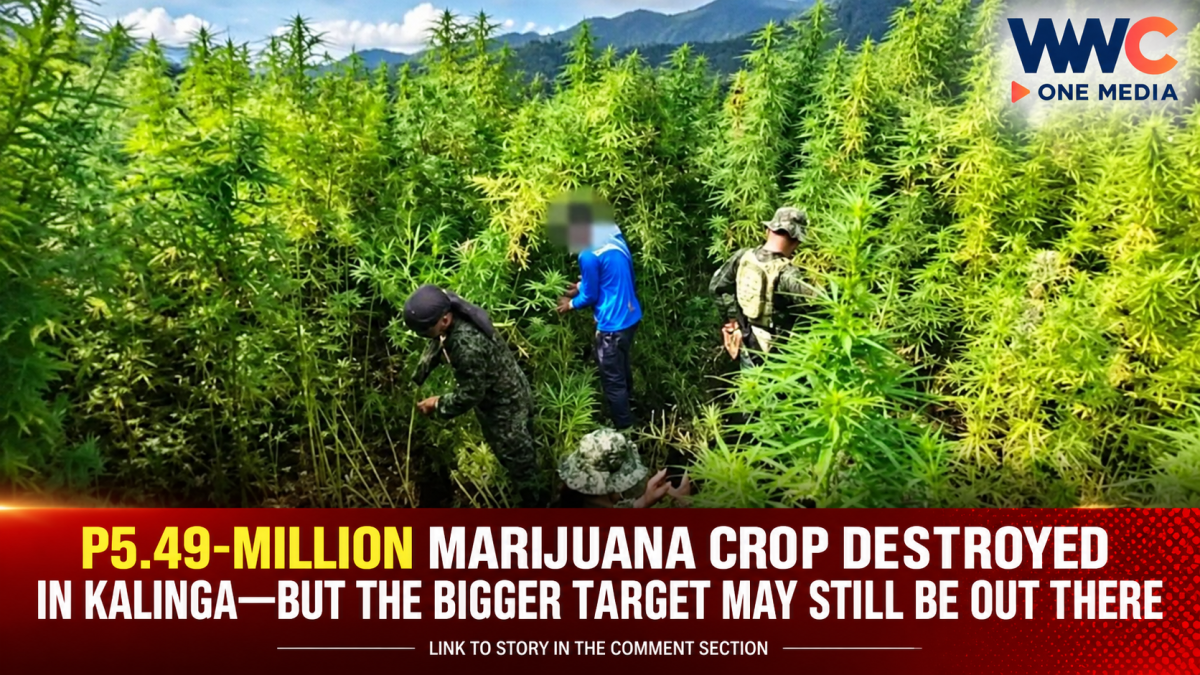
KALINGA, Philippines — Authorities have destroyed an estimated P5.49 million worth of marijuana plants in Kalinga, highlighting the continuing battle against illegal marijuana cultivation in the province’s mountainous communities.
The latest eradication operation adds to a long record of government operations targeting marijuana plantations in Tinglayan and other parts of Kalinga, where authorities have repeatedly discovered extensive cultivation sites in remote mountain areas.
The campaign has involved law-enforcement agencies including the Philippine National Police (PNP) and the Philippine Drug Enforcement Agency (PDEA), which have conducted coordinated operations to locate, uproot and destroy marijuana crops before they can enter the illegal drug market.
Kalinga remains a major focus of marijuana eradication efforts
The province has repeatedly figured in major marijuana-eradication operations.
In one previous operation in Tinglayan, PNP and PDEA personnel destroyed approximately 240,500 fully grown marijuana plants valued at P49.6 million across about 14,200 square meters of plantation area. No cultivator was arrested during that particular operation, according to the Philippine News Agency.
Authorities have also carried out significantly larger operations.
In 2022, the PNP reported the destruction of P111.6 million worth of marijuana plants in Tinglayan, with plantations discovered in Tuglao and Loccong.
The scale of the operations underscores why the mountainous portions of Kalinga have remained a priority for anti-drug authorities.
Millions of pesos in marijuana destroyed in earlier operations
The eradication campaign has produced repeated multimillion-peso seizures.
In August 2021, PDEA reported that an operation in Loccong resulted in the destruction of 87,950 full-grown marijuana plants valued at P17.59 million, along with dried marijuana leaves and stalks valued at another P2.64 million. The combined estimated value was P20.23 million.
Earlier, in June 2020, anti-narcotics authorities destroyed nearly 300,000 fully grown marijuana plants worth more than P59 million in nine plantation sites in Buscalan and Loccong, Tinglayan.
The repeated discoveries indicate that marijuana cultivation remains a persistent law-enforcement challenge despite years of eradication efforts.
Remote plantations make enforcement difficult
Many marijuana plantations in Kalinga are located in mountainous and difficult-to-access areas, requiring law-enforcement personnel to conduct extensive patrols and surveillance before reaching cultivation sites.
Previous PNP operations have involved extensive searches in areas including Mt. Chumanchil, Barangay Loccong and Barangay Buscalan. In a 2024 report, the PNP said an operation in these areas resulted in the destruction of 3,349,500 fully grown marijuana plants covering 195,100 square meters, along with 1,575 kilograms of dried marijuana leaves.
The continuing operations suggest that authorities are not simply targeting individual marijuana plants but are attempting to dismantle the cultivation areas that supply the illegal market.
The challenge goes beyond destroying the crops
While destroying marijuana plantations can immediately remove large quantities of illegal crops from circulation, authorities face a more complicated problem in preventing cultivation from returning.
Past government officials have acknowledged that marijuana planting has been associated with livelihood concerns among some residents in remote communities. In a 2017 operation, the Philippine News Agency reported that authorities were encouraging residents involved in marijuana cultivation to shift toward alternative livelihood opportunities.
That makes sustained enforcement, intelligence gathering and alternative sources of income important components of the broader effort.
For authorities, the latest P5.49-million marijuana eradication is therefore more than a single operation. It is another move in a long-running campaign aimed at cutting off marijuana production at its source.
And with previous operations uncovering plantations worth tens—and sometimes hundreds—of millions of pesos, the bigger question is whether the latest destruction has uncovered only part of the marijuana network operating in Kalinga.



Leave a Reply