
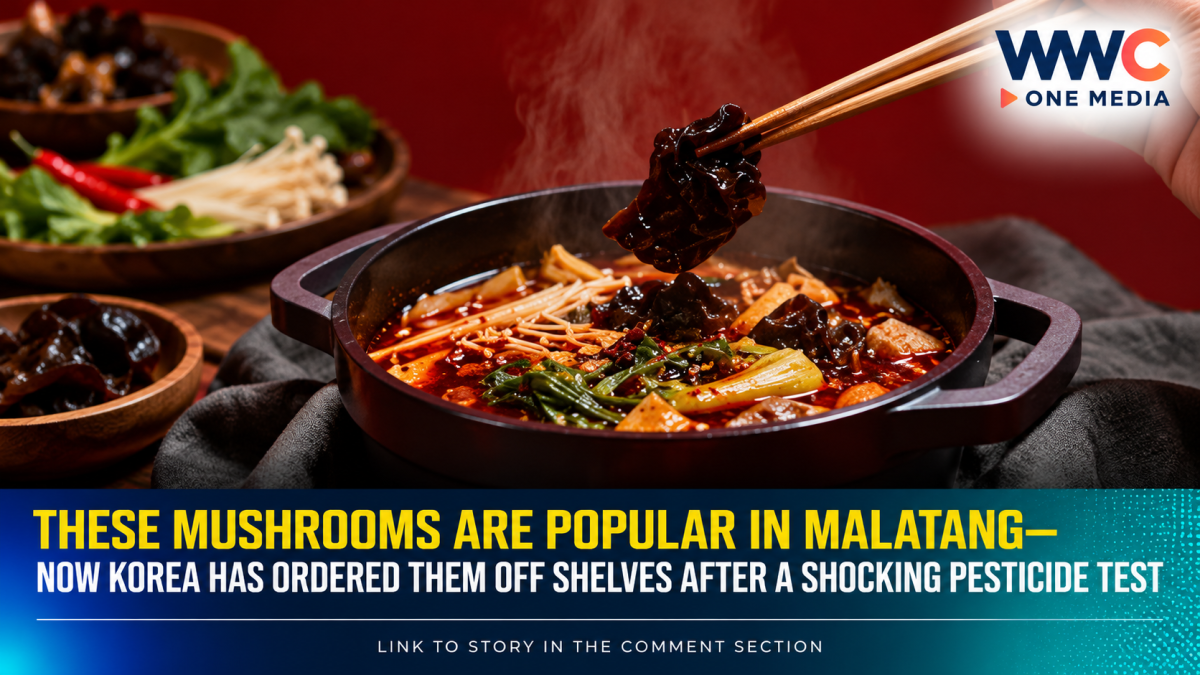
SEOUL — South Korean authorities have ordered the sale and distribution of two imported mushroom products to stop after testing found pesticide residues above the country’s legal limits, including one batch of wood ear mushrooms with carbendazim detected at 17 times the permitted level.
The products are commonly used in dishes such as malatang and jjampong, making the recall particularly relevant to consumers who regularly eat these popular dishes.
The Ministry of Food and Drug Safety (MFDS) announced the recall on Sept. 10 after testing found excessive pesticide residues in Chinese-imported wood ear and white wood ear mushrooms. The agency instructed sellers to stop distribution and urged consumers who purchased the affected products to stop using them and return them to the place of purchase.
One mushroom product tested at 17 times the limit
The first recalled product was wood ear mushrooms imported and sold by Taeyang Trading, based in Guro-gu, Seoul.
Testing detected 0.17 milligrams of carbendazim per kilogram, compared with South Korea’s maximum permitted level of 0.01 mg/kg.
That means the detected concentration was 17 times the legal limit.
A total of approximately 6,900 kilograms of the mushrooms had been imported.
The mushrooms were exported from China by Hubei Piaoyang Food Science and Technology Co. and were packed in 1-kilogram units on May 26, 2026, with a stated shelf life of two years from the packaging date.
A second product also exceeded the pesticide limit
The recall also covers white wood ear mushrooms imported and sold by Sungmin Trading in Ansan, Gyeonggi Province.
Tests found acetamiprid at 0.05 mg/kg, compared with the permitted level of 0.01 mg/kg or less—more than five times the legal limit.
The product was exported by China’s Gutian Yumeijia Food Co.
Authorities said approximately 2,880 kilograms were imported. The mushrooms were packaged in 1-kilogram units on April 2, 2026, with a 24-month shelf life.
What are these pesticides?
Carbendazim is a fungicide used to control fungal diseases in crops, while acetamiprid is an insecticide used to control pests.
The fact that residues were detected above South Korea’s permitted limits does not mean that every serving of the affected products would necessarily cause immediate illness. The recall is a food-safety regulatory action because the measured residues exceeded the country’s established maximum residue limits.
That distinction is important when reporting the story: consumers should not be unnecessarily frightened, but they should follow the government’s instruction not to consume recalled products.
Authorities say consumers should stop using the products
South Korea’s food-safety authorities have told consumers who purchased the affected products to stop using them immediately and return them to the place of purchase.
The products have also been placed on the country’s official recall and sales-suspension system. The MFDS database lists both the Taeyang Trading wood ear mushrooms and Sungmin Trading white wood ear mushrooms among recalled products.
South Korea MFDS recall database
This is not the first mushroom recall this month
The latest recall follows another action announced by South Korean authorities on Sept. 2.
A separate wood ear mushroom product imported and sold by Taerim SM was also recalled after carbendazim was detected above the permitted level.
The product had been packaged on Jan. 14, 2026, and about 8,350 kilograms had been imported, according to South Korean authorities.
That means South Korean regulators have identified multiple imported wood ear mushroom products with excessive pesticide residues within a matter of days, making the latest recalls a broader food-safety story rather than an isolated product issue.
Why the recall matters to malatang lovers
Wood ear mushrooms are a familiar ingredient in Chinese cuisine and are widely used in dishes served in South Korea, including malatang, spicy hotpot-style dishes and jjampong.
Their popularity means contaminated batches can potentially reach a significant number of consumers before testing identifies a problem.
The Korea Herald highlighted the connection to malatang and jjampong while reporting the recall, noting that the affected products were imported from China.
The bigger food-safety issue
The latest recalls also highlight the importance of testing imported agricultural products.
South Korea imports large quantities of food products from around the world, meaning regulators must check products at various stages of importation and distribution.
In this case, authorities detected residues that exceeded established limits and responded by ordering sales to stop and initiating recalls. The official MFDS notice confirms that the agency instructed rapid recall measures for both products.
For consumers, the most important takeaway is straightforward:
If you have purchased the recalled mushroom products, do not eat them. Return them to the retailer.
What consumers should check
Consumers who regularly buy packaged wood ear or white wood ear mushrooms should check the product information carefully and, when possible, compare it with the recall information provided by South Korean authorities.
The affected products identified in the latest recall include:
| Product | Importer/Seller | Problem detected | Amount imported |
|---|---|---|---|
| Wood ear mushrooms | Taeyang Trading | Carbendazim: 0.17 mg/kg, 17× limit | 6,900 kg |
| White wood ear mushrooms | Sungmin Trading | Acetamiprid: 0.05 mg/kg, 5× limit | 2,880 kg |
The official Korean recall database should be treated as the authoritative source for product identification and recall status.
The warning behind the recall
The headline number—17 times the legal limit—is likely to grab consumers’ attention.
But the more important story is what happened next.
South Korea’s food-safety system detected the excessive residues, halted sales and ordered recalls. At the same time, the appearance of another recalled wood ear mushroom product earlier in September shows why continued monitoring of imported foods remains important.
For consumers, the message is simple:
Check before you eat—and if your mushrooms match the recalled products, don’t take the risk.




Leave a Reply