
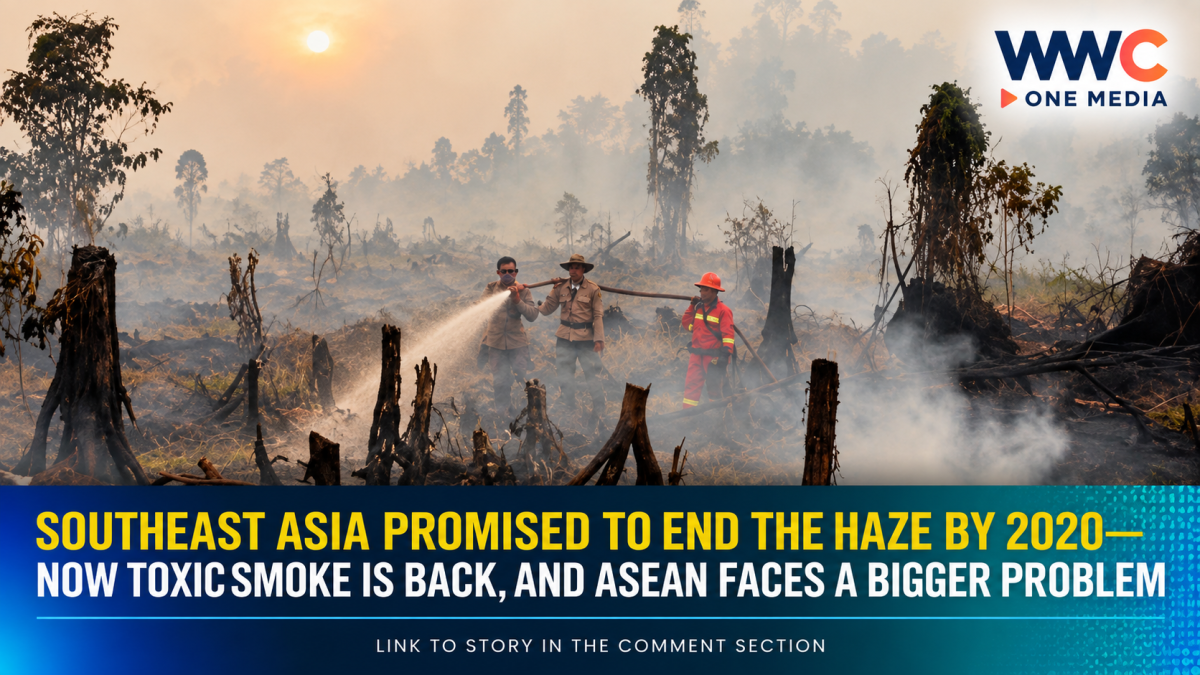
KUALA LUMPUR/JAKARTA — Southeast Asia’s recurring haze crisis has returned with a force that is exposing a problem the region has struggled to solve for more than two decades: ASEAN has agreements, monitoring systems and ambitious targets, but cross-border enforcement remains painfully weak.
The latest episode has pushed the issue back into the regional spotlight as smoke from forest and peatland fires in Indonesia spreads across parts of Malaysia and threatens wider areas of Southeast Asia.
The South China Morning Post reports that ASEAN once aimed to eliminate transboundary haze by 2020. That target was not achieved, and the region is again confronting dangerous pollution from fires in Kalimantan and Sumatra.
The crisis is not simply an environmental problem. Prolonged exposure to fine particulate pollution can aggravate asthma and other respiratory conditions, while PM2.5 particles can enter the bloodstream and contribute to cardiovascular and other serious health risks.
A problem ASEAN has been trying to solve for decades
The ASEAN Agreement on Transboundary Haze Pollution, which entered into force in 2003, was designed to strengthen cooperation among member states in preventing and responding to fires whose smoke crosses national borders.
But the agreement was built around ASEAN’s traditional principles of consensus, sovereignty and non-interference.
That has created a fundamental weakness: the regional framework does not give ASEAN a system of fines or sanctions for non-compliance, while disputes are generally handled through consultation and negotiation.
In other words, ASEAN can coordinate—but its ability to compel action across borders is limited.
That weakness is becoming increasingly visible as Malaysia pushes for stronger action.
Malaysia wants tougher rules
Malaysia has called for a review of the regional haze agreement as smoke from Indonesian fires again affects parts of the country.
CNA reported that Malaysian officials and experts are questioning whether the existing framework is strong enough to deal with today’s increasingly complex fire and pollution threats.
Malaysia has argued that mechanisms for prevention, detection, enforcement and response need to evolve.
But changing the agreement will not be easy.
ASEAN decision-making is heavily dependent on consensus, meaning major reforms require member states—including Indonesia—to agree to stronger mechanisms that could potentially increase scrutiny of activities within their own territories.
Indonesia remains at the center of the crisis
Many of the fires responsible for the current haze are concentrated in Indonesia’s Sumatra and Kalimantan regions.
ASEAN’s Specialised Meteorological Centre activated Alert Level 3 for the southern ASEAN region in late August after the hotspot and smoke-haze situation deteriorated under prolonged dry conditions.
Satellite surveillance detected clusters of hotspots in Kalimantan and Sumatra, with smoke drifting across borders. The ASMC also warned that strengthening El Niño conditions could increase the risk of more severe transboundary haze.
The current crisis has already produced major disruptions.
The Associated Press reported that Indonesia has intensified firefighting operations, with more than 24,000 ground firefighters involved and aerial water-bombing being used in affected areas. Authorities have also arrested dozens of people over suspected illegal burning and investigated companies in connection with the fires.
Malaysia’s schools have already paid the price
The human cost is becoming increasingly visible.
In Sarawak, nearly 600 schools were temporarily closed, affecting almost 200,000 students, after air pollution reached very unhealthy levels in parts of the Malaysian state.
Serian, near the Indonesian border, recorded an Air Pollutant Index of 239—within Malaysia’s “very unhealthy” category.
The disruption demonstrates why haze is more than a seasonal inconvenience.
When pollution becomes severe enough, schools can close, outdoor activities can be restricted and vulnerable people can face increased health risks.
Singapore is preparing—but wants prevention, too
Singapore has also been preparing for the possibility of worsening transboundary haze.
Singapore’s Ministry of Sustainability and the Environment said the southern ASEAN region entered its dry season under warmer and drier conditions associated with developing El Niño conditions.
Singapore’s Haze Task Force has contingency measures in place, including preparations for public-health protection, while schools, preschools and residential and care facilities have been equipped with air purifiers.
But Singapore’s preparations highlight the larger regional dilemma.
Countries affected by haze can prepare for its arrival, but preparation does not eliminate the fires that produce the pollution in the first place.
The missing piece: enforcement
Perhaps the biggest weakness in ASEAN’s approach is accountability.
Singapore has gone further than most regional neighbors by adopting its Transboundary Haze Pollution Act, which allows action against conduct occurring outside Singapore when it contributes to haze pollution within the country.
Yet CNA notes that there have been no publicly confirmed prosecutions or convictions under the law.
One reason is practical: proving who is responsible for a fire across an international border requires information about land ownership, concession boundaries, corporate control and the precise origin of fires—information that may sit in another country’s jurisdiction.
That creates a difficult chain:
Smoke crosses the border → pollution is measured → satellite data identifies fires → but establishing legal responsibility can become far more complicated.
ASEAN is building another mechanism—but it isn’t fully operational yet
ASEAN has not abandoned the fight.
The bloc signed an agreement in 2025 establishing the ASEAN Coordinating Centre for Transboundary Haze Pollution Control, intended to serve as a permanent regional hub for coordinating responses to land and forest fires.
But as of the ASEAN update cited by CNA, the center was still awaiting sufficient national ratifications before it could become fully operational.
Experts say the center could eventually improve real-time satellite monitoring, hotspot information sharing and coordination of firefighting resources.
But technology alone will not solve the problem.
The real battle may be underground
One of the most difficult parts of the crisis is the region’s peatlands.
Peat can burn deep underground and continue smouldering across large areas, producing enormous amounts of smoke.
Experts therefore argue that governments need to focus not only on extinguishing fires but also on preventing them through peatland conservation, rewetting and better land-use management.
This is particularly important because fires can be linked to land clearing, agriculture and plantation activity.
If degraded or drained peatlands remain highly flammable, Southeast Asia can continue fighting the same crisis year after year.
The 2030 promise is now facing a reality check
ASEAN’s Second Haze-Free Roadmap 2023–2030 aims for a transboundary haze-free region by the end of the decade.
But the current crisis raises an uncomfortable question:
Can ASEAN realistically achieve that goal without stronger enforcement and accountability?
CNA quoted experts who questioned whether the 2030 target is realistic under the bloc’s current system of consensus and non-interference.
Malaysia is now calling for stronger regional mechanisms, while Indonesia has indicated support for strengthening implementation of the existing agreement, including early-warning systems, real-time data sharing, firefighting coordination and weather modification.
Meanwhile, the ASEAN Parliamentarians for Human Rights has called for the haze to be treated as a human-rights emergency, including stronger corporate accountability, greater transparency over plantation concession maps and common regional standards for measuring air pollution.
A crisis that refuses to disappear
The lesson from the latest haze episode is not that ASEAN has done nothing.
The region has developed agreements, satellite monitoring, early-warning systems, firefighting cooperation and a new coordinating center.
The problem is that the mechanisms remain weaker than the crisis they are supposed to control.
The smoke does not recognize borders.
Neither do the health consequences.
And unless Southeast Asian governments can move from voluntary cooperation toward faster prevention, transparent information-sharing and meaningful accountability, the region risks repeating the same cycle:
fires start, smoke spreads, schools close, hospitals prepare—and ASEAN holds another meeting.
The real test will be whether the region can finally break that cycle before the next wall of smoke arrives.



Leave a Reply