
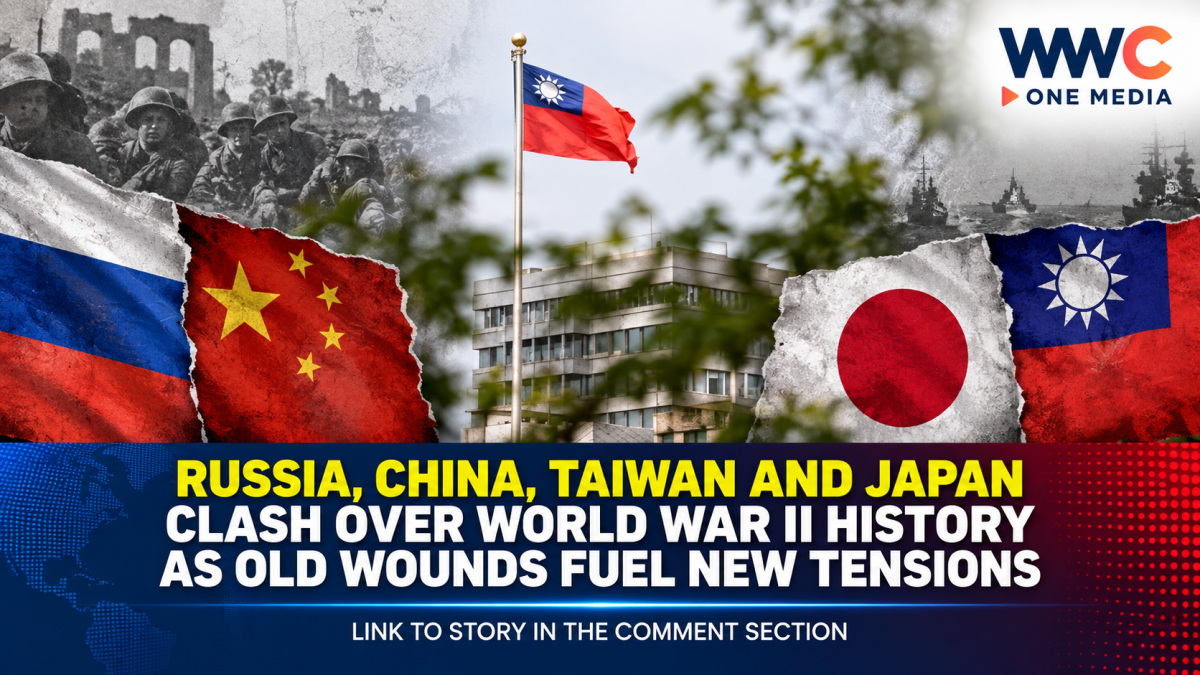
TAIPEI, Taiwan — More than eight decades after the end of World War II, the history of the conflict is once again at the centre of rising tensions between Russia, China, Taiwan and Japan.
A recent screening in Taiwan of a Soviet-era film portraying Japanese militarism has sparked concern in Taipei, where officials fear Moscow may be helping Beijing promote a narrative that portrays Japan as a growing military threat.
But behind the controversy lies a much bigger dispute.
Who really fought Japan? Who deserves credit for victory? And how is World War II still shaping Asia’s most dangerous geopolitical flashpoints today?
A Soviet Film Sparks Fresh Alarm in Taiwan
Russian representatives in Taiwan recently screened a decades-old Soviet film focused on Japan’s wartime militarism and the Soviet Union’s role in defeating Japanese forces.
The event drew attention far beyond its audience size.
Taiwanese authorities reportedly viewed the screening as potentially significant because of growing cooperation between Russia and China.
The concern is that historical narratives could now become part of a broader political and information battle — particularly as tensions rise over Taiwan and Japan takes a more active role in regional security.
For Taipei, history is not simply about the past. It may also be about shaping public opinion for the conflicts of the future.
Russia’s Role Came in the Final Weeks of the War
The Soviet Union entered the war against Japan in East Asia during its final weeks in 1945.
Soviet forces moved rapidly into Japanese-controlled northeastern China, helping reshape the balance of power in the region as Japan approached defeat.
After the war, Soviet troops withdrew from much of northeastern China.
However, Moscow also handed captured Japanese weapons to communist forces led by Mao Zedong.
That support would later become an important part of the wider political transformation of China.
After Mao’s communist forces defeated Chiang Kai-shek’s Republic of China government in the civil war, the Soviet Union quickly recognised the newly established People’s Republic of China in 1949.
The end of World War II had helped create the conditions for an entirely new political order in Asia.
Russia and Japan Still Have No Formal Peace Treaty
One of the war’s most remarkable unresolved legacies involves Russia and Japan.
At the end of World War II, Soviet forces took control of four islands off Japan’s northern coast.
Russia refers to them as part of the Kuril Islands, while Japan calls them the Northern Territories.
The territorial dispute has remained unresolved for decades.
As a result, Moscow and Tokyo have never signed a formal peace treaty officially ending their World War II hostilities.
The dispute remains a major source of tension between the two countries.
More than 80 years after the war ended, Russia and Japan are still divided by territory captured in its final days.
China’s View: A Massive National Sacrifice
China’s government presents World War II as a defining chapter in the country’s modern history.
Beijing emphasises the enormous human cost suffered during Japan’s invasion and occupation, with China describing the conflict as a long and brutal struggle against Japanese aggression.
China’s official narrative highlights both communist resistance and Soviet support.
Beijing describes China and the Soviet Union as major forces in the broader fight against fascism and portrays communist guerrilla forces as a central part of the resistance against Japan.
For China, remembering the war is also tied to national identity.
The conflict is presented as a period of immense suffering — but also one of national resistance and eventual victory.
That narrative remains deeply important to how Beijing views Japan, regional security and China’s own place in the modern world.
Taiwan Strongly Disputes Beijing’s Version of History
Taiwan, whose formal name remains the Republic of China, has a very different interpretation.
Taiwan’s government argues that Beijing’s communist government cannot claim full credit for winning a war that took place before the People’s Republic of China was founded in 1949.
During World War II, the Republic of China was the internationally recognised Chinese government.
Its forces fought Japanese troops while Chiang Kai-shek’s government formed an uneasy wartime alliance with Mao’s communist forces.
Taiwan itself was also under Japanese colonial rule at the time.
The Republic of China ultimately signed Japan’s surrender alongside other Allied powers.
Taiwan’s position is that nationalist forces carried much of the military burden against Japan, while Mao’s communist movement used the wartime period in part to strengthen its own forces.
For Taipei, the argument is not just historical — it is directly connected to the legitimacy of today’s governments on both sides of the Taiwan Strait.
The Civil War Resumed After Japan’s Defeat
Japan’s surrender did not bring lasting peace to China.
The uneasy alliance between Chiang Kai-shek’s nationalist government and Mao Zedong’s communist forces quickly collapsed.
China’s civil war resumed.
By 1949, Mao’s communist forces had emerged victorious on the mainland and established the People’s Republic of China.
Chiang Kai-shek and the Republic of China government relocated to Taiwan.
That outcome created the political division that continues to shape one of Asia’s most sensitive geopolitical disputes.
Beijing regards Taiwan as part of China and insists that eventual reunification is inevitable.
Taiwan rejects Beijing’s sovereignty claims and maintains that its future must be decided by its own people.
And at the heart of today’s Taiwan dispute is a political divide created in the aftermath of World War II.
Japan’s Wartime Past Remains Politically Explosive
Japan’s wartime actions continue to influence its relationships with several Asian neighbours.
Memories of military occupation, atrocities and colonial rule remain deeply sensitive in China and elsewhere in the region.
At the same time, Japan’s expanding defence capabilities have become a major source of debate.
Tokyo has increasingly strengthened its military posture in response to regional security concerns, including China’s growing military power and tensions around Taiwan.
China has repeatedly raised concerns about what it describes as a revival of Japanese militarism.
Japan, however, argues that its defence policies are necessary to respond to a rapidly changing security environment.
That means World War II history and modern military strategy are increasingly becoming part of the same political argument.
History Is Becoming Part of a New Information Battle
The controversy surrounding the Russian film screening highlights how historical memory can become a powerful political tool.
Governments do not simply debate what happened in the past.
They also debate what the past means today.
Different interpretations of World War II can influence public views about:
- Japan’s military expansion
- China’s political legitimacy
- Taiwan’s identity
- Russia’s role in Asia
- Territorial disputes
- Future regional alliances
- Security around the Taiwan Strait
For Taiwan, concern over historical narratives comes at a time when Russia and China have strengthened their strategic relationship.
Taipei fears that coordinated messaging could be used to weaken its growing ties with Japan and other democratic partners.
Why This Matters Now
The renewed debate over World War II comes as geopolitical tensions across East Asia continue to rise.
China and Japan have faced increasing diplomatic and security friction.
Taiwan remains under growing military and political pressure from Beijing.
Russia’s relationship with Japan has also deteriorated.
At the same time, the unresolved historical disputes continue to provide powerful language for governments seeking to explain modern threats.
The danger is that history can become more than a lesson — it can become a weapon.
The Bottom Line
More than 80 years after World War II, Russia, China, Taiwan and Japan are still fighting over its legacy.
Russia’s wartime role remains tied to its unresolved territorial dispute with Japan.
China and Taiwan continue to disagree over who deserves credit for defeating Japanese forces.
And Japan’s growing military role is once again being viewed through the shadow of its wartime past.
What makes the latest dispute especially significant is that these arguments are no longer confined to history books.
As tensions rise over Taiwan and the future of Asia, one haunting question is becoming harder to ignore: Is the region still arguing about World War II — or is the past now being used to prepare for the next major conflict?

Leave a Reply