
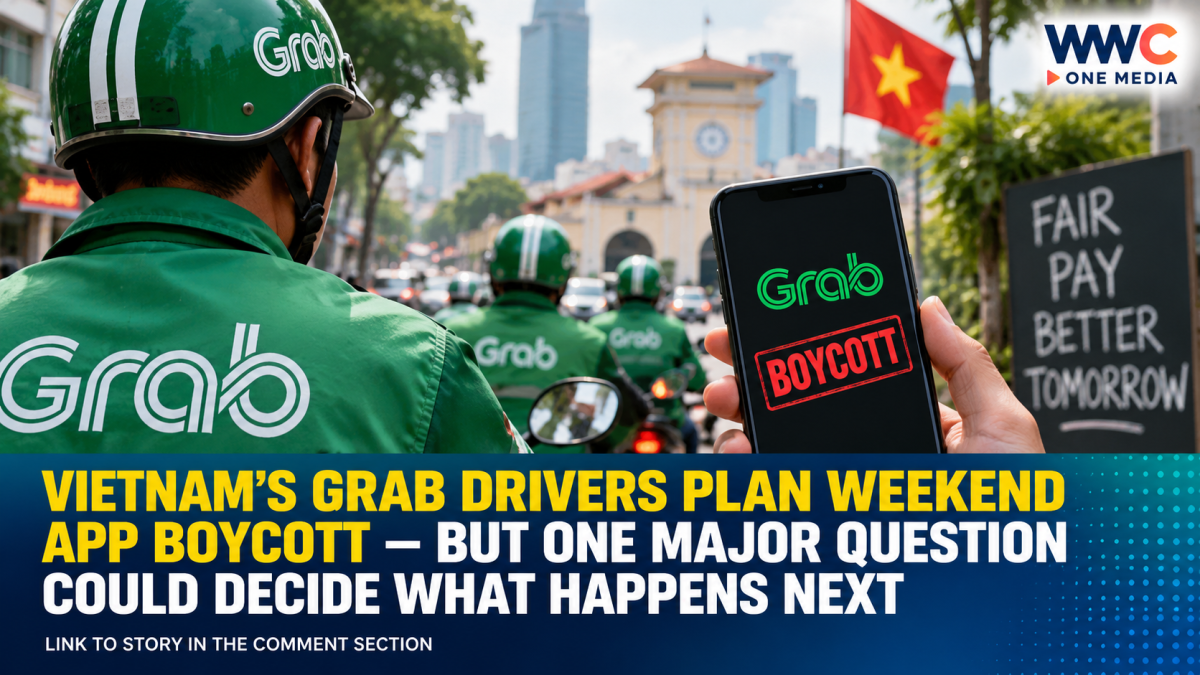
HANOI — Vietnamese Grab drivers are calling on colleagues to switch off the ride-hailing app for two days this weekend, escalating a growing backlash over payment changes that drivers say have pushed their earnings to unsustainable levels.
The planned boycott, scheduled for September 12 and 13, has gained momentum on social media as drivers share screenshots of what they describe as sharply reduced take-home income and urge fellow riders and drivers to stop accepting bookings.
At the centre of the campaign is a Facebook community known as the Vietnam Grab Driver Community, which has around 169,000 members. Posts circulating in the group call for drivers to go offline collectively in a push for what participants describe as fairer compensation.
Drivers Say New Payment System Has Slashed Their Income
The dispute centres on changes to Grab’s payment structure that drivers say were introduced in July.
According to reporting by Vietnam’s state-run VTC News, cited by Reuters and other outlets, drivers claim deductions can reach as much as 50% of a fare under the new structure.
The reported figures suggest motorcycle drivers could be left with roughly 2,600 Vietnamese dong per kilometre, while car drivers could receive about 6,000 dong per kilometre — before accounting for fuel, maintenance and vehicle depreciation.
For drivers who depend on the platform for their primary income, those additional operating costs are at the heart of the growing frustration.
Social Media Becomes the Protest Ground
Rather than organising a traditional street protest, drivers are using the platform economy’s own digital tools against it.
Screenshots of reduced earnings have circulated across Facebook, alongside calls for drivers to simply stop working and refuse ride requests over the weekend.
The strategy is straightforward: switch off the app and reduce the number of available drivers at the same time.
One message shared in the driver community urged colleagues to unite and temporarily go offline to demand fairer treatment, according to Reuters reporting.
Whether the boycott will attract enough participants to significantly disrupt Grab’s services remains unclear.
Grab Says It Is Speaking With Drivers
Grab said it is engaging with its driver community to listen to concerns, address questions and correct misinformation while working to keep its services operating normally.
The company’s response highlights the difficult balancing act facing ride-hailing platforms: drivers want higher and more predictable earnings, while companies must also manage operating costs, customer prices and competition in a rapidly evolving digital transport market.
But Some Drivers Fear What Happens If Grab Leaves
The anger over falling earnings is not shared without concern.
Amid calls for a boycott, at least some members of the driver community have warned that a major disruption could carry risks for workers who depend heavily on Grab for their livelihoods.
One driver expressed concern that if Grab were ever to withdraw from Vietnam, many drivers could be left without a comparable source of income.
That tension reveals the deeper issue behind the boycott: drivers are demanding better compensation from a platform that many of them also rely on for daily work.
Why the Vietnam Grab Boycott Matters
Grab is one of Vietnam’s major ride-hailing operators and also provides food delivery and other digital services, meaning any large-scale driver action could potentially affect commuters and consumers beyond the transport sector.
The planned September 12-13 boycott will now test whether online frustration can translate into meaningful collective action — and whether Grab’s engagement with drivers can ease tensions before the dispute grows further.
For now, the biggest question remains: how many drivers will actually switch off their apps this weekend?
If the boycott draws widespread participation, Vietnam’s ride-hailing industry could face one of its most visible tests yet over the balance between platform fees, driver earnings and the rising cost of making a living in the gig economy.



Leave a Reply