
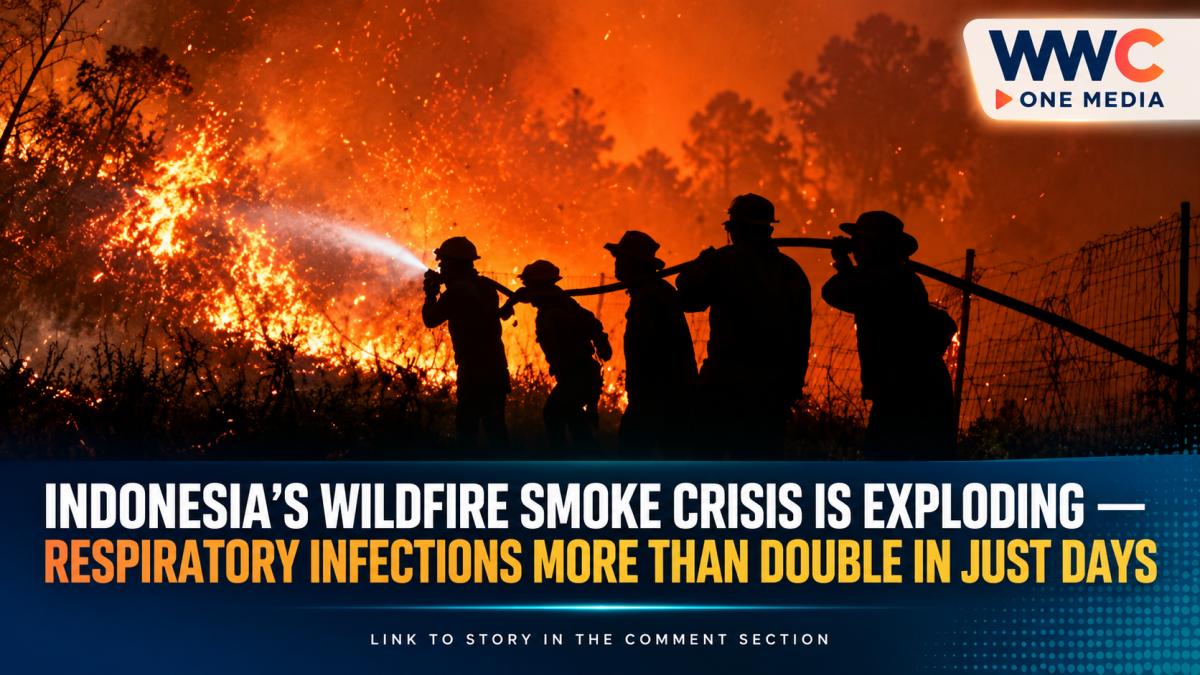
JAKARTA, Indonesia — Indonesia’s devastating wildfire and haze crisis is rapidly turning into a major public health emergency, with wildfire-related respiratory illnesses more than doubling in just over a week as thick smoke continues to blanket parts of Sumatra and Borneo.
According to Indonesia’s Health Ministry, 113,336 people had developed respiratory illnesses linked to wildfire pollution as of September 9, a dramatic increase from 50,891 cases recorded on September 1. The sharp rise comes as forest and peatland fires continue to produce hazardous smoke across some of the country’s hardest-hit regions.
The worsening crisis has raised fears that Indonesia — and neighboring parts of Southeast Asia — could face an even more serious health and environmental emergency if the fires continue through the peak of the dry season.
Wildfire Smoke Pushes Health System Into Emergency Response
Indonesia’s fires have been burning across large areas of forest and peatland, particularly on the islands of Sumatra and Borneo, where prolonged dry conditions and extreme heat have intensified the situation.
Health authorities have responded by sending nearly one million masks, hundreds of oxygen concentrators and thousands of medical workers to affected areas, according to Reuters reporting on the Health Ministry’s response.
The latest figures underscore how quickly the health impact of the fires is escalating.
Respiratory illnesses can spread beyond the immediate areas affected by flames because smoke and haze can travel long distances, exposing communities far from the original fire zones to hazardous air pollution.
More Than 1.4 Million Students Hit as Schools Move Online
The health crisis is also disrupting education across Indonesia.
More than 1.4 million students have been affected by school disruptions, with many schools shifting to remote learning as air pollution worsens. In Palembang, the capital of South Sumatra province, more than 250,000 students in 1,030 schools were affected by the move to online classes, according to the Associated Press.
The smoke has not remained confined to Indonesia.
Haze from the fires has spread across Southeast Asia, affecting neighboring Malaysia and Singapore, while reports indicate that smoke has also reached as far as the Philippines. The regional spread has intensified concerns over another major transboundary haze crisis.
Malaysia recently declared an emergency in the Sarawak town of Serian after air pollution reached critical levels, highlighting the growing regional consequences of Indonesia’s fire season.
Indonesia Faces Its Most Severe Fire Season in Years
Indonesia’s Forestry Ministry has warned that September remains a critical month in the battle against the fires.
CNA reported that Indonesia had already seen approximately 202,000 hectares burn by the end of July, with nearly half of that area — around 94,539 hectares — burned in July alone. The rapid spread has been fueled by a combination of the annual dry season and strong El Niño conditions that have brought hotter and drier weather.
Reuters has described the current wildfire season as Indonesia’s most intense in more than a decade, with severe drought conditions helping fires spread across vulnerable forests and peatlands.
Fire emissions have also surged sharply. Data reported by Reuters showed that Indonesian wildfire emissions between September 1 and 7 reached approximately 19.7 million metric tons of carbon dioxide, accounting for more than a third of global wildfire emissions during that period, according to Copernicus climate monitoring data.
Fires Spread Toward Indonesia’s New Capital
The wildfire emergency has expanded beyond traditional hotspots.
Reuters reported earlier this month that fires had begun spreading into areas near Nusantara, Indonesia’s under-construction new capital in eastern Borneo.
Around 400 hectares were reported burned near the new capital area, prompting authorities to call for additional cloud-seeding and water-bombing operations.
Indonesia has deployed dozens of aircraft and thousands of personnel to battle the fires, while international assistance is also increasing.
Japan has sent three CH-47 Chinook helicopters and personnel to assist Indonesian firefighting operations, with the aircraft expected to support water-bombing missions in some of the hardest-hit areas.
Pressure Mounts Over Land Burning and Enforcement
Indonesia’s wildfire crisis has also renewed scrutiny over land-clearing practices.
Authorities have arrested dozens of people suspected of starting fires, while investigations have also examined possible links between fires and companies operating in affected areas.
Government officials have taken action against several companies whose concessions were affected by fires, including permit suspensions and other enforcement measures as investigations continue.
Indonesia has struggled with recurring forest and peatland fires for decades, particularly during dry periods when fires can spread rapidly through highly flammable peat areas.
The Worst May Not Be Over Yet
Perhaps the most alarming warning is that Indonesia’s wildfire season may still have room to worsen.
Indonesia’s Forestry Minister Raja Juli Antoni has described September as a crucial period in the country’s fight against the fires, with meaningful rainfall not expected to provide significant relief until around early October, according to CNA.
That means millions of people could remain vulnerable to dangerous smoke exposure in the coming weeks.
With respiratory illnesses already surging past 113,000 cases, schools disrupted, air quality deteriorating and haze spreading across international borders, Indonesia’s wildfire crisis is no longer just an environmental disaster.
It is rapidly becoming a regional public health emergency — and officials are warning that the toughest part of the battle may not be over.


Leave a Reply