
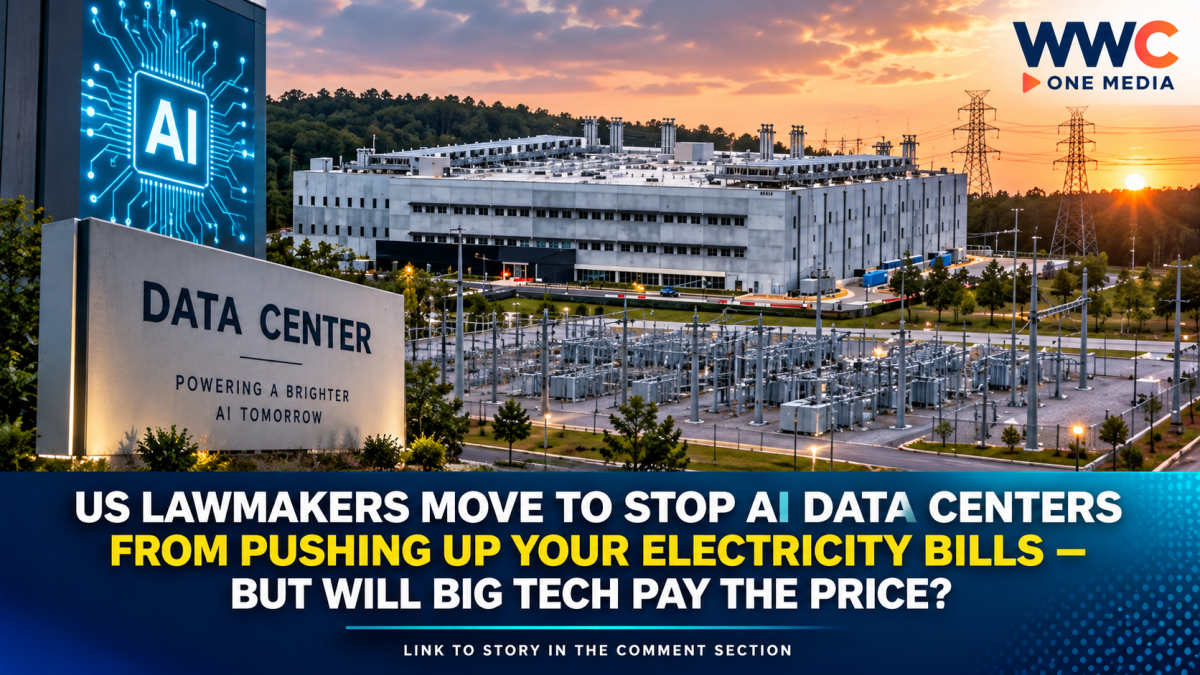
WASHINGTON — The explosive growth of artificial intelligence and massive data centers is now creating a new political battle in the United States: who should pay for the enormous amount of electricity needed to power the AI boom?
The U.S. House of Representatives is preparing to take up the bipartisan Ratepayer Protection Act, legislation aimed at preventing ordinary households and other electricity customers from being forced to absorb costs linked to the rapid expansion of energy-hungry data centers.
The planned vote comes as concerns grow across the United States that the race to build artificial intelligence infrastructure could place increasing pressure on electricity grids — and ultimately push utility bills even higher for consumers.
Reuters reported that House leadership is expected to bring the measure forward as lawmakers face growing public pressure over electricity affordability and the massive power requirements of new data centers.
AI Boom Meets America’s Power Bill
The debate comes at a critical moment for the U.S. electricity system.
According to the latest projections cited by Reuters from the U.S. Energy Information Administration, American electricity consumption is expected to reach new record highs in both 2026 and 2027, with the expansion of AI-focused data centers among the major forces driving demand higher.
Total U.S. electricity demand is projected to rise from approximately 4,195 billion kilowatt-hours in 2025 to 4,270 billion kWh in 2026, before climbing further to around 4,349 billion kWh in 2027, according to the EIA projections reported by Reuters.
That surge is forcing utilities and policymakers to confront an increasingly controversial question:
Should families and small businesses help pay for the new power plants, transmission lines and grid upgrades required by massive AI data centers? Or should the companies building them cover more of the costs themselves?
The proposed legislation seeks to put consumer protection at the center of that debate.
Why Data Centers Are Becoming a Political Flashpoint
Data centers have become essential infrastructure for artificial intelligence, cloud computing and the digital economy. But the facilities can consume extraordinary amounts of electricity, particularly as companies deploy increasingly powerful AI systems.
The problem is no longer limited to technology companies or utility executives.
Communities across the United States are increasingly questioning whether the rapid construction of data centers could lead to higher electricity costs, heavier pressure on local infrastructure and major new demands for power generation.
Reuters has reported that manufacturers and industrial electricity users in parts of the U.S. are also facing concerns about grid costs being spread across customers as utilities invest in infrastructure needed to accommodate massive new loads.
The issue has become politically sensitive ahead of the November elections, with Republicans and Democrats alike facing pressure from communities concerned about rising utility bills and the rapid expansion of AI infrastructure.
Axios reported that the House vote is being positioned as part of a broader effort to demonstrate action on electricity affordability and the costs associated with data center growth.
A Growing Divide Over Big Tech and AI Infrastructure
The congressional move also highlights a growing divide within U.S. politics over artificial intelligence.
While federal policymakers continue to emphasize America’s need to compete globally in AI, support for rapid data center expansion is increasingly colliding with local concerns about power prices, water use, land development and environmental impacts.
Reuters recently reported that political leaders in several states have begun adopting tougher positions on data centers as voter concerns grow. In Texas and other states, policymakers have increasingly questioned whether projected data center electricity demand is realistic and whether grid infrastructure can keep pace.
Texas, one of America’s biggest emerging AI infrastructure hubs, has already taken steps to examine new grid connection requests and concerns surrounding so-called speculative or “ghost” electricity demand from proposed data center projects.
That signals a major shift.
For years, states competed aggressively to attract technology investment. Now, some communities are beginning to ask whether the economic benefits of new data centers justify the pressure placed on local electricity systems.
Pressure Builds for Data Centers to Pay Their Fair Share
The Ratepayer Protection Act is part of a wider push in Washington to ensure that consumers are not left paying for infrastructure primarily built to support large corporate users.
Other lawmakers are also proposing broader federal reforms.
Representative Suhas Subramanyam of Virginia recently introduced a package of legislation focused on data center development, including proposals requiring large facilities to account for their energy and community impacts and contribute more directly to infrastructure costs associated with their operations.
The growing legislative activity reflects a fundamental change in the AI debate.
Until recently, much of the political conversation focused on AI innovation, jobs and national security.
Now, the conversation is increasingly shifting toward something voters see every month:
their electricity bill.
Can America Build Enough Power for AI?
The challenge for policymakers is that the United States is simultaneously trying to expand its AI industry while rapidly increasing electricity generation and grid capacity.
That will likely require enormous investments in transmission lines, power plants, energy storage and potentially nuclear generation.
Google and other major technology companies have already been exploring long-term energy agreements to secure reliable electricity for their growing AI operations.
In Iowa, for example, Reuters reported that Google signed a long-term agreement linked to the planned restart of the Duane Arnold nuclear power plant, highlighting how major technology companies are increasingly seeking dedicated sources of large-scale electricity.
Similar concerns are emerging internationally.
In Finland, political opposition parties have raised questions about electricity supply and affordability following Google’s massive planned investment in AI infrastructure and a long-term energy arrangement connected to nuclear power generation.
The global trend is clear:
AI is no longer just competing for computer chips and data. It is increasingly competing for electricity.
The Bigger Question: Who Pays?
Supporters of consumer protections argue that ordinary households should not be required to subsidize infrastructure built to support some of the world’s largest and most valuable technology companies.
Data center operators and technology firms, however, argue that AI infrastructure can generate investment, jobs and broader economic benefits — while also supporting America’s technological and national security interests.
The challenge for lawmakers will be finding a balance.
The United States wants more AI infrastructure.
Utilities need more investment.
Communities want reliable electricity.
And consumers want to know why their monthly power bills are rising.
The upcoming House vote could become an important test of whether Washington is prepared to make the rapidly expanding AI industry bear a larger share of the infrastructure costs it creates.
With U.S. electricity demand projected to reach record levels in the coming years, the fight over data centers may soon become one of the most important economic battles of the AI era.
The AI revolution is accelerating — but Congress is now asking a question millions of electricity customers may soon be asking too:
Will Big Tech power the future, or will ordinary consumers end up paying for it?



Leave a Reply