
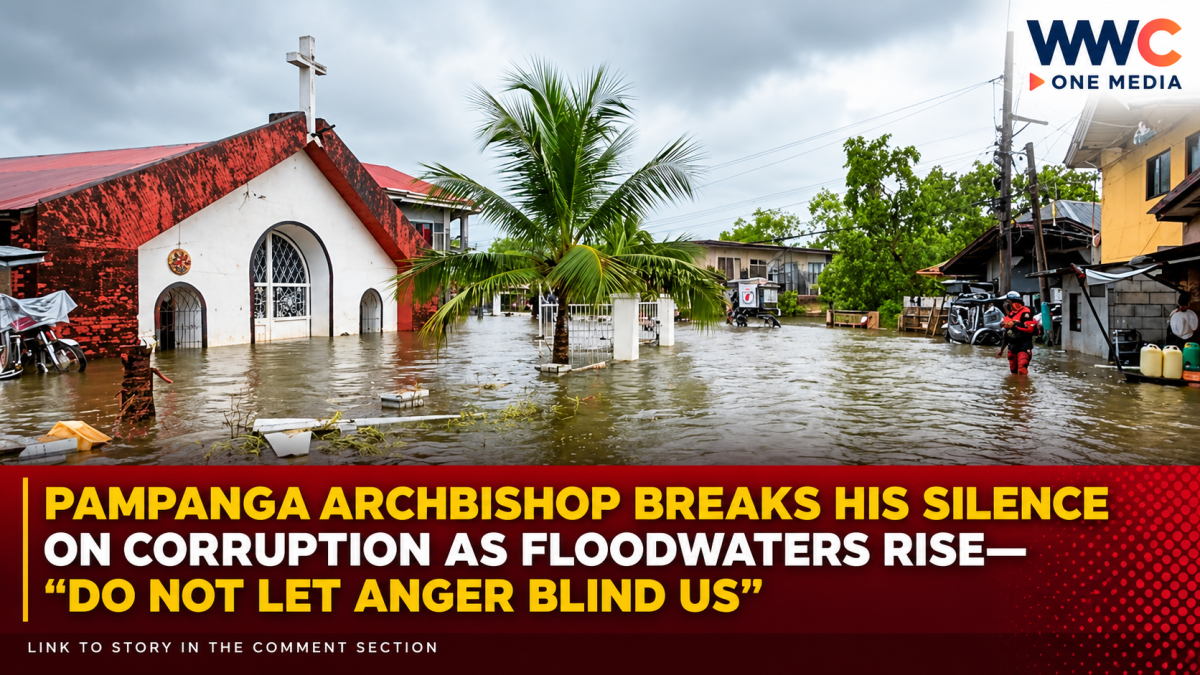
CITY OF SAN FERNANDO, PAMPANGA — As floodwaters continue to disrupt communities across Pampanga, Archbishop Florentino Lavarias has urged Filipinos to speak out against corruption and expose wrongdoing—but warned that the fight for accountability should be driven by a genuine desire for justice, not revenge.
Lavarias made the appeal during Pampanga’s celebration of the 70th anniversary of the canonical coronation of the Virgen de los Remedios, the province’s patroness, amid prolonged flooding that has affected communities across the province.
His message comes as public anger over flood-control spending continues to grow nationwide, with questions being raised over whether billions of pesos allocated for flood protection have actually delivered the infrastructure communities need.
The archbishop’s call echoes a broader movement within the Catholic Church and civil society demanding transparency, accountability and answers over alleged irregularities in flood-control projects.
‘Criticize corruption, but with good intentions’
Lavarias urged Filipinos not to remain silent when confronted with corruption or wrongdoing.
But he stressed that criticism should be rooted in the pursuit of what is right rather than personal retaliation.
The distinction is significant as public frustration continues to intensify in flood-hit areas where residents have been forced to endure prolonged inundation despite years of government spending on flood-control infrastructure.
The archbishop’s message effectively puts the focus on accountability without vengeance: expose wrongdoing, demand answers and pursue justice, but avoid allowing anger to become the motivation.
That appeal comes at a particularly sensitive moment for Pampanga, where flooding has become not only a disaster-management problem but also part of the national debate over infrastructure planning and alleged corruption.
Pampanga has endured weeks of flooding
The scale of the disaster underscores why the issue has become so emotionally charged.
The Philippine Information Agency reported that Pampanga was placed under a state of calamity on Aug. 12, 2026, after widespread flooding caused by continuous heavy rains and the enhanced southwest monsoon, or habagat.
At the time of the declaration, hundreds of barangays had already been affected, with hundreds of thousands of families impacted and significant agricultural losses recorded.
By early September, the situation remained severe.
The Philippine Daily Inquirer reported that Pampanga had experienced flooding for 34 days since Aug. 4, while the provincial government reported hundreds of flooded barangays across numerous municipalities. The flooding also prompted the Archdiocese of San Fernando to scale down the Virgen de los Remedios anniversary celebration and redirect donations toward food and other necessities for flood victims.
The province’s flooding has also affected major transportation routes.
Inquirer reported that Pampanga officials deployed equipment and personnel to help ease flooding along portions of the North Luzon Expressway in San Simon, where motorists had experienced severe traffic disruptions. Provincial officials also reported P1.339 billion in damage to crops, fisheries, machinery and farm structures.
Why corruption has become part of the flood debate
The archbishop’s remarks come against the backdrop of a much larger national controversy involving alleged irregularities in flood-control projects.
In Pampanga itself, complaints have been filed over alleged anomalies involving flood-control projects worth hundreds of millions of pesos.
Philstar reported that criminal and administrative complaints were filed against former Pampanga congressman Aurelio “Dong” Gonzales Jr., members of his family and several public works officials involving projects in the province. The complaints alleged problems including substandard infrastructure and other irregularities. Gonzales has denied wrongdoing, and one earlier complaint was reportedly dismissed by the Ombudsman for lack of merit.
The Manila Tribune likewise reported a P359.37-million plunder complaint involving alleged irregularities in flood-control projects along the Abacan River. The complainant presented video footage and geotagged material that he said showed collapsed structures, severe erosion and unfinished works. These remain allegations subject to investigation and legal proceedings.
The controversy is not confined to Pampanga.
The national investigation into alleged flood-control corruption has expanded substantially, with numerous contractors, government officials and politicians facing complaints or criminal cases.
Inquirer reported that the government’s investigation began gaining national attention after President Ferdinand Marcos Jr. exposed an allegedly nonexistent P55-million river-wall project in Bulacan, prompting scrutiny of thousands of flood-control projects nationwide.
More recently, the investigation has reached some of the country’s most prominent political figures. The Associated Press reported that former House Speaker Martin Romualdez was arrested on Sept. 7, 2026, in connection with a plunder case alleging kickbacks tied to flood-control and other government projects. Romualdez has denied the allegations.
Pampanga Church has spoken out before
Lavarias’ latest appeal also builds on the Archdiocese of San Fernando’s previous calls for accountability.
In September 2025, the archdiocese endorsed the symbolic ringing of church bells across its parishes as a show of pastoral support for public demands for transparency, accountability and justice concerning alleged corruption surrounding flood-control and other infrastructure projects.
That history makes the archbishop’s latest message more than an isolated statement.
It reflects an increasingly prominent position from church leaders that citizens should not simply accept recurring disasters as inevitable—and that public institutions must be scrutinized when government projects fail to protect communities.
Cardinal Pablo Virgilio David made a similar argument in late August, saying Filipino resilience should not become passive acceptance of corruption, incompetence or neglect. He called on citizens to demand answers about who designed, built, inspected and maintained flood-control projects and how public funds were spent.
Beyond resilience: Who should answer for recurring floods?
For Pampanga residents, the debate is deeply personal.
Flooding is not simply a political talking point when homes, farms, businesses, roads and livelihoods are repeatedly affected.
The province’s geography makes it particularly vulnerable: Pampanga serves as a major catch basin for the Pampanga River system, making flood management dependent on more than isolated projects in individual communities. Inquirer has previously highlighted the need for a broader approach to flood management in Central Luzon.
This is why Lavarias’ appeal for accountability carries particular weight.
The question is no longer simply how Filipinos can remain resilient when the waters rise.
It is also whether government projects are being planned, constructed and maintained effectively enough to prevent communities from facing the same crisis again and again.
And as investigations into alleged flood-control anomalies continue, the public is increasingly asking a much harder question:
If billions are being spent to keep communities safe from floods, why are so many Filipinos still being forced to endure the same devastation?
For Lavarias, the answer should begin with citizens willing to confront wrongdoing—but with justice, truth and the common good, rather than revenge, guiding the fight.


Leave a Reply