
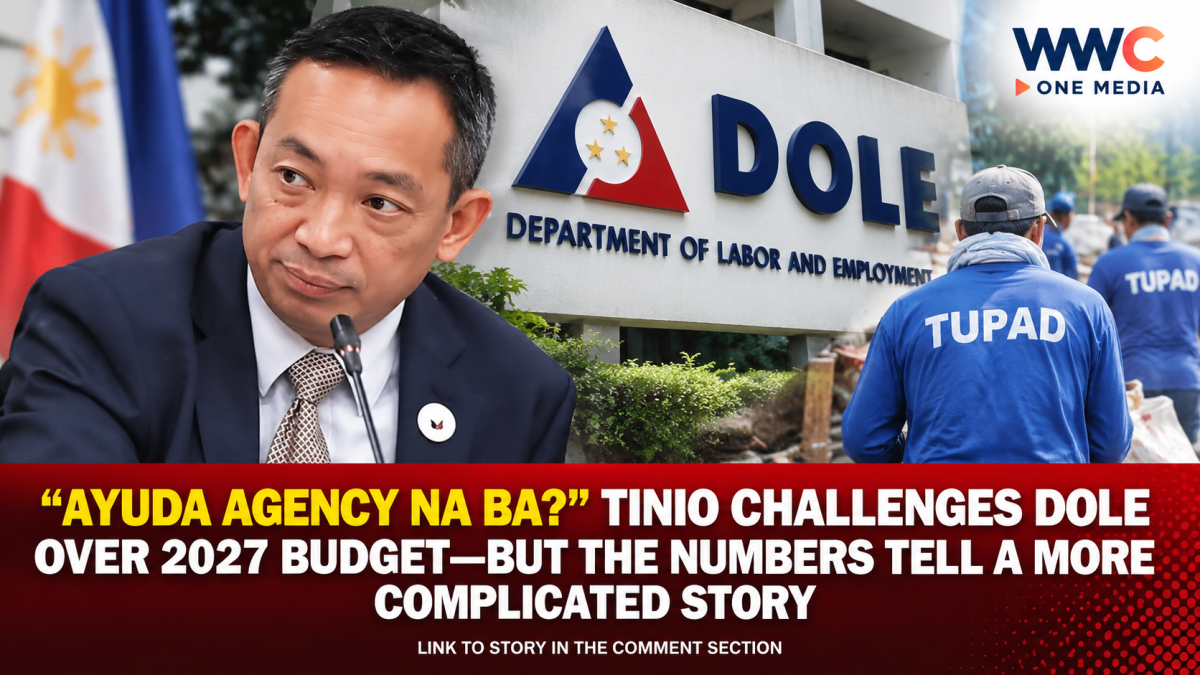
MANILA, Philippines — A proposed multibillion-peso budget for the Department of Labor and Employment (DOLE) has sparked a fresh debate in Congress, with ACT Teachers party-list Rep. Antonio Tinio questioning whether the agency is becoming more focused on distributing temporary assistance than creating long-term jobs for Filipino workers.
Tinio, the House deputy minority leader, raised the issue during discussions on the government’s proposed 2027 national budget, questioning the growing prominence of the Tulong Panghanapbuhay sa Ating Disadvantaged/Displaced Workers (TUPAD) program.
His criticism came as DOLE presented a proposed ₱20.95-billion budget for the department itself, while the combined proposed allocations for DOLE and its attached agencies reach about ₱47.06 billion for 2027.
Tinio asks: Is DOLE becoming an “ayuda agency”?
Tinio questioned the direction of DOLE, arguing that its primary responsibility should be to create decent employment, protect workers’ rights and improve working conditions—not primarily distribute short-term assistance.
In remarks reported by Abante, Tinio questioned whether DOLE had effectively become an “ayuda agency,” particularly because of the continued prominence of TUPAD years after the COVID-19 pandemic.
He also criticized what he described as the government’s continued reliance on temporary work assistance instead of investing more heavily in sustainable employment, skills development and worker protection.
The lawmaker specifically pointed to the contrast between TUPAD funding and other labor-related priorities, including technical and skills development.
But here’s the important part: TUPAD funding is actually going down
Despite the political criticism, the budget figures show a more complicated picture.
Under the proposed 2027 National Expenditure Program, TUPAD is allocated ₱11.03 billion, according to government budget documents. That’s significantly lower than the ₱21.28 billion appropriated for TUPAD under the 2026 General Appropriations Act—a reduction of about 48.2 percent.
BusinessMirror reported that DOLE is targeting approximately 672,776 beneficiaries for TUPAD in 2027, compared with about 1.48 million beneficiaries served as of August 2026.
So while Tinio’s criticism focuses on the role and prominence of TUPAD within DOLE’s mandate, the proposed 2027 allocation itself is not an increase from the current year’s GAA level.
Labor groups want a shift from temporary aid to permanent jobs
The controversy is not limited to Congress.
Labor groups Sentro and the Labor Education and Research Network (LEARN) have also called for a stronger emphasis on decent and secure employment, arguing that temporary assistance programs should not become substitutes for sustainable jobs.
The groups said TUPAD should be reviewed and redesigned toward what they called genuine public employment, while calling for stronger government support for labor inspection, enforcement of labor standards, labor justice, collective bargaining and wage policies.
Their position highlights the central issue behind the debate: whether short-term employment programs should remain a major instrument of government assistance or whether more public funds should be directed toward permanent employment and worker development.
DOLE says its 2027 priorities go beyond TUPAD
DOLE, for its part, has defended its broader 2027 spending priorities.
During its House budget presentation, Labor Secretary Francis Tolentino said the department’s priorities include creating more jobs, preparing workers for future industries, strengthening worker protection and improving access to labor services and justice.
DOLE said its employment strategy includes its “Trabaho Agad” initiative, while its “Future-Ready Manggagawa” program aims to equip workers with skills needed in an increasingly changing labor market.
The department also highlighted programs involving worker protection, labor justice, social protection and industrial peace.
The proposed budget also includes funding for other employment and livelihood programs. DOLE’s broader livelihood and emergency employment allocation, however, is projected to fall from ₱27.91 billion in 2026 to ₱19.31 billion in 2027, according to BusinessMirror.
Some programs are getting more funding
Not every employment program is facing a cut.
BusinessMirror reported that funding for the Government Internship Program (GIP) is proposed to increase substantially, reaching about ₱3.21 billion, compared with ₱1.16 billion in 2026.
Meanwhile, the DOLE Integrated Livelihood Program (DILP) is proposed to receive approximately ₱2.23 billion, lower than its 2026 allocation.
DOLE has also pointed to stronger spending on labor standards and enforcement, including increased funding for its Labor Laws Compliance System.
The bigger question: Jobs or temporary assistance?
The controversy ultimately raises a broader question about how the government should spend billions intended for Filipino workers.
TUPAD provides temporary employment to disadvantaged or displaced workers, allowing beneficiaries to earn income through short-term community-based work. For critics, however, temporary assistance cannot replace the creation of stable, decent-paying jobs.
For DOLE, the 2027 budget presentation shows an agency attempting to balance employment generation, skills development, labor protection and social assistance.
And that is where the debate over Tinio’s “ayuda agency” accusation becomes more complicated.
The issue is not simply whether TUPAD is getting more money. The proposed figures show a substantial reduction from the 2026 GAA. The bigger question is whether the remaining billions are being used in the most effective way to move Filipino workers from temporary assistance toward sustainable employment.
Congress will still deliberate on the proposed 2027 National Expenditure Program before the final budget is enacted, meaning the allocations—and potentially the government’s priorities—could still change during the legislative process.



Leave a Reply