
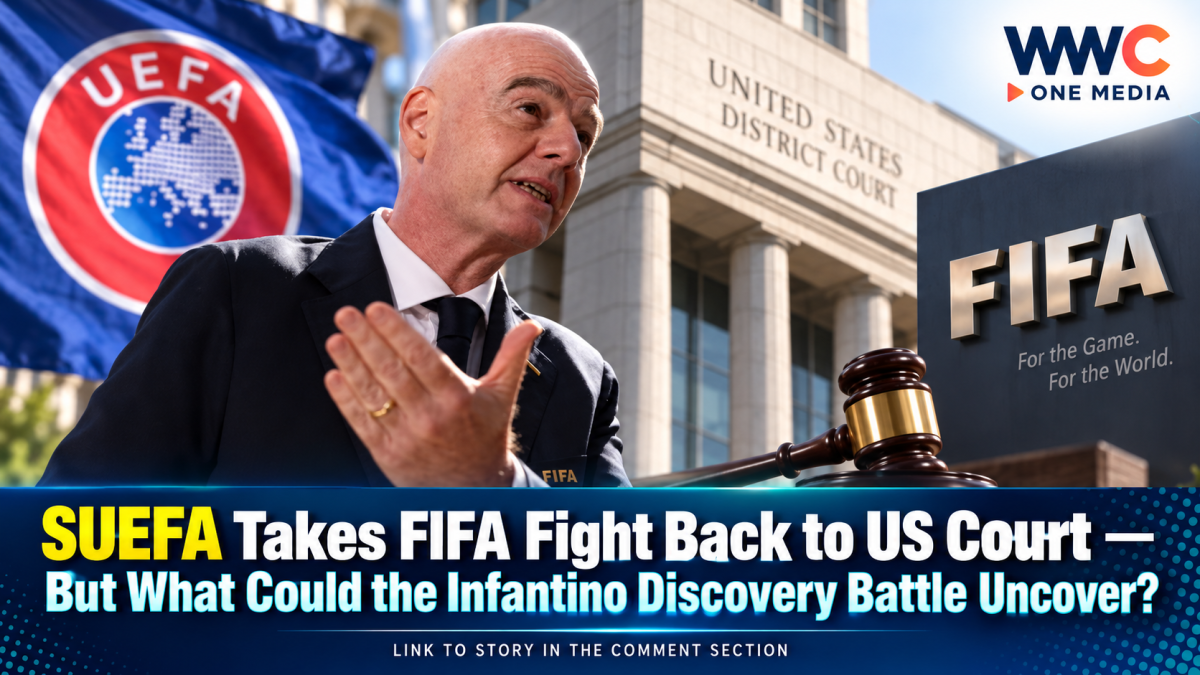
The latest court filing marks another escalation in the increasingly bitter dispute between European football’s governing body and FIFA over a controversial plan that was ultimately abandoned following widespread opposition.
According to Reuters, UEFA argued that FIFA (Americas) Inc. and FWC2026 US Inc. should not be allowed to intervene in UEFA’s discovery application because the companies are not targets of the subpoenas and would not be parties to any potential criminal proceedings in Switzerland.
What Is UEFA Trying to Obtain?
UEFA is seeking permission from a U.S. court to obtain documents and testimony from Thrive Capital Management and its founder, Joshua Kushner, as part of its investigation into FIFA’s now-abandoned FIFA Forward Enterprise (FFE) project.
The proposed venture would have transferred commercial rights connected to major FIFA competitions, including the men’s and women’s World Cups and the Club World Cup, into a new entity. UEFA has raised concerns about how the proposal was developed and whether FIFA’s governance procedures were properly followed.
The European governing body has said it is considering filing a criminal complaint in Switzerland against Infantino and potentially other FIFA officials or advisers over alleged mismanagement.
However, no criminal complaint or criminal charges have yet been filed in this case, and the allegations have not been proven in court.
FIFA Calls UEFA’s Move a ‘Smear Campaign’
FIFA has strongly rejected UEFA’s legal effort, describing the discovery applications as part of what it called a “smear campaign” against the organisation and its leadership.
In earlier court filings, FIFA’s American subsidiaries sought to intervene or delay UEFA’s discovery requests. FIFA argued that UEFA was pursuing evidence for criminal proceedings that it described as merely contemplated rather than existing.
UEFA has now pushed back, arguing that the two U.S. subsidiaries do not have a sufficient legal interest to enter the discovery fight.
According to Reuters, UEFA also argued that if confidential information is genuinely at risk, FIFA itself — rather than its American subsidiaries — would be the appropriate party to raise those concerns.
The court has not yet ruled on either UEFA’s discovery request or the subsidiaries’ attempt to intervene.
Why the FIFA Forward Enterprise Plan Became So Controversial
The legal dispute stems from one of the biggest governance controversies surrounding FIFA in recent months.
FIFA Forward Enterprise was linked to a proposal that would have brought private investment into FIFA’s commercial operations and involved a stake in the commercial rights of some of football’s biggest competitions.
The proposal faced strong resistance from UEFA and other football confederations before it was withdrawn on July 31. FIFA has maintained that the initiative was intended to support the future growth and development of football, while critics questioned the level of consultation and transparency surrounding the proposal.
The collapse of the plan has since become a major flashpoint in the wider power struggle between FIFA and several football bodies.
Pressure on Infantino Continues to Grow
The courtroom dispute is unfolding as Infantino faces increasing political pressure ahead of the next FIFA presidential election.
France’s Football Federation has withdrawn its support for Infantino’s re-election bid, with its leadership citing concerns over trust, governance and the abandoned commercial rights proposal. Several other European football bodies have also expressed concerns about FIFA’s decision-making.
Belgium has separately said it will withhold support for Infantino unless it receives satisfactory answers regarding governance concerns and the handling of a separate World Cup disciplinary controversy involving U.S. player Folarin Balogun.
Despite the growing criticism, Reuters reported that Infantino still has significant support among national football associations and remains in a strong position ahead of the presidential vote scheduled for March 2027.
What Happens Next?
The immediate question is whether the U.S. court will allow FIFA’s American subsidiaries to participate in the discovery proceedings.
If UEFA succeeds in obtaining the requested documents and testimony, the information could potentially be used as UEFA considers whether to pursue a criminal complaint in Switzerland.
But that remains a significant legal step away.
For now, the case is centered on access to evidence — not a criminal trial.
Still, the dispute could have consequences far beyond the courtroom.
With FIFA’s leadership already facing growing scrutiny over governance, transparency and the future direction of world football, the documents UEFA is seeking may become another major chapter in the battle over who controls the game’s most powerful organisation.
The court has yet to decide — but as UEFA and FIFA dig deeper into their legal positions, the bigger question is becoming impossible to ignore: what, if anything, will the discovery process reveal?



Leave a Reply