
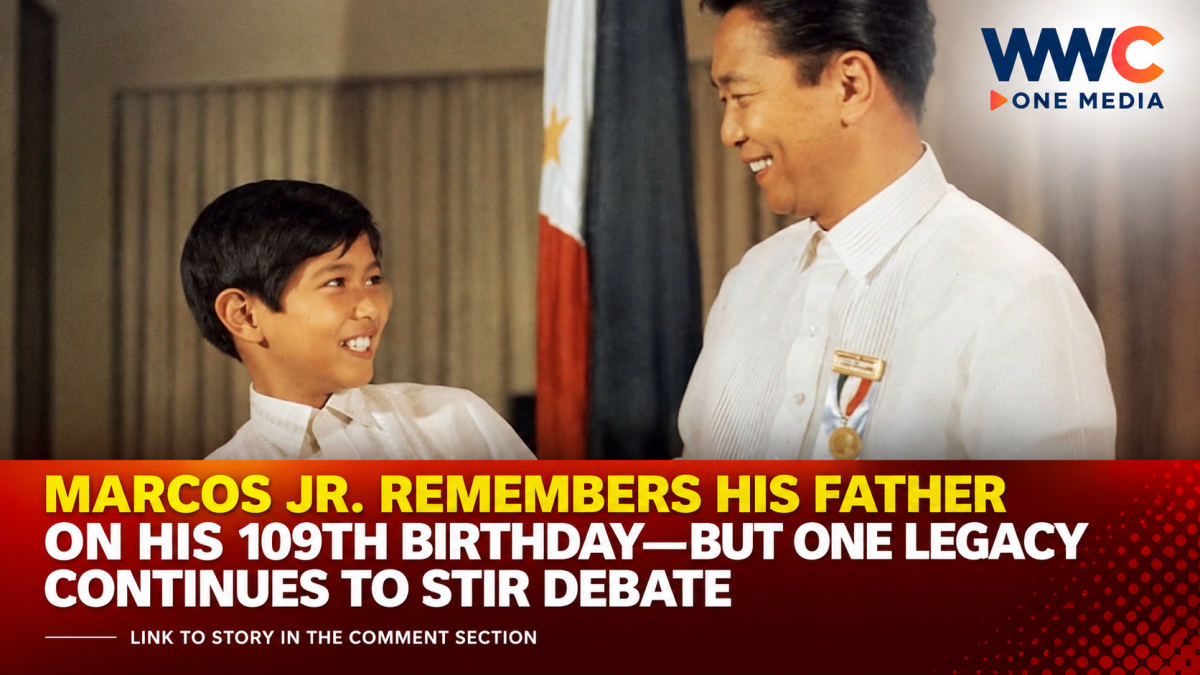
President Ferdinand Marcos Jr. is marking the 109th birth anniversary of his late father and namesake, former President Ferdinand E. Marcos Sr., with commemorative activities in Ilocos Norte—a yearly observance that continues to place the Marcos family’s political legacy in the national spotlight.
Marcos Sr. was born on September 11, 1917, in Sarrat, Ilocos Norte. He served as president of the Philippines from 1965 until 1986, when he was removed from power during the People Power Revolution. He later went into exile in Hawaii, where he died in 1989.
For this year’s anniversary, Malacañang declared September 11 a special non-working day throughout Ilocos Norte, allowing residents to participate in activities commemorating the former president’s birth anniversary. Acting Executive Secretary Ralph Recto signed Proclamation No. 1421 on September 8.
The declaration is part of an annual tradition in the province, where the Marcos family maintains deep political and historical ties.
A father’s influence on the President
Marcos Jr. has repeatedly spoken about the influence his father continues to have on his approach to public service.
During last year’s 108th birth anniversary commemoration, the President described his father’s lessons as a source of guidance, emphasizing the importance of putting the national interest and the welfare of Filipinos first.
He also recalled his father’s advice not to choose the easy path when faced with difficult decisions, saying that doing what is right can sometimes mean taking the harder route.
In another reflection released by the Philippine Information Agency in October 2025, Marcos Jr. said he still turns to his father’s experiences when confronting difficult decisions in government, asking himself what his father might have done in a similar situation.
That continuing influence has made the annual birthday commemoration more than a family remembrance—it has also become an occasion for Marcos Jr. to articulate how he views his father’s legacy and its relevance to his own presidency.
Ilocos Norte prepares to mark the occasion
According to reports from PNA, ABS-CBN and Philstar, the special holiday is intended to give residents of Ilocos Norte an opportunity to participate in commemorative activities honoring Marcos Sr.
The province has historically held Masses, wreath-laying ceremonies and other activities connected to the former president’s birth anniversary.
Last year, Marcos Jr. attended a thanksgiving Mass and wreath-laying ceremony in Batac City, where he spoke about the values he said his father instilled in him.
The 2026 observance comes as the Marcos family continues to maintain a significant political presence in Ilocos Norte. A House bill separately seeks to make September 11 an annual special non-working holiday in the province in honor of Marcos Sr.’s birth anniversary; the measure had passed the House of Representatives as of May 2026 and was transmitted to the Senate.
A legacy that remains deeply contested
While Marcos Jr. and his supporters continue to highlight his father’s contributions, discipline and nationalist ideals, the elder Marcos’ presidency remains one of the most contested periods in Philippine history.
Marcos Sr. declared martial law in 1972 and remained in power until his ouster in 1986. His administration has been associated with extensive human-rights abuses, political repression and allegations of corruption, issues that continue to shape public debate surrounding the Marcos name.
At the same time, supporters of the former president continue to point to infrastructure projects, economic programs and his administration’s emphasis on national development.
That conflicting assessment means each Marcos Sr. commemoration carries significance beyond the birthday itself.
For Marcos Jr., however, the anniversary remains deeply personal. His public remarks have consistently framed his father’s memory around lessons of leadership, service and responsibility—while the broader country continues to debate what that legacy ultimately means.
And as the Marcos family marks another anniversary, one question remains difficult to escape: how much of the father’s legacy will continue to shape the son’s presidency—and the Philippines beyond it?



Leave a Reply