
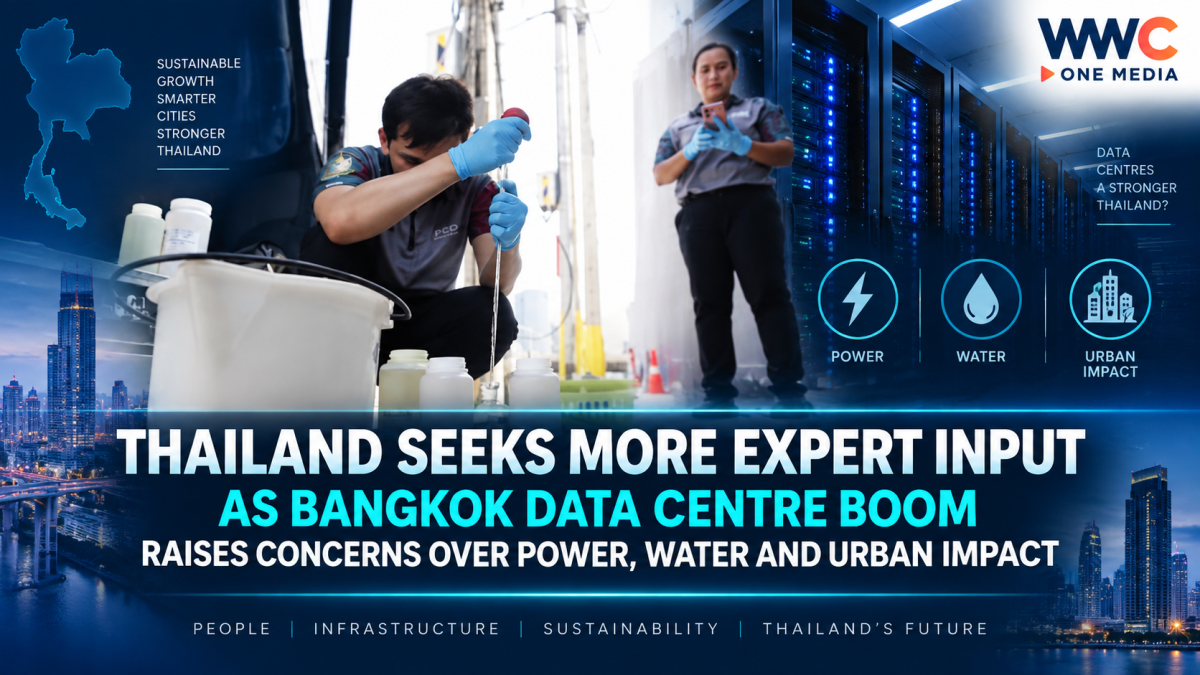
BANGKOK — Thailand is seeking more expert input on the rapid expansion of data centres in and around Bangkok as authorities confront growing concerns over electricity demand, water consumption, urban planning and the long-term benefits of the country’s booming digital infrastructure sector.
The move comes as Thailand takes a closer look at a massive wave of proposed data centre investments, with officials seeking to balance the economic opportunities created by artificial intelligence and cloud computing against the growing pressure these facilities could place on public infrastructure.
The issue has become increasingly urgent after authorities moved to review a large number of data centre projects nationwide while new standards are being developed. The review is focusing on power demand, water use, environmental effects, site selection and the economic value generated for Thailand.
Bangkok’s Data Centre Boom Faces a Reality Check
Data centres have become one of Southeast Asia’s fastest-growing infrastructure sectors as global technology companies race to expand cloud computing and AI capabilities.
Thailand has positioned itself as an increasingly attractive destination for these investments because of its location, digital infrastructure and access to regional markets.
But the rapid growth has raised a critical question:
Can Bangkok’s infrastructure handle an explosion in energy-hungry data centres?
Recent reports indicate that Thailand is reviewing 166 data centre projects, including facilities already under construction and others awaiting approval, as policymakers work on a clearer national framework.
Power Demand Emerges as a Major Concern
One of the biggest issues facing authorities is electricity.
Large data centres can require enormous amounts of power to operate servers, cooling systems and backup infrastructure around the clock.
Officials are now examining how proposed projects could affect Thailand’s electricity system and whether the costs of supplying massive amounts of energy could eventually affect other users.
The government is reportedly considering stricter standards for major facilities, including requirements connected to energy consumption and infrastructure capacity.
The concern is not unique to Thailand.
Across Southeast Asia, governments are increasingly confronting the growing electricity demands of data centres as AI technology drives a new wave of infrastructure development. Malaysia, another major regional data centre hub, has also reported sharply rising power consumption linked to the sector.
Water Use Also Under the Spotlight
Data centres need extensive cooling systems to prevent equipment from overheating.
Depending on the technology used, this can require significant amounts of water.
Thailand’s planned review is therefore expected to examine whether projects have sufficient water resources and whether their operations could create pressure on local communities.
The issue is particularly sensitive as climate conditions and water availability can vary dramatically across Thailand.
Experts are also expected to examine whether facilities should be required to adopt more efficient cooling technologies or closed-loop systems designed to reduce water consumption.
Where Should Data Centres Be Built?
Location has emerged as another major concern.
Data centres require large amounts of land, electricity infrastructure and connectivity.
But poorly planned projects could create conflicts with nearby communities or place additional pressure on already congested urban infrastructure.
Thailand’s review is expected to include stronger consideration of site selection and the distance between major data centre facilities and surrounding developments.
Officials are also working toward a more centralised system that would allow agencies to track where projects are located, how much electricity and water they require and what approvals they have received.
Government Wants More Than Just Big Investment Numbers
Thailand has attracted growing interest from global technology and infrastructure investors.
But authorities are increasingly asking whether large investments alone are enough.
The government wants to assess what long-term benefits data centres can deliver to Thailand, including:
- Job creation
- Technology development
- Digital skills
- Local business opportunities
- Energy investment
- Innovation
- Tax revenue
- Environmental sustainability
The broader policy debate is shifting from simply attracting more data centres to ensuring that projects provide meaningful economic value without placing an unfair burden on public utilities and communities.
Why Experts Are Being Asked to Weigh In
The rapid development of AI has changed the economics of data centres.
Traditional cloud facilities were already major consumers of electricity.
But AI infrastructure requires even more computing power, creating a new generation of extremely energy-intensive facilities.
That makes expert input increasingly important.
Urban planners, engineers, environmental specialists, electricity experts and technology industry representatives could all play a role in determining how Thailand manages future growth.
The challenge is particularly complex because a data centre can generate significant economic activity while also creating substantial infrastructure demands.
Getting the balance wrong could either discourage investment or leave communities and public utilities struggling to keep up.
Thailand Does Not Want to Kill the Data Centre Boom
Despite the growing scrutiny, Thailand is not signalling that it wants to abandon the sector.
Instead, the government appears to be trying to build clearer rules before the country’s data centre expansion grows even larger.
Officials have stressed the importance of creating standards covering infrastructure, environmental impacts, economic returns and appropriate locations.
That could eventually make Thailand more attractive to long-term investors by providing greater regulatory certainty.
But the temporary review has also created pressure to develop new rules quickly so that investment momentum is not lost to competing countries.
The Bottom Line
Thailand is seeking deeper expert input as Bangkok and the rest of the country face a rapidly expanding data centre boom that could transform the digital economy — but also place enormous pressure on electricity, water and urban infrastructure.
With dozens of projects under construction and many more awaiting approval, authorities are now reviewing how data centres should be regulated, where they should be built and what benefits they must deliver.
The race to become a regional AI and cloud computing hub is far from over. But Thailand is now facing a difficult question: how can it welcome the world’s biggest technology investments without allowing the digital boom to overwhelm the infrastructure ordinary people depend on every day?




Leave a Reply