
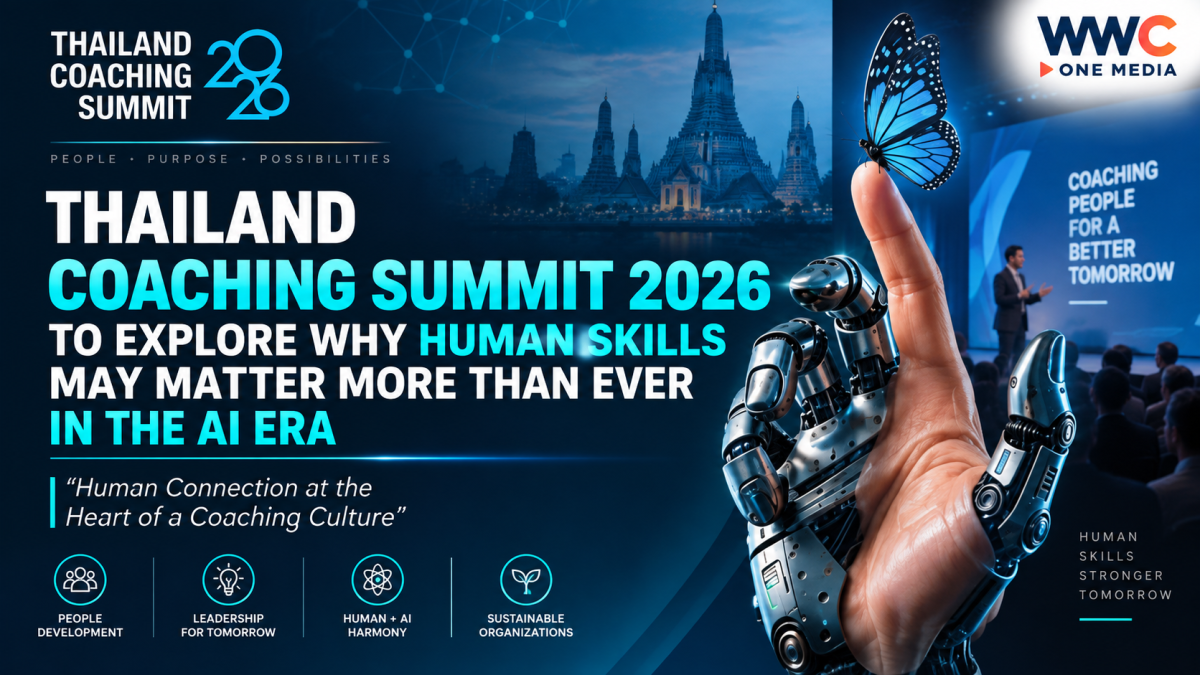
BANGKOK — As artificial intelligence rapidly changes how businesses operate and how professionals make decisions, a major gathering in Thailand is set to ask a question becoming increasingly important across the modern workplace: What will humans do better than AI?
The Thailand Coaching Summit 2026, scheduled for November 11 in Bangkok, will bring together executives, organisational development leaders and professional coaches to examine the changing role of leadership, human connection and coaching in an increasingly AI-driven world.
The event is expected to focus on how organisations can build stronger coaching cultures while redefining the value of human skills as AI becomes more deeply integrated into daily work. The summit is set to feature seven sessions, 22 speakers and moderators, and more than 500 participants.
AI Is Changing the Workplace — But Can It Replace Human Connection?
Artificial intelligence can now analyse information, generate ideas, automate tasks and assist with decision-making at remarkable speed.
But as AI becomes more capable, organisations are increasingly confronting another challenge: Which human abilities will become even more valuable?
Leadership, empathy, trust, communication, self-awareness and the ability to build meaningful relationships are among the areas expected to take centre stage at the Thailand Coaching Summit.
The growing conversation around human-AI collaboration reflects a wider shift in the workplace. The question is no longer simply whether companies should adopt AI, but how humans and machines can work together without losing the qualities that make effective leadership and teamwork possible.
Coaching Faces a New Challenge in the Age of AI
The rapid rise of AI is also forcing coaches, consultants and experts to rethink their roles.
People can increasingly turn to AI for instant answers, advice and information — often before speaking with another person.
That has created difficult questions for professionals whose work depends on expertise and personal interaction.
If AI can provide answers in seconds, what makes a human coach valuable?
A growing view among coaching professionals is that the answer may lie not simply in providing information, but in understanding context, building trust, asking the right questions and helping people navigate complex personal and professional decisions.
The broader coaching conversation is increasingly centred on what remains uniquely human as AI becomes more capable.
Leadership May Need to Become More Human — Not Less
One of the central challenges facing organisations is how to embrace advanced technology without creating workplaces that feel increasingly disconnected.
AI may improve efficiency, automate repetitive work and provide valuable insights.
But technology cannot automatically create trust inside a team.
It cannot guarantee that employees feel heard.
And data alone cannot always explain the emotions, motivations and conflicts that influence human behaviour.
This is why many workplace and HR discussions in Thailand have increasingly focused on balancing technological progress with human-centred leadership.
Recent industry events have highlighted the importance of combining AI capabilities with empathy, human connection and leadership that understands people rather than simply measuring performance.
What Will the Thailand Coaching Summit Explore?
The November summit is expected to focus on issues including:
- The changing role of leaders in the AI era
- Building stronger coaching cultures
- Human-AI collaboration
- Leadership development
- Trust and communication
- Organisational transformation
- Human skills that remain critical in an increasingly automated workplace
The discussions are expected to bring together business leaders, development professionals and coaches at a time when companies are reassessing not only how people work, but what skills they will need to remain valuable in the future.
AI Can Assist — But Humans Still Define the Direction
One of the biggest fears surrounding AI is that machines will eventually replace people across a growing number of professions.
But another possibility is emerging.
Instead of simply replacing humans, AI may force people to move away from tasks that machines can perform efficiently and focus more heavily on areas involving judgement, relationships, creativity, responsibility and emotional intelligence.
Recent research into AI-assisted coaching and human-AI collaboration has also raised concerns about over-reliance on technology, suggesting that effective systems may need to support human development rather than simply take control of tasks.
That could make the role of coaches and leaders even more important.
The future may not belong to humans who compete directly against AI. It may belong to those who understand how to use AI without surrendering the skills that technology cannot easily replicate.
Why This Conversation Matters for Thailand
Thailand is moving deeper into an AI-powered economy, with businesses across sectors increasingly adopting automation, data analytics and intelligent technologies.
But technological transformation also creates pressure on workers and leaders to adapt.
Employees may need new technical skills.
Managers may need to lead teams working alongside AI.
And organisations may need to rethink how they develop people.
That makes the human side of the AI revolution increasingly important.
Technology may change how people work — but leadership could determine whether those changes actually make workplaces better.
The Bottom Line
Thailand Coaching Summit 2026 is set to put one of the AI era’s biggest questions under the spotlight: as machines become smarter, what makes humans indispensable?
The November gathering will bring together hundreds of executives, coaches and organisational leaders to explore leadership, coaching cultures and the changing relationship between people and technology.
As AI takes over more routine tasks, the value of empathy, trust, judgement and genuine human connection may only grow.
The AI revolution may be changing the future of work — but Thailand’s coaching leaders are preparing to argue that the most important technology in the workplace may still be the human being using it.



Leave a Reply