
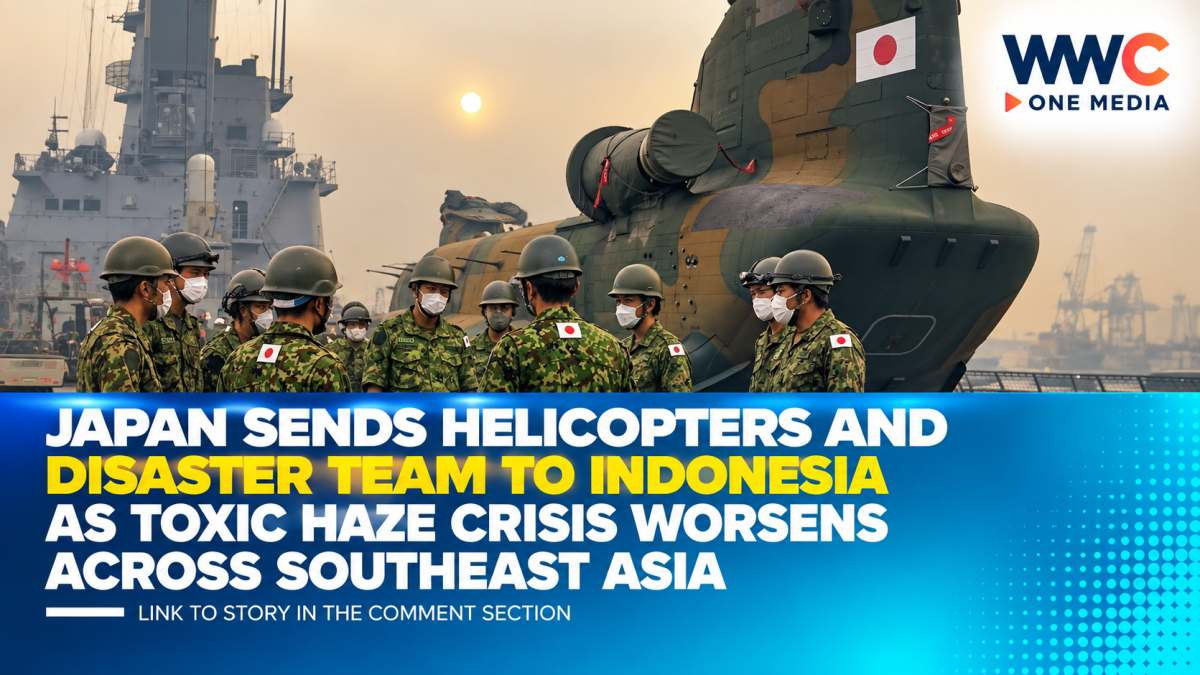
JAKARTA — Japan has deployed helicopters, a military transport vessel and hundreds of personnel to Indonesia as devastating forest and land fires continue to blanket parts of Southeast Asia in toxic haze, triggering a worsening public health emergency.
The Japanese disaster relief mission arrived in West Kalimantan on Sept. 10, bringing three CH-47 Chinook helicopters aboard the landing ship JS Kunisaki to support Indonesia’s massive firefighting operation.
The helicopters are expected to join efforts to battle fires in some of the hardest-hit areas of Borneo, where prolonged drought and extreme weather have helped flames spread across forests and peatlands.
The deployment marks a major milestone for Japan, with the operation described as the Japan Self-Defense Forces’ first known overseas firefighting mission.
Japan Steps In as Indonesia Battles One of Its Worst Fire Crises
Japan’s assistance follows a request from Indonesia as authorities struggle to contain fires that have spread across large parts of Sumatra and Borneo.
Tokyo dispatched:
- Three CH-47 Chinook helicopters
- The landing ship JS Kunisaki
- Hundreds of disaster relief and military personnel
Japan’s government had announced the disaster relief deployment in late August, citing humanitarian concerns and the close relationship between the two countries.
Japanese and Indonesian personnel are now coordinating preparations before the helicopters begin firefighting operations.
More Than 113,000 People Hit by Respiratory Illnesses
The crisis is no longer just an environmental disaster.
Indonesia’s health authorities reported that respiratory illnesses linked to the wildfire haze had surged dramatically, with more than 113,000 people affected as of Sept. 9.
The figure was more than double the number reported just over a week earlier.
More than 12.5 million people across seven provinces have reportedly been exposed to smoke and haze, forcing authorities to distribute masks, oxygen equipment and other emergency medical supplies.
The fires have been especially severe in Sumatra and Borneo, while the haze has also affected neighbouring countries, including Malaysia and Singapore.
Schools Shut as Millions of Children Face Dangerous Air
Children are among those most severely affected by the worsening air quality.
More than 1.4 million students have been forced into remote learning as schools close or suspend normal classes due to hazardous haze conditions.
In Palembang alone, hundreds of thousands of students have been affected after schools shifted to online learning to protect children from the dangerous smoke.
The growing number of school closures has turned the wildfire emergency into a major education crisis as well.
Authorities have said in-person classes can resume only when air conditions improve.
Why Indonesia’s Fires Are So Difficult to Stop
Indonesia’s annual fire crisis has been made significantly worse this year by an exceptionally severe dry season and El Niño-related weather conditions.
The flames have spread rapidly across forests and peatlands, which can be especially difficult to extinguish because fires can continue burning beneath the surface.
Authorities have already deployed dozens of aircraft for:
- Water bombing
- Cloud seeding
- Aerial surveillance
- Emergency logistics
But firefighting operations face major challenges, including difficult terrain and limited access to water in remote areas.
More than 202,000 hectares of land had reportedly burned between January and July, with further fires continuing into August and September.
Japan’s Chinooks Could Strengthen Water-Bombing Operations
The three Japanese CH-47 Chinooks will provide additional heavy-lift capability to Indonesia’s firefighting effort.
The helicopters are being prepared for water-bombing missions in Kalimantan, one of the regions hardest hit by the fires.
Indonesia has already mobilised major air and ground resources, but the scale of the emergency has prompted growing international support.
Japan’s deployment comes as Indonesia receives assistance and support from several international partners amid fears that the haze crisis could continue spreading across national borders.
The disaster has also renewed memories of previous transboundary haze emergencies that affected millions of people across Southeast Asia.
A Crisis That Has Gone Beyond Indonesia’s Borders
The smoke from Indonesia’s fires is increasingly becoming a regional problem.
Hazardous haze has affected air quality in neighbouring countries, raising concerns about respiratory illnesses and the wider economic consequences of prolonged pollution.
The crisis demonstrates how a fire burning in one part of Southeast Asia can quickly become an international emergency.
Flights, schools, businesses and public health systems can all be affected when thick smoke travels across borders.
For Japan, the mission also represents a new form of international disaster cooperation.
The deployment comes as Tokyo and Jakarta continue strengthening their relationship, with disaster relief becoming another important area of cooperation between the two countries.
The Bottom Line
Japan has stepped into Indonesia’s worsening wildfire emergency with helicopters, a military transport ship and hundreds of personnel as toxic haze spreads across the region.
The Japanese CH-47 helicopters are set to reinforce firefighting operations in Kalimantan, while Indonesia battles fires that have already burned vast areas of land and contributed to a sharp surge in respiratory illnesses.
With more than 113,000 people reportedly suffering respiratory problems and over 1.4 million students affected by school disruptions, the crisis is rapidly becoming one of Southeast Asia’s most serious environmental and public health emergencies of 2026.
But as international help begins arriving, the biggest question remains: can Indonesia and its regional partners bring the fires under control before the toxic haze pushes millions more people into danger?
WWC ONE MEDIA J.M.D



Leave a Reply