
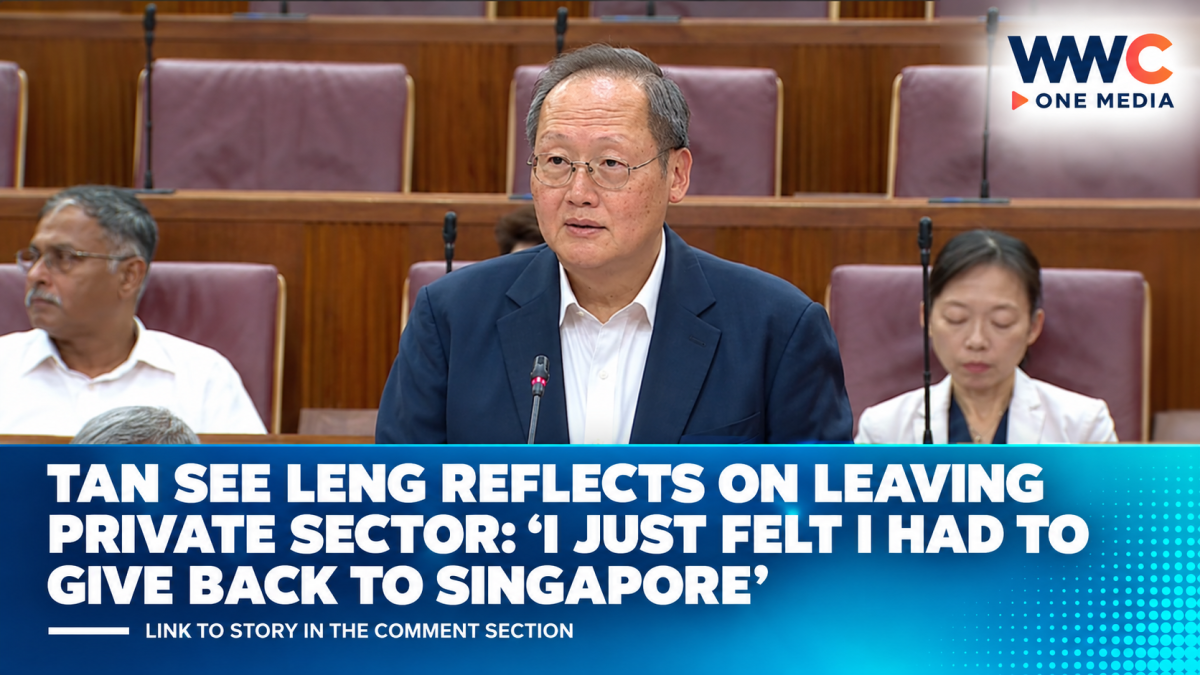
SINGAPORE — Minister for Trade and Industry (Energy and Industry) Tan See Leng has offered a deeply personal perspective on Singapore’s heated political salary debate, saying he would never have entered politics if money had been his main consideration.
Speaking in Parliament on Sept. 10 during the debate over proposed adjustments to political salaries, Dr Tan reflected on the difficult decision to leave a successful private-sector career and enter public service.
For him, the move was ultimately about something far more personal than compensation.
“I just felt I had to give back to the country,” he said, explaining why he chose a path that came with significant personal, professional and financial sacrifices.
‘If Money Was My Primary Consideration, I Would Never Have Entered Politics’
Dr Tan’s remarks came as Singaporeans continue debating planned changes to the salaries of political office holders and Members of Parliament.
The issue has generated strong public reactions, particularly as many Singaporeans continue to face concerns over living costs, jobs and economic uncertainty.
But Dr Tan said his own experience demonstrated why the decision to enter politics cannot be reduced to a simple calculation about salary.
Before joining politics, he had built a career in the private sector. Leaving that world to enter government meant stepping away from an established professional path and taking on a dramatically different set of responsibilities.
He told Parliament that if financial gain had been his main motivation, politics would not have been his choice.
A Decision That Came With Personal Sacrifice
Dr Tan also reflected on the realities of transitioning into public service.
He said there were times when he wished he had a longer runway and had been better equipped before taking on the demands of political office.
The transition involved more than simply changing jobs.
Political leaders face:
- Intense public scrutiny
- Long working hours
- Major responsibilities affecting the country
- Reduced privacy for themselves and their families
- Difficult trade-offs between public service and personal life
Dr Tan’s reflections added a personal dimension to a debate that has largely focused on numbers and salary benchmarks.
Behind every discussion about ministerial pay is another question: What does Singapore need to do to persuade capable people to leave established careers and take on the pressures of public office?
Why Tan Says Salary Still Matters
Despite saying money was not his personal motivation, Dr Tan argued that compensation still plays an important role in Singapore’s ability to attract future leaders.
His concern was not simply about existing ministers.
It was about the next generation.
Dr Tan warned that if entering public service becomes too costly personally and financially for too many capable Singaporeans, the country could eventually reduce the pool of people willing to step forward.
That, he argued, could become a far bigger problem than the cost of political salaries themselves.
Singapore’s government has consistently defended competitive political salaries as necessary to attract capable people from different backgrounds — including professionals in their 30s and 40s who may be building careers, raising families and carrying significant financial responsibilities.
Singapore’s Political Salary Changes
The government has accepted recommendations from an independent committee reviewing the political salary framework.
Existing political appointment holders will receive a one-off adjustment of up to 9 per cent from Oct. 15, 2026, depending on individual circumstances, including performance.
Future adjustments will also depend on performance and responsibilities rather than automatically moving everyone immediately to the revised benchmark.
The revised framework raises the benchmark salary for an entry-level ministerial position, although the government has said ministers will not immediately receive the full amount.
The changes mark the first salary adjustment for political office holders in about 15 years.
Public Concerns Remain
The government has acknowledged that political salaries are an emotional and sensitive issue.
Critics have questioned the timing of the increases, particularly as Singaporeans deal with higher living costs and uncertainty surrounding employment and economic changes.
During the parliamentary debate, MPs and Nominated MPs raised concerns relayed by residents, including questions about how ministerial performance should be measured and whether more transparency should be provided about actual remuneration.
The Workers’ Party supported the immediate adjustments being implemented during the current term but differed with the government over the longer-term formula used to benchmark political salaries.
Prime Minister Lawrence Wong has said the issue is politically difficult but argued that avoiding it would not be the responsible approach if Singapore wants to maintain a strong pool of future leaders.
Tan’s Personal Story Changes the Conversation
Dr Tan’s speech stands out because it shifts the focus away from how much ministers are paid and towards what people give up to enter politics.
His message was not that politicians should be shielded from criticism.
Instead, his argument was that Singapore must honestly consider whether talented professionals will continue stepping forward if the personal cost becomes increasingly difficult to bear.
For Dr Tan, the answer to his own decision was clear.
He did not enter politics for the money.
He entered because he believed he had a responsibility to give back to the country.
But he also made clear that Singapore cannot assume every capable person will be able to make the same sacrifice under any circumstances.
The Bottom Line
Tan See Leng’s emotional reflection has added a powerful new dimension to Singapore’s political salary debate.
The minister said he would never have entered politics if money had been his primary consideration, describing his decision to leave the private sector as a personal desire to give back to Singapore.
Yet his bigger warning was aimed at the future.
Singapore may be able to find capable leaders today — but can it continue attracting them tomorrow if entering public service demands an increasingly heavy personal and financial sacrifice?
As the debate over political pay continues, Dr Tan’s message may leave Singaporeans with an even bigger question than how much ministers should earn:
What is the real cost of convincing the country’s best people to serve?
WWC ONE MEDIA J.M.D




Leave a Reply