
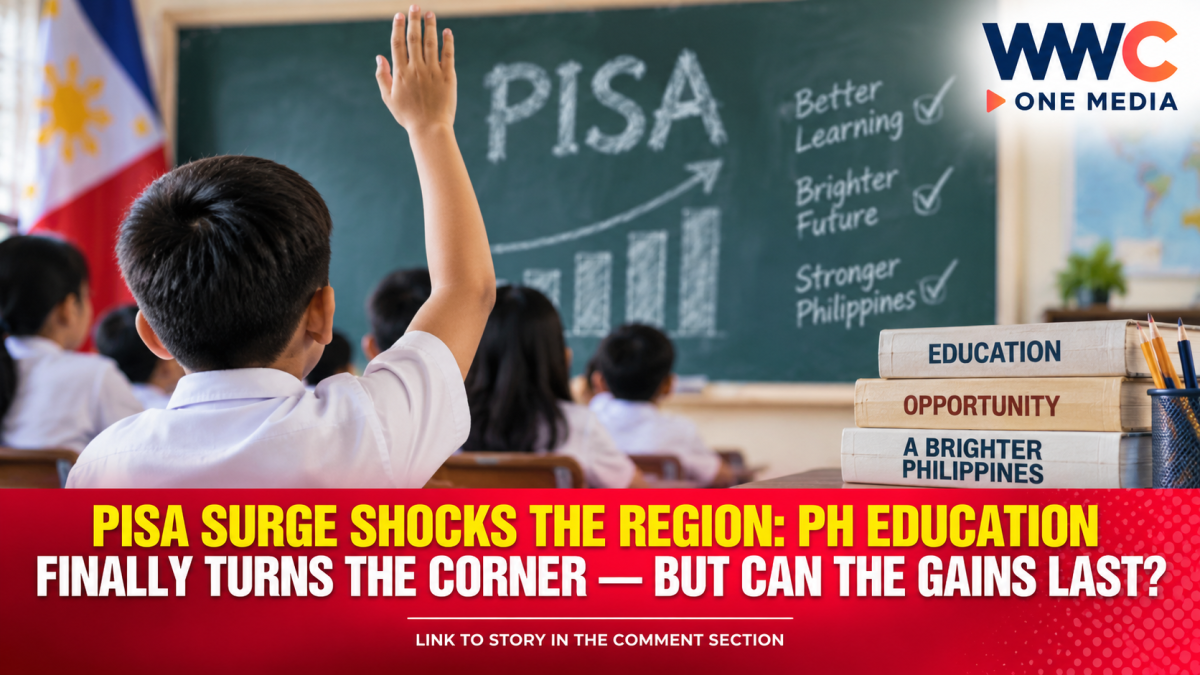
MANILA, Philippines — The Philippines’ surprising jump in the latest global education assessment is doing more than improving the country’s numbers on paper—it is giving fresh momentum to a reform movement that increasingly brings together government, educators, parents and the private sector.
The country’s 2025 Programme for International Student Assessment (PISA) results showed substantial gains in all three core areas: reading, mathematics and science. Filipino 15-year-olds scored 367 in reading, 371 in mathematics and 373 in science, representing increases of 20, 16 and 17 points, respectively, from 2022.
The improvement has prompted officials and education advocates to argue that years of reforms and increased investment may finally be producing measurable results.
But there is a catch: the Philippines is improving, yet it remains well below OECD average performance.
And that is why the latest PISA numbers may be less a victory lap than a test of whether the country can sustain reform for the next decade.
FROM EDUCATION CRISIS TO MEASURABLE GAINS
The latest results mark a dramatic change from the Philippines’ first PISA participation in 2018, when the country ranked near the bottom across the major assessment areas.
Education Secretary Sonny Angara described the 2025 results as evidence that Filipino learners can make meaningful progress when reforms are sustained and properly supported.
The Organisation for Economic Co-operation and Development’s 10-year trend analysis identified the Philippines as the fastest-improving country in reading over the period covered, while the country was also among the most improved in mathematics.
The Philippines also moved in the opposite direction of the broader OECD trend between 2022 and 2025, with OECD average scores declining in reading, mathematics and science while Philippine scores increased.
That contrast is one of the strongest reasons officials are viewing the latest results as significant.
MORE STUDENTS ARE REACHING THE BASIC PROFICIENCY LEVEL
The improvement is not limited to average scores.
The percentage of Filipino students reaching at least Level 2, considered the baseline proficiency level in PISA, also increased.
According to the reported 2025 results:
- Reading: 31%, up from 24% in 2022
- Mathematics: 21%, up from 16%
- Science: 32%, up from 23%
That means a larger share of Filipino learners demonstrated minimum proficiency than in the previous assessment cycle.
Still, the figures reveal just how much work remains.
Only about one in five Filipino students reached Level 2 in mathematics, while fewer than one-third reached that threshold in reading and science.
THE BUSINESS COMMUNITY IS NOW PART OF THE EDUCATION CONVERSATION
The PISA improvement comes as government and business groups have increasingly pushed a whole-of-society approach to education reform.
The Philippine Business for Education (PBEd), for example, has backed DepEd’s strategy of using public-private partnerships to accelerate the construction of classrooms and modernize the country’s education infrastructure.
DepEd has identified a massive classroom shortage, with its PPP infrastructure program targeting more than 100,000 classrooms over several projects.
But the private sector’s role is being framed as more than simply building classrooms.
Business and education advocates have pushed for partnerships involving digital learning, teacher training, curriculum development, workforce preparation and learning recovery.
That matters because the country’s education crisis is not simply an infrastructure problem.
It is also a learning, teacher-support and technology problem.
EDUCATION IS BEING TREATED AS AN ECONOMIC STRATEGY
Angara has increasingly connected education reform with the Philippines’ long-term economic competitiveness.
Better learning outcomes could eventually mean a stronger pool of workers capable of competing for higher-value industries and technology-driven jobs.
The Education secretary has pointed to the country’s young population as a potential economic advantage—but only if Filipino learners acquire the skills businesses will need in the future.
That is where the private sector’s interest becomes particularly important.
For companies, improving education means potentially developing a larger pool of workers who are better prepared for technology, digital services, engineering, manufacturing, business and other higher-skilled industries.
In other words, education spending is increasingly being viewed not only as social spending, but as human-capital investment.
GOVERNMENT HAS PUT MORE MONEY INTO EDUCATION
The reform push has also received a significant increase in government funding.
Angara told InsiderPH that education received its first P1-trillion budget in 2026, with education spending reaching roughly 4.3% of GDP, moving closer to international benchmarks.
DepEd has simultaneously pursued programs aimed at addressing learning gaps, including the Academic Recovery and Accessible Learning (ARAL) Program, teacher development, curriculum reforms, classroom construction and digital initiatives.
The department has also sought to reduce administrative burdens on teachers so they can spend more time on instruction.
These interventions are now being watched against the PISA results to determine which reforms are actually producing measurable improvements.
BUT THE NUMBERS ALSO REVEAL A BIG PROBLEM
Celebrating the gains without acknowledging the remaining gap would be misleading.
EDCOM 2 reported that Philippine scores remained substantially below OECD averages:
- Science: 109 points below the OECD average
- Reading: 94 points below
- Mathematics: 92 points below
There are also serious infrastructure and resource gaps.
Nearly 48% of Filipino students were in schools where insufficient learning materials were reported as a hindrance to instruction, while 58% were in schools affected by inadequate physical infrastructure, according to EDCOM 2’s assessment of the PISA data.
So while the country has moved forward, the distance to high-performing education systems remains substantial.
THE NEXT CHALLENGE: DON’T LET THE MOMENTUM DIE
Perhaps the most important message coming from education officials is that PISA improvement is not the finish line.
Angara has warned that fixing the country’s education system will require approximately another decade of sustained reforms and funding.
EDCOM 2 has similarly called for consistency in implementation and continued investment rather than short-term responses tied to individual administrations.
The commission’s National Education and Workforce Development Plan 2026–2035 lays out a longer-term reform roadmap, reflecting the view that the country’s learning crisis cannot be solved within a single budget cycle or political term.
Senate President Win Gatchalian has also said the PISA gains should help guide deliberations over the 2027 national budget, particularly spending on learning recovery, early childhood development and teacher education.
A NEW TEST FOR GOVERNMENT AND BUSINESS
The latest PISA results have therefore created an unusual opportunity.
For the first time in years, the conversation is not solely about how badly Philippine students are performing.
It is also about what worked—and how to scale it.
Government now faces pressure to protect funding for programs that produce results.
Business leaders face a choice about whether to deepen their involvement beyond individual corporate social-responsibility projects.
Teachers need sustained training and support.
Parents and communities need to remain part of the learning process.
And students ultimately need to see the benefits inside their classrooms—not simply in an international ranking.
The Philippines has finally produced a PISA story that sounds different from the ones that came before.
But the harder story begins now.
Can the country turn one impressive assessment cycle into a decade-long transformation of Philippine education?
Or will the latest gains become another promising moment that fades before the next crisis arrives?



Leave a Reply