
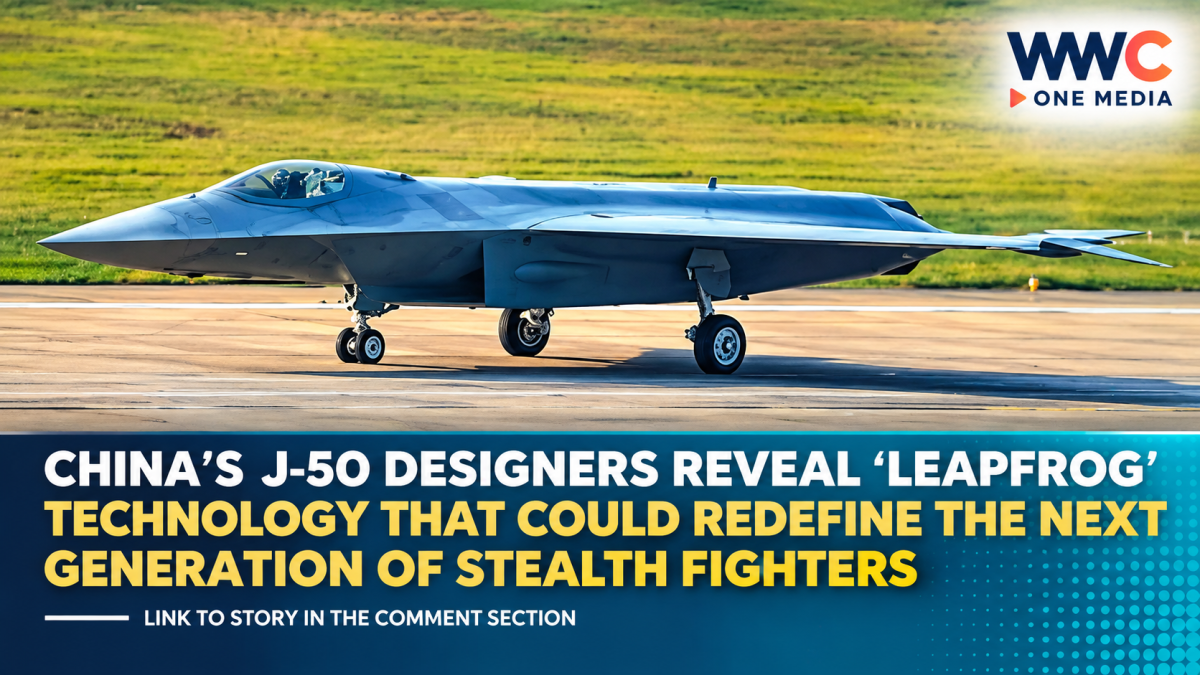
BEIJING — Engineers linked to the development of China’s next-generation stealth fighter have revealed new details about technologies they believe could help the country make a major leap in future air combat — as Beijing races against the United States and other military powers to develop sixth-generation aircraft.
The focus is on the aircraft widely known as the J-50, an unofficial designation used by analysts for a mysterious tailless stealth fighter associated with China’s Shenyang Aircraft Corporation.
While Beijing has not officially confirmed the aircraft’s programme or specifications, the J-50 has been repeatedly photographed and analysed since emerging publicly in late 2024. New information from designers is now offering a glimpse into the technologies being explored for China’s future combat aircrafT.
A ‘Leapfrog’ Strategy for China’s Future Fighters
China’s next-generation fighter programmes are increasingly focused on more than simply building faster or stealthier aircraft.
The emerging concept involves combining advanced aerodynamics, stealth, sensors, computing power, artificial intelligence and potentially uncrewed aircraft into an integrated combat system.
This approach could allow future fighters to operate as the command centre of a wider network of drones, sensors and weapons rather than functioning as individual aircraft operating largely alone.
The J-50’s unusual tailless design has already attracted significant attention. Images analysed by aviation specialists suggest a highly streamlined configuration intended to reduce radar signatures, while its distinctive wing design and apparent thrust-vectoring features could help compensate for the aerodynamic challenges of operating without conventional tail surfaces.
The J-50’s Strange Design Is Raising Big Questions
The aircraft associated with the J-50 programme is believed to feature a tailless lambda-wing configuration, twin engines and unusual articulating wingtip control surfaces.
Those swivelling wingtips are among the design’s most distinctive features and could potentially help the aircraft maintain control and manoeuvrability without traditional vertical and horizontal tail surfaces.
Analysts have also identified signs of advanced sensor integration and a highly streamlined structure designed around low observability.
However, many details remain uncertain.
China has not publicly released official specifications, meaning the J-50’s name, exact role, performance and eventual operational configuration remain the subject of outside analysis rather than confirmed government information.
China Is Not Building Just One Future Fighter
One of the most significant developments in the global race for next-generation air power is that China appears to be testing more than one radically different stealth aircraft concept.
Alongside the smaller Shenyang design commonly called the J-50, another much larger aircraft unofficially known as the J-36 has also been seen conducting flight tests.
The J-36 and J-50 appear to represent very different approaches to future air combat.
The larger J-36 is associated with long-range operations and a much bigger airframe, while the J-50 appears to be a smaller and potentially more agile design.
That could indicate that China is exploring multiple roles rather than betting everything on a single sixth-generation fighter concept.
AI Could Become a Powerful Weapon — But China’s Engineers Are Warning of Risks
Artificial intelligence is expected to play an increasingly important role in future military aviation.
AI systems could potentially process massive amounts of sensor data, help pilots identify threats and coordinate aircraft with uncrewed systems.
But Chinese aerospace engineers have also publicly warned about a major danger: AI hallucinations.
Engineers associated with China’s next-generation fighter research have cautioned that AI-generated information can appear convincing while containing false technical details or conclusions that violate real-world physical and operational constraints.
Their warning highlights a critical challenge for future military aviation.
The more powerful AI becomes, the more important it may become to ensure that human operators and engineers can distinguish reliable information from plausible but incorrect outputs. (South China Morning Post)
The Real Race May Be About Networks, Not Just Jets
The global competition over sixth-generation fighters is increasingly becoming a competition over entire combat ecosystems.
Future aircraft are expected to feature deeper integration with:
- Advanced sensor networks
- Artificial intelligence
- Uncrewed aircraft
- Long-range weapons
- Secure data links
- Electronic warfare systems
- Space-based and ground-based intelligence networks
The United States is developing the F-47 under its Next Generation Air Dominance programme, while the US Navy is also moving toward a decision on its future F/A-XX fighter programme.
China’s parallel development of multiple next-generation aircraft is adding urgency to the global competition for future air superiority. (Reuters)
China’s Desert Test Expansion Adds to the Pressure
China is also expanding infrastructure linked to advanced military aviation testing.
Recent satellite imagery analysis has pointed to a major expansion of facilities at Lop Nur in Xinjiang, a remote area associated with Chinese aerospace and weapons testing.
The expansion comes as the country’s next-generation aircraft programmes continue attracting international attention.
Analysts believe expanded facilities could support faster development and testing of increasingly complex aircraft, although publicly available evidence does not establish the exact relationship between every facility and individual fighter programme. (The Economic Times)
Can China Leapfrog Existing Fighter Technology?
That is now the central question.
China already operates advanced aircraft, including the J-20 stealth fighter, but the next generation is expected to demand much more than improved radar evasion.
The goal appears to be a dramatic integration of stealth, sensors, computing and autonomous systems.
If successful, China’s future aircraft could potentially leap beyond traditional fighter concepts by acting as highly connected platforms controlling and sharing information across an entire combat network.
But there is still a major gap between an experimental prototype and an operational military aircraft.
Developing a sixth-generation fighter requires years of testing, engine development, software validation and manufacturing work.
And despite the growing number of images and reports, much of the J-50 programme remains officially unconfirmed. (South China Morning Post)
The Bottom Line
China’s J-50 programme is becoming one of the most closely watched developments in the global race for next-generation stealth technology.
The aircraft’s tailless design, unusual control surfaces and apparent focus on advanced systems suggest that Chinese aerospace engineers are exploring ways to move beyond conventional fighter designs.
But the biggest transformation may not be the aircraft itself.
The future of air combat could depend on whether nations can successfully connect fighters, AI, sensors and uncrewed aircraft into a single intelligent combat network.
China appears determined to make that leap.
And as the United States accelerates its own next-generation fighter programmes, the race is no longer just about who builds the fastest stealth jet — but who can build the smartest air combat system first.
WWC ONE MEDIA J.M.D




Leave a Reply