
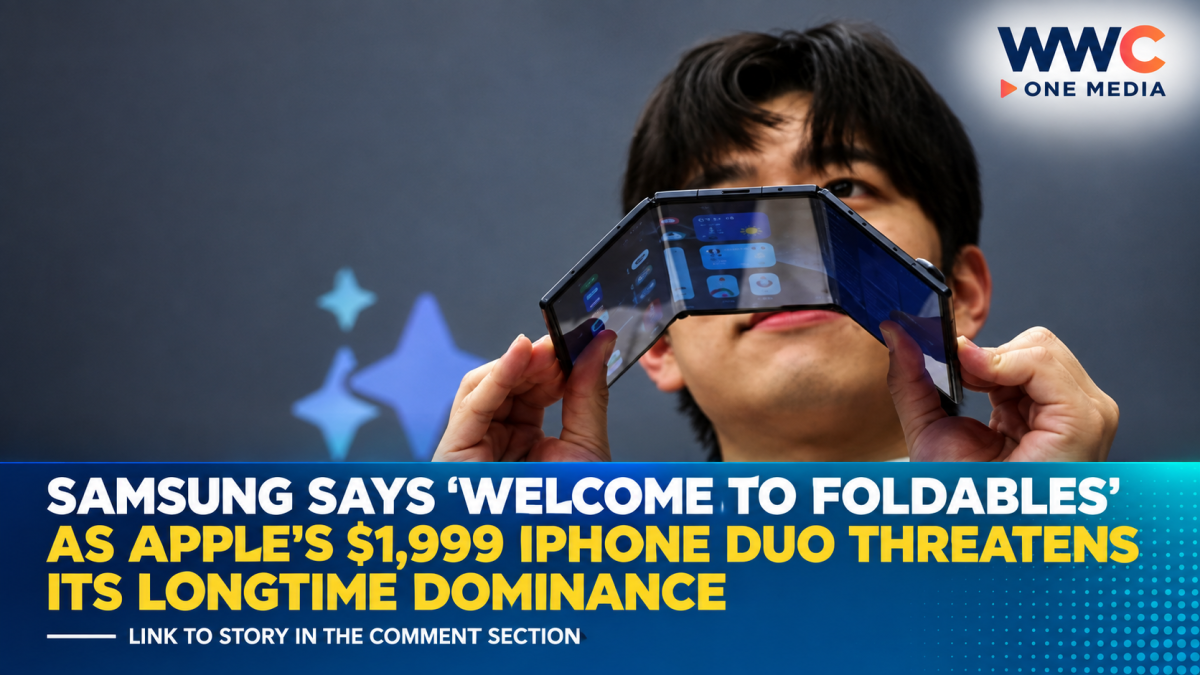
SEOUL — Samsung is welcoming Apple to the foldable smartphone market — but behind the friendly message is a growing battle for control of one of the technology industry’s most important premium categories.
After Apple unveiled its first foldable smartphone, the US$1,999 iPhone Duo, Samsung responded with a bold promotional campaign built around a simple message: “Welcome to Foldables.”
The message may sound welcoming, but the competitive stakes could not be higher.
Samsung has spent years building the foldable smartphone market since launching its first Galaxy Fold in 2019. Now Apple — the world’s most influential smartphone brand — has entered the category with a device carrying a similar premium price and a book-style design that puts it directly into competition with Samsung’s latest Galaxy Z Fold lineup. (Reuters)
Samsung Built the Foldable Market — Now Apple Wants In
Samsung has spent nearly eight generations refining its foldable phones, tackling some of the technology’s biggest problems, including bulky designs, fragile displays, visible screen creases and concerns about hinges.
Apple, meanwhile, has entered the market years later with what analysts describe as a classic second-mover strategy.
Instead of being first, Apple has waited for competitors to identify many of the technology’s weaknesses before introducing its own version.
The iPhone Duo features a 5.4-inch outer display and unfolds into a 7.6-inch internal screen. It starts at US$1,999 and is designed to combine smartphone portability with a larger display for multitasking, entertainment and productivity. (Reuters)
Samsung Launches a Counterattack
Samsung has responded to Apple’s arrival with advertisements and social media posts highlighting its years of experience in foldable technology.
The South Korean technology giant is emphasizing its engineering leadership, lighter devices and the experience gained from years of selling foldable phones before Apple entered the category.
Samsung’s latest Galaxy Z Fold8 weighs just 201 grams, according to company executives, reflecting the industry’s push to make foldables feel less like experimental gadgets and more like everyday smartphones. (Reuters)
But Samsung’s response also appears designed to remind consumers of one crucial fact:
Apple may have the world’s biggest smartphone ecosystem — but Samsung has been folding phones for years.
Apple Could Quickly Take a Huge Chunk of the Market
That experience, however, may not be enough to guarantee Samsung’s dominance.
Analysts expect Apple’s entry to dramatically reshape the foldable market.
Reuters reported that analysts believe Apple could quickly capture around 25% of the foldable smartphone market, putting it within striking distance of Samsung’s estimated market share of about 38%.
Other forecasts are even more aggressive, with analysts expecting Apple to potentially capture a much larger share as consumers upgrade into its ecosystem. (Reuters)
That means Apple’s arrival could create the biggest challenge Samsung has faced in the foldable category.
The Twist: Apple May Help Samsung Sell More Foldables
There is another possibility.
Apple’s entry could actually help expand the entire foldable market.
Despite years of innovation from Samsung, Huawei and other manufacturers, foldables have remained a relatively small part of the global smartphone business.
High prices, durability concerns, battery compromises and screen creases have kept many consumers away.
Apple could change that.
The company has previously helped turn emerging product categories into mass-market businesses through its ecosystem, branding and enormous customer base.
Industry analysts believe the iPhone Duo could bring millions of new consumers into the foldable category — potentially benefiting Samsung as well as Apple and other manufacturers. (Reuters)
Apple Enters a Market Samsung Helped Create
Samsung pioneered the modern book-style foldable category with its original Galaxy Fold.
But the early years were not easy.
The first-generation Galaxy Fold faced highly publicized durability problems, while subsequent generations continued to face questions about hinges, screen protection, dust resistance and repairability.
Samsung has since refined the design, while competitors including Huawei, Xiaomi, Honor and Google have entered the market with their own approaches.
Apple’s arrival now adds a completely different level of pressure.
The company that once changed the smartphone industry with the original iPhone is now challenging a category Samsung spent years developing.
Apple’s $1,999 Gamble
The iPhone Duo is also a major test for Apple.
At US$1,999, it is one of the company’s most expensive smartphones ever.
The foldable features the A20 Pro chip, multitasking capabilities, Apple Pencil support and storage configurations reaching up to 2TB. Apple is betting that consumers will pay a premium for a device capable of functioning as both a smartphone and a larger-screen productivity device.
But the price could become one of its biggest challenges.
Foldables remain a premium category, and Apple must convince millions of consumers that folding technology offers enough practical benefits to justify paying significantly more than for a conventional smartphone.
Samsung Still Has One Major Advantage
Samsung’s biggest weapon may simply be experience.
The company has years of data from real customers using foldables every day.
It knows where screens fail.
It knows how consumers use larger internal displays.
And it has already gone through multiple generations of redesigns.
Samsung executives have argued that reducing weight and improving usability are critical to making foldables more mainstream.
Apple, however, is entering with one advantage of its own:
It has been able to learn from every mistake Samsung and other manufacturers have already made. (WIRED)
The Foldable War Is About to Get Bigger
Apple’s arrival is also intensifying competition beyond Samsung.
Huawei remains a major force in China and the global foldable market, while Xiaomi and other Chinese manufacturers continue launching increasingly advanced devices.
Huawei and Xiaomi both unveiled new premium foldables ahead of Apple’s launch, highlighting how quickly the category is evolving. (Reuters)
The battle is no longer simply about who can build a phone that folds.
It is increasingly about:
- Thinner designs
- Better batteries
- More durable hinges
- Less visible screen creases
- Improved cameras
- AI features
- Multitasking
- Ecosystem integration
And now, for the first time, Apple is officially part of that fight.
The Bottom Line
Samsung may be saying “Welcome to Foldables,” but Apple is not entering the market as a casual visitor.
The US$1,999 iPhone Duo represents Apple’s biggest smartphone redesign in years and could quickly take a significant share of a market Samsung has spent nearly a decade building.
Samsung still has the experience.
Apple has the ecosystem.
And both companies now have premium foldables priced around US$2,000.
The foldable smartphone war has officially entered a new era — and Samsung’s friendly welcome may soon turn into one of the fiercest technology battles Apple has faced in years.
The question now is no longer whether foldable phones will go mainstream. The real question is: when millions of iPhone users finally start folding their phones, will Samsung still be the company leading the market?
WWC ONE MEDIA J.M.D




Leave a Reply