
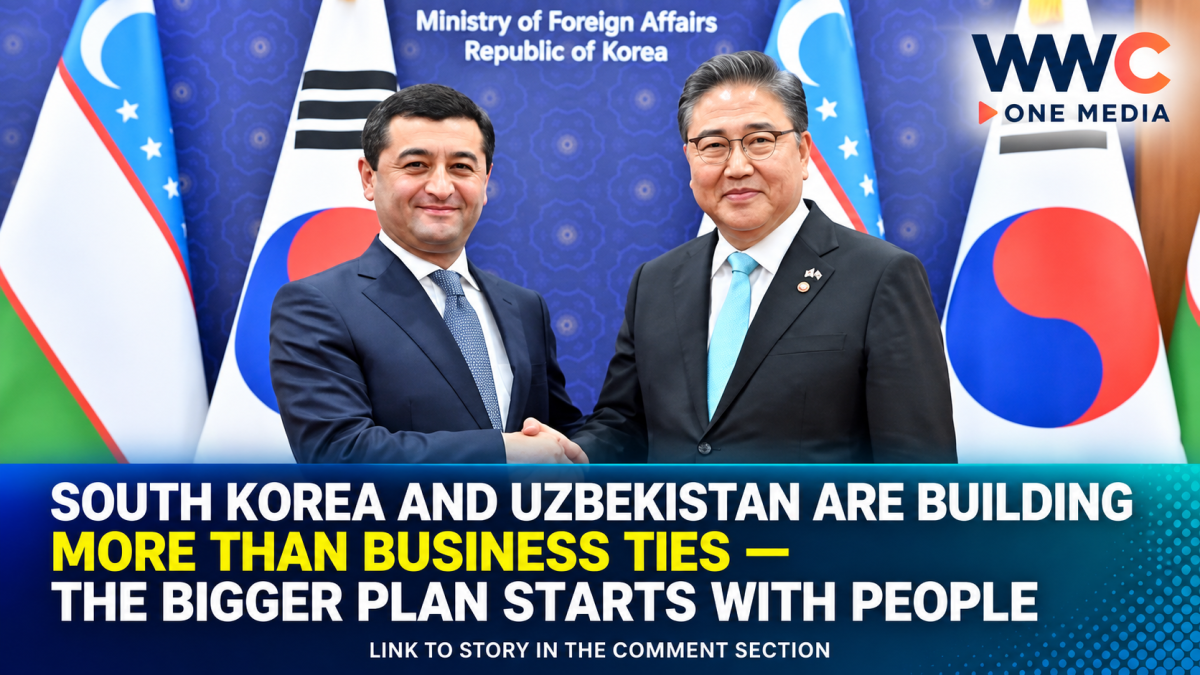
TASHKENT, Uzbekistan — Uzbekistan and South Korea are deepening a partnership that is moving well beyond trade and investment, with education, technology, scientific research and human-capital development increasingly becoming central to their long-term relationship.
A new commentary published by The Korea Herald argues that the most important foundation of the expanding Uzbekistan–South Korea relationship may not be factories or investment figures, but the people being trained to operate the next generation of industries.
The article, written by Ilkhomjon Tukhtasinov, rector of Uzbekistan State World Languages University, highlights how cooperation between the two countries is increasingly connecting universities, vocational training, research, technology and industry.
THE PARTNERSHIP IS GETTING BIGGER
The education push comes as Uzbekistan and South Korea expand cooperation in several strategic sectors.
During a September 2025 meeting in New York, Uzbek President Shavkat Mirziyoyev and South Korean President Lee Jae Myung agreed to prepare a new long-term Technological and Industrial Partnership Program.
The proposed cooperation covers areas including critical raw-material processing, chemistry, mechanical engineering, agriculture, transport, aviation and biotechnology. Uzbekistan’s presidential office said Korean companies’ direct investment in the Uzbek economy had exceeded $8 billion at that time.
That means the relationship is increasingly being built around industries that require highly trained engineers, researchers, technicians, managers and other specialists.
And this is where education becomes strategically important.
FOUR KOREAN UNIVERSITY BRANCHES ALREADY OPERATE IN UZBEKISTAN
Uzbekistan says four branches of leading South Korean universities are already operating in the country, alongside vocational education centers in different regions.
The two governments have also highlighted cooperation through institutions including the Korea International Cooperation Agency (KOICA) and the Korea Export-Import Bank.
According to Uzbekistan’s presidential office, the combined project portfolio involving KOICA, the Export-Import Bank of Korea and related funds has reached approximately $3.5 billion.
The trend shows how the partnership is moving from traditional investment toward a broader model involving skills, technology transfer and industrial capability.
THE KOREAN LANGUAGE IS BECOMING A STRATEGIC SKILL
At Uzbekistan State World Languages University, the Korean language has become an important component of that relationship.
The Korea Herald commentary says Korean has been taught at the university since 1995, initially as a second foreign language, before becoming one of the institution’s main foreign-language offerings in 2017.
According to the article, 972 students were studying Korean at the university, including undergraduate and graduate students, while the program employed Korean and Uzbek instructors.
The significance goes beyond language itself.
For students preparing to work with Korean companies, universities and institutions, language skills can provide access to Korean business practices, culture and professional networks.
KOICA IS PUTTING MONEY INTO THE EDUCATION PIPELINE
One of the clearest examples is the Korea Culture and Education Center at Uzbekistan State World Languages University.
The university confirmed that the center was established through a $1.116 million KOICA project running from 2025 to 2027.
The program includes Korean-language instruction, cultural activities, teacher development and extracurricular programs such as taekwondo, dance and music. A total of 70 Korean volunteer teachers are planned to participate over the project period.
The center officially opened on April 21, 2026, marking another step in the educational side of the bilateral relationship.
The university said the project includes modern equipment and facilities designed to strengthen Korean-language and cultural education.
BUT THE BIGGER GOAL IS TECHNOLOGY
The most significant part of the partnership may ultimately be what happens outside the classroom.
Uzbekistan is trying to build an economy capable of producing more high-value and technology-intensive goods, while South Korea brings extensive experience in manufacturing, engineering, research and industrial development.
That connection is already visible in Uzbekistan’s plans for a new scientific-production and educational cluster for the chemical industry in Tashkent’s Mirzo Ulugbek district.
The planned cluster covers about 60 hectares and is expected to include a Chemical Technology Innovation Center developed in cooperation with South Korea.
The concept is significant because it attempts to connect education, scientific research, laboratories, startups and industrial production rather than treating them as separate activities.
FROM CLASSROOMS TO FACTORIES
The Korea Herald commentary makes a broader argument: importing technology alone does not guarantee economic transformation.
Countries also need people capable of understanding, adapting, improving and eventually developing that technology themselves.
That means an engineer trained for a Korean-linked industrial project, a researcher working in a joint laboratory, a translator supporting a multinational company or a manager handling a cross-border operation can all become part of the same economic ecosystem.
This is why Uzbekistan’s investment in education could have consequences far beyond universities.
THE INDUSTRIAL CONNECTION IS ALREADY TAKING SHAPE
Uzbekistan’s government has been pursuing deeper cooperation with South Korea across several sectors.
The September 2025 presidential meeting specifically identified chemistry, mechanical engineering, agriculture, transportation, aviation, biotechnology and critical-material processing as potential areas for the new long-term technological and industrial partnership.
In other words, the education push is happening alongside an industrial strategy.
The objective is not simply to teach more Uzbek students Korean.
It is to create a workforce capable of participating in a much larger economic relationship.
WHY THIS MATTERS
The Uzbekistan–South Korea relationship offers an example of how modern international partnerships are increasingly built.
Investment can provide capital.
Technology can provide equipment and know-how.
But human capital determines whether those investments can be sustained and expanded.
That is the central argument behind Tukhtasinov’s Korea Herald commentary.
For Uzbekistan, developing a generation of specialists who understand both advanced technology and international cooperation could help the country move higher up global value chains.
For South Korea, deeper educational and industrial links could create new opportunities in a strategically important Central Asian market.
And for thousands of Uzbek students learning Korean today, the payoff may eventually come not from a language certificate—but from a career inside the expanding Uzbekistan–South Korea economic corridor.
The bigger question is now whether today’s classrooms can produce the engineers, researchers and innovators needed for tomorrow’s factories and technology projects.


Leave a Reply