
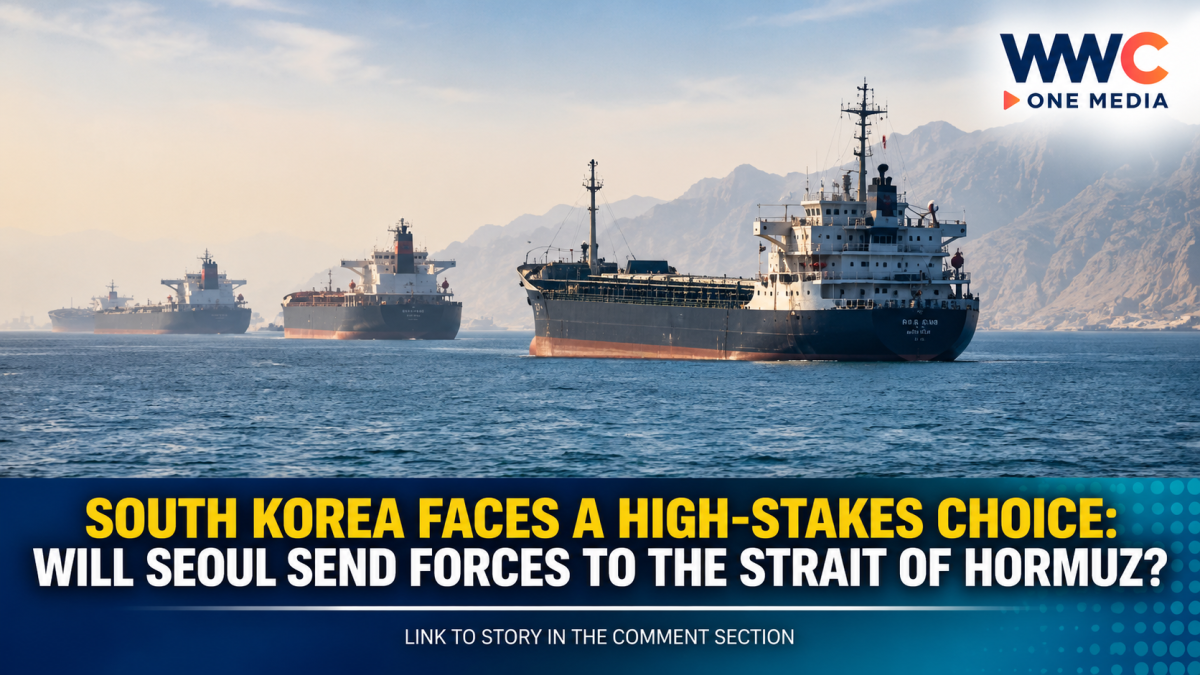
SEOUL — South Korea is facing a growing foreign-policy dilemma over whether to contribute military forces to security efforts in the Strait of Hormuz, with the government stressing that any deployment would require legal procedures and broad public support.
The Korea Herald reported Thursday that First Vice Foreign Minister Park Yoon-joo told lawmakers that both domestic legal procedures and “social consensus” would have to be considered before Seoul makes any decision. Importantly, South Korea has not finalized a troop deployment.
The issue has become increasingly sensitive as the conflict involving the United States and Iran continues to affect one of the world’s most strategically important shipping routes.
SEOUL HAS NOT MADE A FINAL DECISION
Park’s comments came during questioning at the National Assembly, where lawmakers pressed the government over reports that Washington has been seeking greater international support for maintaining freedom of navigation through the Strait of Hormuz.
According to The Korea Herald, Park said any deployment would have to follow South Korea’s domestic legal procedures and take public sentiment into account. He also stressed that a deployment decision had not yet been finalized.
Prime Minister Han Seong-sook likewise said Wednesday that no decision had been made and that Seoul was considering different options for contributing to freedom of navigation in the strategic waterway.
That distinction is crucial.
South Korea is considering its options—but that does not mean Seoul has decided to send troops.
THE UAE MISSION RAISES MORE QUESTIONS
The uncertainty intensified after South Korea’s Defense Ministry sent an assessment team to the United Arab Emirates to examine security conditions and operational circumstances connected to the Strait of Hormuz.
The Korea Herald’s wider reporting, carried by the Asia News Network, said experts cautioned against interpreting the mission as proof that Seoul had already decided to deploy forces. The Defense Ministry has described the mission as an assessment of the situation rather than a commitment to troop deployment.
South Korean broadcaster SBS similarly reported that officials have emphasized that the UAE assessment was not based on a predetermined decision to deploy troops and that no deployment had been finalized.
This leaves Seoul walking a narrow line: gathering information and preparing contingency options without publicly committing to military participation.
WHY THE STRAIT OF HORMUZ MATTERS TO SOUTH KOREA
For Seoul, the issue isn’t simply about military alliances.
The Strait of Hormuz is a critical artery for global energy supplies, and South Korea has historically depended heavily on Middle Eastern energy moving through the waterway.
Any prolonged disruption could therefore affect oil prices, shipping costs, manufacturing and the broader South Korean economy.
Japan is facing a similar concern. Park said Tokyo is closely monitoring the situation because freedom of navigation through the strait is directly connected to shipping and energy supply chains. Seoul and Tokyo are also discussing ways to address supply-chain disruptions, including exchanging stockpiles and securing energy supplies.
THE CONSTITUTIONAL HURDLE COULD BE JUST AS IMPORTANT
A potential deployment also faces a significant constitutional requirement.
The Korea Herald reported that South Korea’s Constitution provides that the National Assembly must consent to the deployment of armed forces abroad, with a two-thirds vote of all lawmakers required for approval.
That means the government cannot simply decide internally to send combat forces overseas and proceed without parliamentary approval.
The political environment is already complicated.
Opposition and even some lawmakers from the governing liberal bloc have voiced concerns about South Korea becoming directly involved in the Middle East conflict.
WASHINGTON’S REQUEST PUTS SEOUL IN A TOUGH SPOT
The United States has been pushing allies and partners to contribute to efforts aimed at protecting navigation around the Strait of Hormuz.
For Seoul, responding positively could reinforce its alliance with Washington and demonstrate support for maintaining an important international shipping route.
But military involvement could also expose South Korean personnel, ships and other assets to a conflict with potentially serious consequences.
That explains why officials have repeatedly avoided describing the current discussions as a finalized deployment decision.
Recent South Korean reporting indicates that the government is carefully reviewing what form any possible contribution might take, while stressing that preparatory assessments should not automatically be interpreted as a decision to send troops.
SEOUL AND TOKYO ARE ALSO WATCHING THE ENERGY THREAT
The crisis is increasingly becoming an economic-security issue for East Asia.
The Korea Herald reported that Seoul is coordinating with Tokyo on supply-chain disruptions caused by the Middle East conflict. The two governments are pursuing discussions involving stockpiles and energy supplies, highlighting how seriously Asian economies are treating the possibility of prolonged disruption around the strait.
The stakes are particularly high because any sustained disruption could ripple through global oil markets and raise costs far beyond the Middle East.
IRAN HAS ALSO SENT A WARNING
The debate is unfolding against increasingly direct warnings from Tehran.
Iranian officials have warned that countries contributing forces to operations around the Strait of Hormuz could face consequences. An analysis published by Aju Press reported that Iran’s Foreign Ministry issued a Korean-language warning that countries stationing forces in the Persian Gulf or Strait of Hormuz could be viewed as supporting the party responsible for aggression.
That adds another layer of risk for Seoul.
A South Korean deployment could strengthen coordination with Washington—but potentially worsen relations with Tehran and increase risks to South Korean commercial interests and personnel in the region.
SEOUL’S DILEMMA: ALLIANCE OR AVOIDING A WIDER WAR?
The government is effectively caught between competing priorities.
On one side is the U.S.-South Korea alliance and the strategic importance of keeping international shipping lanes open.
On the other is the danger of becoming directly involved in an escalating Middle East conflict while exposing South Korean forces and economic interests to retaliation.
And then there is the domestic political question.
Will South Korean voters and lawmakers support sending forces into the region?
For now, Seoul is not answering that question with a commitment.
Instead, officials are emphasizing procedure, national interest and public consensus.
THE NEXT MOVE COULD BE THE MOST IMPORTANT ONE
The UAE assessment mission, parliamentary questioning and diplomatic consultations show that the issue is no longer merely theoretical.
But the most important fact remains unchanged:
South Korea has not made a final decision to deploy military forces to the Strait of Hormuz.
The government now faces a decision in which energy security, the U.S. alliance, relations with Iran, constitutional requirements and public opinion are all pulling in different directions.
And as the conflict continues, the pressure on Seoul is unlikely to disappear.
The question is no longer simply whether South Korea can help protect the world’s critical shipping lane—it is whether Seoul can do so without being pulled directly into the war.




Leave a Reply