
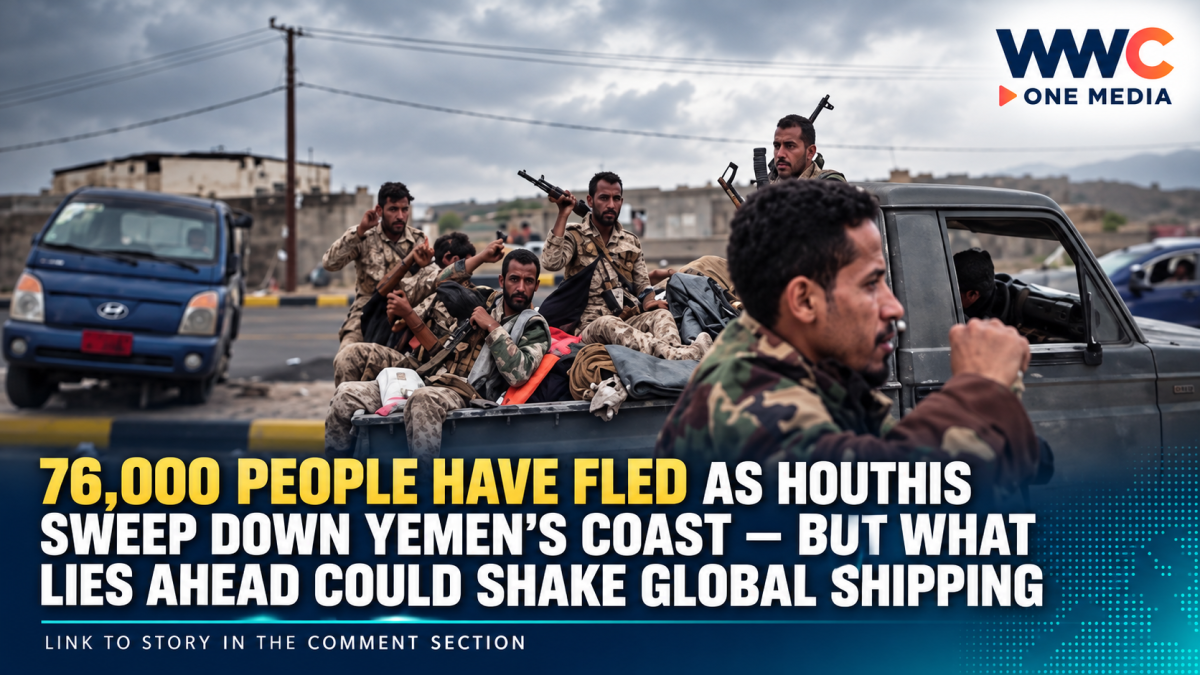
ADEN, Yemen — Families are pouring into southern Yemen after a rapid Houthi offensive along the country’s Red Sea coast shattered years of relative calm, sending civilians fleeing with little more than what they could carry and raising fears that Yemen could again slide into full-scale war.
At least 76,000 people have been displaced since July, according to figures reported by the Associated Press as fighting intensified between the Iran-backed Houthi movement and forces aligned with Yemen’s internationally recognised government. Many of the newly displaced have headed toward Aden, where residents and relatives have opened their homes to families escaping the western coastal areas.
For some, the escape came with almost no warning.
Alaa Ali Salem told the AP that his family fled amid what he described as “hysterical panic,” joining congested roads as the front line shifted rapidly. His motorcycle overturned during the escape, injuring members of his family. Other displaced Yemenis described gunfire, retreating soldiers and uncertainty over whether roads would remain open long enough for civilians to get out.
The accounts offer a civilian view of a military offensive whose significance now extends far beyond Yemen.
Houthis seize Mokha as Yemen’s fragile calm unravels
The latest escalation accelerated in early September as Houthi forces, also known as Ansar Allah, launched a major push down Yemen’s strategic western coastline.
On September 10, United Nations Special Envoy Hans Grundberg told the UN Security Council that the Houthis had gained control of Mokha, a Red Sea port roughly 75 kilometres from the Bab el-Mandeb Strait, while warning that the military situation remained fluid.
Grundberg said the escalation effectively marked the end of the period of relative calm that followed the UN-brokered truce in 2022, warning that renewed warfare could pull Yemen deeper into the wider regional confrontation.
Reuters separately reported that the Houthi offensive had transformed the strategic picture around the Red Sea and placed additional pressure on Saudi Arabia, the Yemeni government and Washington.
Subsequent reporting by AP and other international outlets said Houthi forces had also taken Mayun, or Perim, Island, which sits directly in the Bab el-Mandeb waterway.
That makes what happens next in Yemen important not only to the people caught in the fighting but also to international energy markets and maritime trade.
Why Bab el-Mandeb matters to the rest of the world
Bab el-Mandeb — whose name is often translated as the “Gate of Tears” — connects the Red Sea with the Gulf of Aden and the Arabian Sea.
The narrow passage is an essential link for vessels travelling between Asia, the Middle East and Europe through the Suez Canal. Reuters estimates that oil equivalent to roughly 7% of global output normally moves through the route, alongside huge volumes of containerised goods and other commodities.
That vulnerability has already been demonstrated.
Houthi missile and drone attacks beginning in 2023 led many major shipping companies to divert vessels away from the Red Sea and around Africa’s Cape of Good Hope, adding distance, time and cost to journeys between Europe and Asia.
The latest Houthi territorial gains therefore raise a larger question: whether the movement will gain enough control along the Yemeni side of Bab el-Mandeb to exert even greater pressure on commercial shipping.
Reuters reported that this possibility has created a new strategic dilemma for the United States, particularly because instability has also affected the Strait of Hormuz, another critical route for global energy supplies.
Displacement figures are rising fast
The humanitarian impact was visible even before the latest breakthrough.
On September 8, the United Nations said more than 5,600 households had been displaced across Taiz and southern Al Hudaydah following fighting that escalated on September 3. Humanitarian groups had managed to provide emergency assistance to only part of that population, while damaged roads, insecurity and continuing combat complicated relief efforts.
That UN figure covers a narrower period and area than the subsequent AP-reported total of at least 76,000 displaced since July, which helps explain why the numbers differ rather than necessarily contradicting one another.
Yemen was already suffering from one of the world’s most severe humanitarian emergencies before the latest fighting.
The war’s death toll is even larger than one headline number suggests
Reports frequently state that Yemen’s conflict has killed more than 150,000 people, but that figure generally refers to deaths caused directly by political violence.
The Armed Conflict Location & Event Data Project estimated more than 150,000 direct conflict deaths by the end of 2021. A broader United Nations Development Programme assessment estimated that the war had caused about 377,000 deaths by the end of 2021 when indirect deaths from hunger, disease and the collapse of essential services were included.
That distinction matters because renewed large-scale warfare threatens more than battlefield casualties. Yemen’s previous war devastated hospitals, water systems, livelihoods and food supplies, turning military escalation into a much wider public-health and humanitarian emergency.
Saudi Arabia faces pressure on another front
The Yemen escalation is unfolding alongside mounting pressure on Saudi Arabia’s energy infrastructure.
Iraq confirmed that attacks that forced the shutdown of an important Saudi oil pipeline originated from Iraqi territory, although Iran-aligned Iraqi militia groups denied responsibility. AP reported that regional officials said some Iraqi factions had previously coordinated attacks with the Houthis.
The combination of threats to Saudi infrastructure, instability around the Strait of Hormuz and the Houthi advance toward Bab el-Mandeb has intensified fears about oil prices and maritime security.
Yet military intervention carries its own risks.
Saudi Arabia led a coalition into Yemen in 2015 in an attempt to restore the internationally recognised government after the Houthis seized Sanaa. Years of airstrikes and ground fighting failed to defeat the movement and contributed to enormous civilian suffering before the 2022 truce substantially reduced large-scale fighting.
For Yemenis, the geopolitical struggle is painfully personal
Strategists may see ports, islands and shipping chokepoints on the map.
For civilians fleeing Mokha, al-Khokha and other communities along Yemen’s western coast, the calculations are far simpler: whether there is fuel to escape, whether a road will remain open and whether relatives in Aden have enough space to take in another family.
That is why the latest Houthi advance is potentially more consequential than another territorial change in a war that has lasted more than a decade.
The battle is approaching one of the world’s most strategically important waterways at the same time that tens of thousands of Yemenis are once again being uprooted.
And after four years in which Yemen appeared to have stepped back from the edge of all-out war, the warning from the United Nations is increasingly difficult to ignore: the relative calm has broken, and the next phase could be far harder to contain.




Leave a Reply