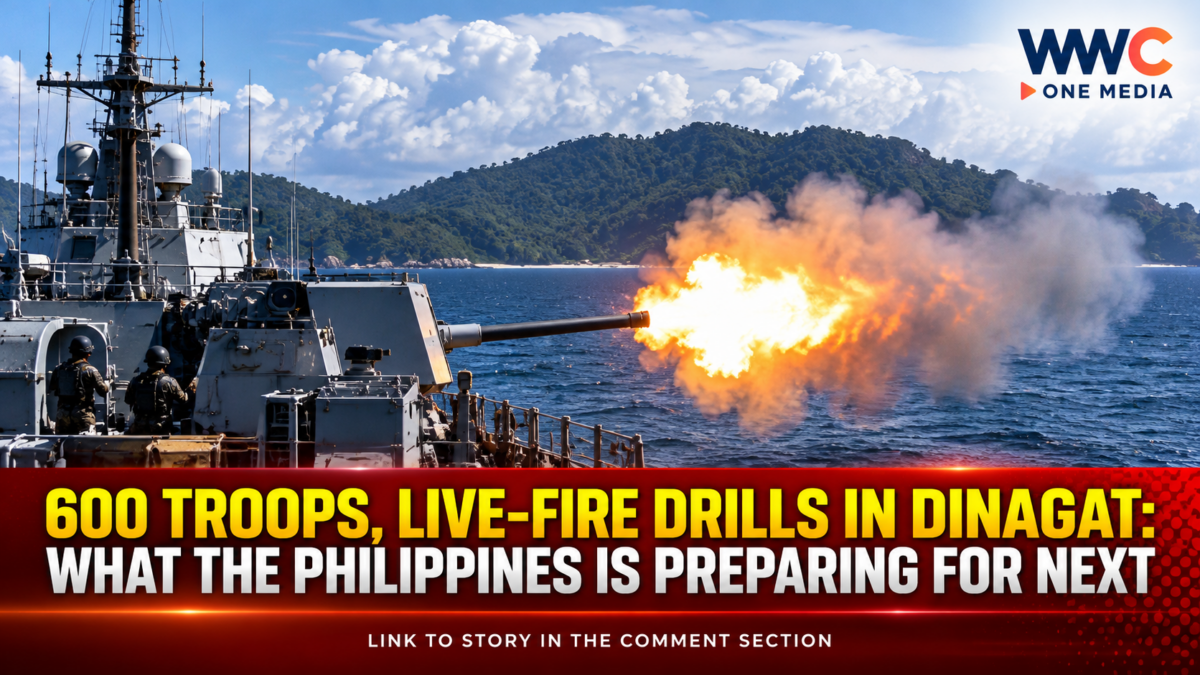
DINAGAT ISLANDS, Philippines — More than 600 military personnel have taken part in a major Philippine military exercise in Dinagat Islands, as the Armed Forces of the Philippines (AFP) steps up preparations for external security threats and reinforces defenses along the country’s eastern seaboard.
Dubbed Exercise Surigao Sentinel 01-2026, the exercise brings together the Philippine Army, including reservists, the Philippine Navy, the Philippine Air Force, and civilian security and government agencies. The drills are designed to test coordination, operational readiness, and the ability of military and civilian authorities to respond to simulated threats.
According to reports from the Philippine News Agency and the Philippine Information Agency, the exercise is part of a broader effort to strengthen territorial defense and improve cooperation among military units, local governments, law enforcement, and emergency responders.
Live-fire drills and military movements put Dinagat Islands in focus
The exercise featured activities intended to test how Philippine forces would respond to simulated security threats involving the country’s maritime approaches and coastal areas.
Military and local authorities issued public advisories ahead of the drills to prepare residents for troop movements, military equipment deployments, and the sounds associated with controlled training activities.
During the live-fire phase, authorities imposed restrictions on designated maritime areas to protect fishing communities, boat operators, and other vessels. Residents and maritime users were urged to follow instructions from the Philippine Coast Guard and local authorities.
These precautions are particularly important in an island province where fishing, passenger transport, and other maritime activities are essential to everyday life.
Officials emphasized that the activities were scheduled military training, not evidence of an immediate attack or a newly confirmed security emergency.
Why Dinagat Islands matters to Philippine defense
Dinagat Islands occupies a strategically important position near Surigao Strait, a maritime passage with both historical and contemporary significance.
The surrounding waters were the scene of the Battle of Surigao Strait in October 1944, part of the wider Battle of Leyte Gulf during World War II. The exercise’s theme, “Beyond the Strait: Converging Historical Legacy and Multi-Domain Security,” connects that history with present-day efforts to improve national defense.
The drills also reflect the AFP’s emphasis on the country’s Comprehensive Archipelagic Defense Concept, which calls for stronger coordination and capabilities across the Philippine archipelago.
In practical terms, protecting the country requires more than deploying troops. Military units must also coordinate surveillance, maritime security, coastal defense, communications, emergency response, and cooperation with civilian authorities.
Military and civilian agencies work together
The exercise involves more than the armed forces. Reports identify the participation of agencies including the Philippine National Police, Bureau of Fire Protection, Philippine Coast Guard, local government units, and other civilian institutions.
This inter-agency approach is intended to improve the government’s ability to respond when security incidents affect communities, transportation, public services, or critical infrastructure.
The Dinagat Islands provincial government has also supported the activity financially and through public information efforts. Earlier reports from the PNA said the province committed ₱1 million in support of the exercise and planned class suspensions during the main drills to help protect students and teachers.
The preparations underline an important part of territorial defense: communities and local authorities need to know how to respond alongside military units when emergencies occur.
A wider shift toward external defense
The Dinagat Islands exercise comes as the AFP places greater emphasis on external defense while maintaining its other security responsibilities.
The country’s maritime environment requires forces to monitor surrounding waters, respond to potential incursions, coordinate across different military services, and work with agencies responsible for maritime safety and law enforcement.
The exercise offers an opportunity to identify gaps in readiness and coordination before an actual crisis occurs. Its value will ultimately depend on whether lessons from the drills translate into better planning, stronger communication, and more effective responses.
What happens next?
The exercise was scheduled to run across Surigao City and Dinagat Islands from October 20 to 25, 2026, with major simulated-threat activities in Dinagat Islands and events connected to the commemoration of the Battle of Surigao Strait.
The military has presented the activity as preparation for possible external threats, not a response to a specific imminent attack.
For residents, the immediate priorities are to observe temporary maritime restrictions, follow official safety advisories, and avoid spreading unverified claims about military movements.
For the Philippines, the larger question is whether exercises such as Surigao Sentinel can improve the country’s ability to protect its territory, secure its maritime approaches, and coordinate a rapid response when future challenges arise.
The message is clear: strengthening national defense depends not only on military capability, but also on coordination among government agencies and the readiness of the communities they serve.