
PANGASINAN, Philippines — What may begin with a few typed words, a social media post or a video intended as a prank can trigger something far bigger: frightened students, worried parents, suspended classes, police deployments and potentially serious legal consequences.
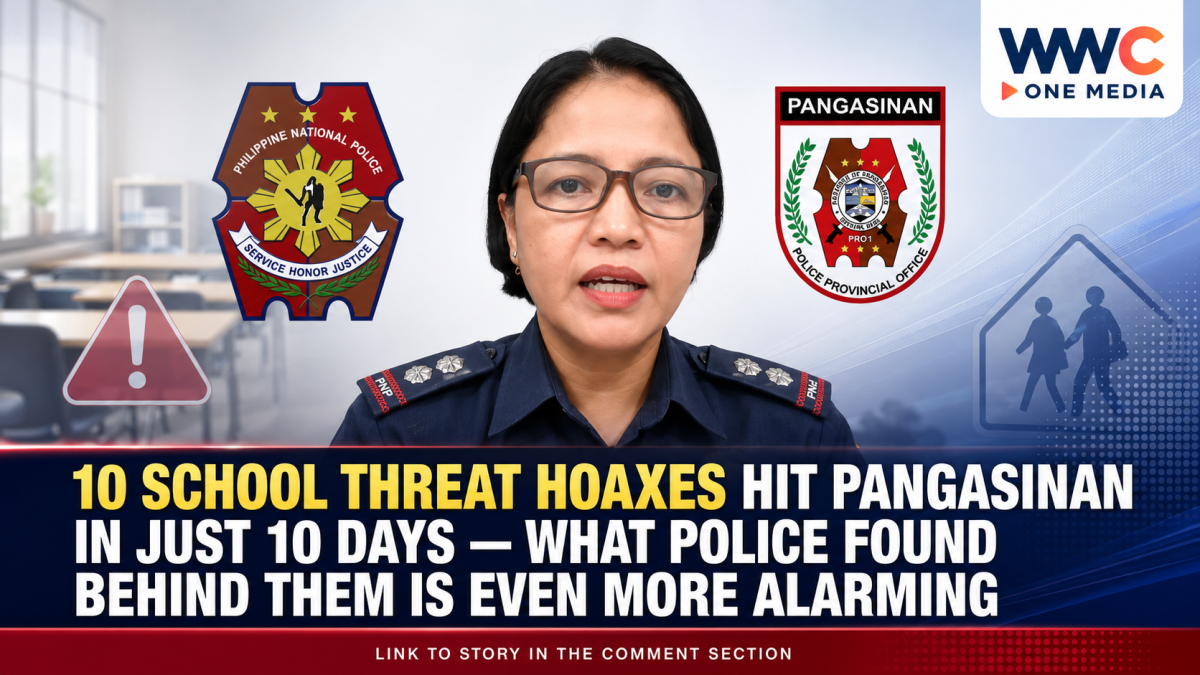
That warning has taken on new urgency in Pangasinan after authorities recorded 10 threat incidents involving secondary schools in just 10 days in July 2026, all of which were eventually assessed by police as fake threats or hoaxes.
But authorities say dismissing the incidents as harmless teenage jokes would miss the bigger issue.
The threats reportedly surfaced in Rosales, Lingayen, Santo Tomas, Mangaldan, Bautista, San Jacinto, San Manuel, Laoac, Bayambang and San Carlos City, according to the Pangasinan Police Provincial Office.
Police said the cases allegedly involved minors, with reported motives ranging from attempts to avoid attending school or trigger class suspensions to pranks, peer influence, anger and resentment.
And in several cases, investigators were able to trace who was allegedly behind the messages.
Seven Cases Solved in Early Police Investigation
By July 31, the Pangasinan PPO said authorities had identified seven individuals linked to seven of the 10 threat incidents, which occurred between July 18 and July 28.
At that point, police considered seven cases solved while three remained under investigation.
Police Major Aileen Catugas, spokesperson for the Pangasinan PPO, said complaints involving Presidential Decree No. 1727 and grave threats in relation to the Cybercrime Prevention Act had been filed in connection with three of the incidents.
Four other cases were referred to municipal social welfare authorities for further proceedings, according to the police account reported by the Philippine News Agency and Manila Bulletin.
Because minors were allegedly involved, however, legal accountability is more complicated than simply treating every suspect as an adult offender.
Under the Juvenile Justice and Welfare Act, a child aged 15 or younger is exempt from criminal liability but may be subjected to an intervention program. A child older than 15 but younger than 18 is likewise generally exempt unless authorities determine that the child acted with discernment — meaning the child understood the wrongfulness and consequences of the act.
That distinction became particularly relevant in one of Pangasinan’s most publicized cases.
15-Year-Old Traced After Rosales School Threat Video
On July 18, a threatening video began circulating online involving Rosales National High School.
GMA Regional TV reported that the video warned students against going to school and included a claim that the person speaking was associated with an armed group.
Pangasinan police later traced the voice to a 15-year-old student from the school, using cyber investigation, intelligence monitoring and follow-up operations.
Police said a pellet gun and baseball bat allegedly seen in connection with the video were recovered. The teenager reportedly told investigators that there had been no intention to carry out an attack and that the video was made as a joke influenced by social media content.
The minor was referred for appropriate social-welfare intervention.
The incident illustrates exactly why police are warning students that saying something was intended as a joke does not automatically erase its consequences.
A threat can force authorities to treat a potentially dangerous situation as real until investigators establish otherwise.
That means police deployments, security searches, disruption of classes and fear among students, teachers and parents — even when no actual weapon or attack ultimately exists.
Another Threat Had Already Shut Down Face-to-Face Classes
The atmosphere of concern was already evident one day before the 10 incidents counted by the Pangasinan PPO began.
On July 17, Manaoag National High School temporarily suspended face-to-face classes after a social media post circulated threatening a shooting at a school identified by the initials “MNHS.”
Because it was unclear which school the initials referred to, authorities had not confirmed that Manaoag National High School itself was the intended target.
Still, school officials chose to act cautiously.
Police were deployed, local disaster personnel responded and security measures were strengthened while authorities investigated the source of the post.
That Manaoag incident is separate from the 10 cases recorded by the Pangasinan PPO from July 18 to 28, but it demonstrates how even an ambiguous social media threat can immediately disrupt an entire school community.
Why a Fake Bomb Threat Can Become a Real Legal Problem
Philippine law specifically addresses deliberately fabricated bomb and explosive threats.
Under Presidential Decree No. 1727, knowingly spreading false information or willfully making threats involving bombs, explosives, incendiary devices or similar destructive means can constitute an offense.
The law was specifically intended to address threats and false information capable of causing public confusion and disrupting public safety.
Other types of threats may also potentially fall under provisions of the Revised Penal Code or, when committed through computer systems or online platforms, relevant provisions connected with the Cybercrime Prevention Act of 2012, depending on the specific facts and evidence.
That is why police repeatedly caution that typing “it was only a joke” afterward is not a legal reset button.
Investigators must consider what was said, how it was communicated, who was targeted, whether fear or disruption resulted, the age and circumstances of the alleged offender and whether applicable elements of an offense are present.
DepEd Had Already Tightened Rules on Threats and Dangerous Pranks
The Pangasinan incidents also came as the Department of Education was strengthening nationwide rules governing campus safety.
Under DepEd Order No. 006, series of 2026, or the Guidelines on Ensuring a Safe and Motivating Learning Environment, schools were given updated standards designed to protect learners from violence, abuse and other threats while preserving due process and appropriate interventions.
In July, DepEd specifically warned that false information, dangerous pranks and bomb threats in schools should not be considered harmless behavior, noting that such incidents can disrupt learning, cause class suspensions and consume emergency-response resources.
Pangasinan education authorities had also ordered public schools to strictly implement security measures in cooperation with law enforcement agencies, local governments, barangays and parent-teacher associations.
The message from both education officials and police is increasingly consistent: prevention cannot begin only after a threatening post has gone viral.
Police: Watch the Warning Signs, But Don’t Jump to Conclusions
Authorities are also urging parents and teachers to look beyond punishment.
The Pangasinan PPO has advised adults to pay attention to major or persistent behavioral changes in young people, particularly when those changes occur alongside threatening statements, violent online content, harassment or expressed intentions to hurt someone.
Possible warning signs can include withdrawal, unusual irritability, declining school performance, repeated intimidation, harassment or recurring references to violence, death or revenge.
Police stressed, however, that no single behavior automatically means a student is dangerous. A quiet child, an angry teenager or someone struggling academically should not automatically be labeled a threat.
Instead, the focus should be on patterns, context, early communication and timely intervention.
What Students, Parents and Schools Should Do
Authorities advise anyone who encounters a threatening post, message or video to avoid confronting the sender directly when there may be an immediate safety risk.
Instead, recipients should preserve evidence — including screenshots, usernames, profile links, messages and phone numbers — and promptly alert school administrators, parents or law enforcement.
If the message suggests an immediate danger, people should move to a safe location and contact authorities.
This is particularly important because deleting, reposting or casually forwarding threatening material can complicate an investigation and potentially spread panic far beyond the original audience.
The Bigger Question After Pangasinan’s 10 Threat Cases
There is some reassuring news.
Police said all 10 incidents included in their July count were ultimately assessed as hoaxes, and the Pangasinan PPO has maintained that the province’s overall peace-and-order situation remains generally stable and manageable.
But that does not make what happened insignificant.
Ten school-threat incidents emerging across 10 Pangasinan communities within roughly a week and a half reveal how quickly social media, peer behavior and reckless communication can force schools and police into emergency mode.
For parents, educators and authorities, the challenge now goes beyond identifying the person behind the next anonymous account.
It is making young people understand the consequences before someone presses “post.”
Because the most dangerous misconception exposed by Pangasinan’s experience may be the simplest one of all:
A threat does not become harmless just because the person who made it later calls it a joke.




Leave a Reply