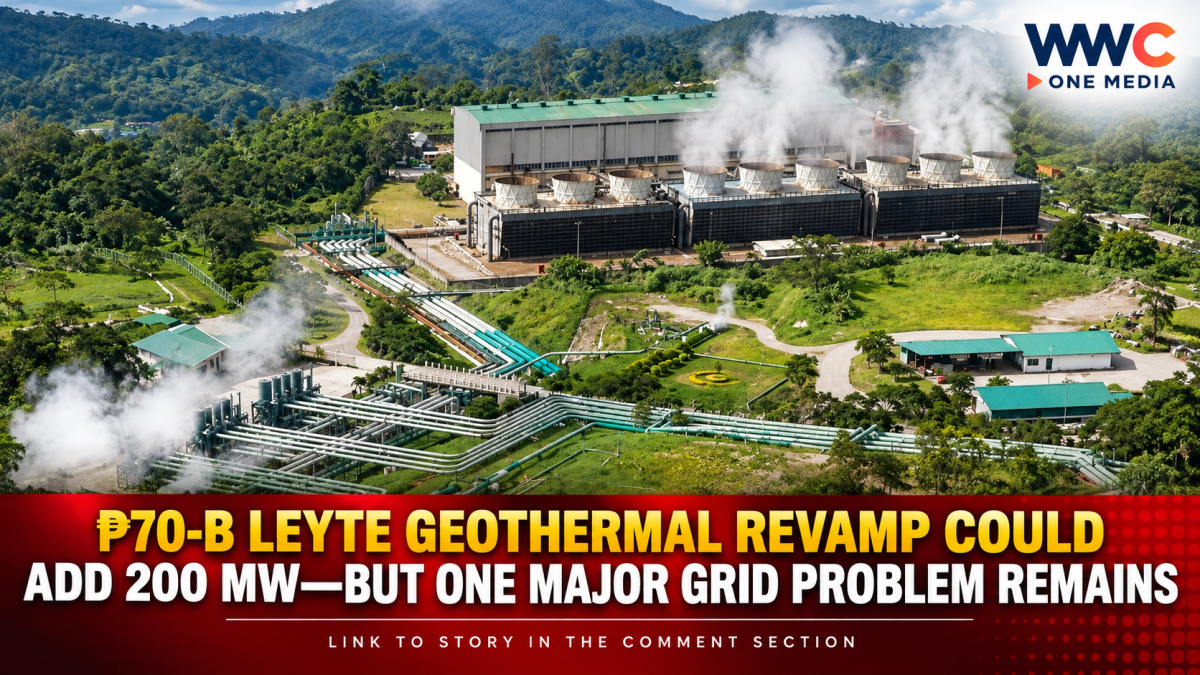
MANILA, Philippines — A massive redevelopment plan for the Philippines’ aging Leyte geothermal facilities could inject more than 200 megawatts (MW) of additional renewable baseload capacity into the power system, but the project’s full potential may depend on whether the transmission grid can keep pace.
For more Philippines energy and grid coverage, see our Philippines hub and Business desk.
First Gen Corp. is studying a ₱70-billion redevelopment of its Leyte geothermal facilities, with the company targeting an increase in output from roughly 400 MW to at least 640 MW, according to a September 18 report by Power Philippines.
First Gen President and COO Francis Giles B. Puno said the proposed redevelopment would focus on redesigning aging facilities around the geothermal field’s current steam conditions. The goal is to generate more electricity from the same geothermal resource rather than simply relying on additional steam extraction.
“What we want to do is make use of the steam quality so that we’re generating more capacity for the same quantity of steam,” Puno said, according to Power Philippines.
From aging infrastructure to a new-generation geothermal complex
The Leyte geothermal system has been operating for decades and remains a major source of renewable baseload electricity for the Philippines.
First Gen’s 2025 integrated report describes the “One Leyte” initiative as a comprehensive redevelopment and optimization program covering the Leyte geothermal complex. The program includes reservoir management, drilling, infrastructure upgrades and new facilities intended to sustain and increase the resource’s long-term productivity.
The company said geothermal remains an important source of indigenous, round-the-clock renewable power, while acknowledging that maintaining geothermal output requires continuing investment as reservoirs and equipment evolve over time.
The proposed ₱70-billion project is still under evaluation, with engineering studies continuing. First Gen is considering a final investment decision as early as 2027, while completion is being targeted around 2030. First Gen Renewables President Jerome Cainglet said full-scale operations could potentially extend into 2031, depending on feasibility and government support.
Another Leyte upgrade plan is already on the table
The latest ₱70-billion redevelopment proposal should not be confused with an earlier, broader Energy Development Corp. (EDC) investment plan.
In January, Philstar reported that EDC was preparing an investment of up to ₱100.88 billion to expand the capacity of the Tongonan Geothermal Project in Leyte. The plan sought to increase installed capacity from 637.21 MW to 967.22 MW.
One component was the proposed 450-MW New Upper Mahiao Power Plant, designed to replace the existing facility as it approaches the end of its operating life.
The distinction is important: the ₱70-billion figure refers to First Gen’s newly reported redevelopment concept, while the ₱100.88-billion figure comes from EDC’s earlier, larger Tongonan expansion proposal. They should not be presented as the same project.
Why Leyte matters to the Visayas grid
Leyte is already one of the Philippines’ most important geothermal centers.
The Unified Leyte geothermal complex has more than 700 MW of generating capacity, according to the Philippine News Agency. It includes the 232.5-MW Malitbog Geothermal Power Station, described by PNA as the world’s largest geothermal generating facility under a single roof.
First Gen and EDC have also emphasized that geothermal can provide electricity continuously, unlike renewable sources whose output varies depending on weather conditions.
But there is a catch.
The billion-peso question may not be generation—it may be transmission
First Gen executives have pointed to transmission constraints in Leyte as a major challenge.
According to Power Philippines, limited grid capacity has at times prevented all available geothermal power from being delivered to demand centers, with some geothermal steam being released rather than fully converted into electricity.
That means increasing generation capacity alone may not guarantee that every additional megawatt reaches consumers.
First Gen has said stronger transmission infrastructure will be important, particularly as more solar generation is added to the Visayas grid.
The issue comes as Eastern Visayas itself is seeking greater access to Leyte’s geothermal power.
In July, the Philippine Information Agency reported that First Gen said its Leyte geothermal facilities had available capacity that could help meet the region’s growing electricity demand, provided future procurement rules allow the company to participate more effectively.
PNA likewise reported that First Gen was prepared to offer uncontracted geothermal capacity through future competitive bidding or emergency procurement mechanisms.
What happens next?
For now, the ₱70-billion Leyte redevelopment remains a proposal under study—not a completed investment commitment.
If approved and successfully executed, the project could raise geothermal output by more than 200 MW while extending the usefulness of a strategically important renewable energy complex.
But the bigger challenge could extend beyond the power plants themselves: new generation will need adequate transmission capacity to reach the consumers and businesses that need it.
That makes the Leyte project more than an equipment upgrade. It is potentially a test of whether the Philippines can simultaneously modernize aging renewable infrastructure, expand clean baseload power and strengthen the grid needed to deliver it.
And as the investment decision approaches, the question may no longer be simply how much electricity Leyte can generate—but how much of that electricity the Visayas grid can actually carry.
What the reports establish
- ₱70 billion: First Gen’s newly reported Leyte geothermal redevelopment concept.
- 400 MW → 640+ MW: Potential output increase under the new redevelopment concept.
- 2027: Potential target for giving the redevelopment the go-ahead.
- Around 2030–2031: Potential completion/full-scale operations timeframe, subject to feasibility and support.
- ₱100.88 billion: Separate EDC Tongonan expansion plan reported earlier in 2026.
- 637.21 MW → 967.22 MW: Target capacity under that broader Tongonan proposal.
- More than 700 MW: Capacity of the broader Unified Leyte geothermal complex cited by PNA.
- Transmission constraints: A significant issue identified by First Gen executives that could limit how much new geothermal generation can be delivered.