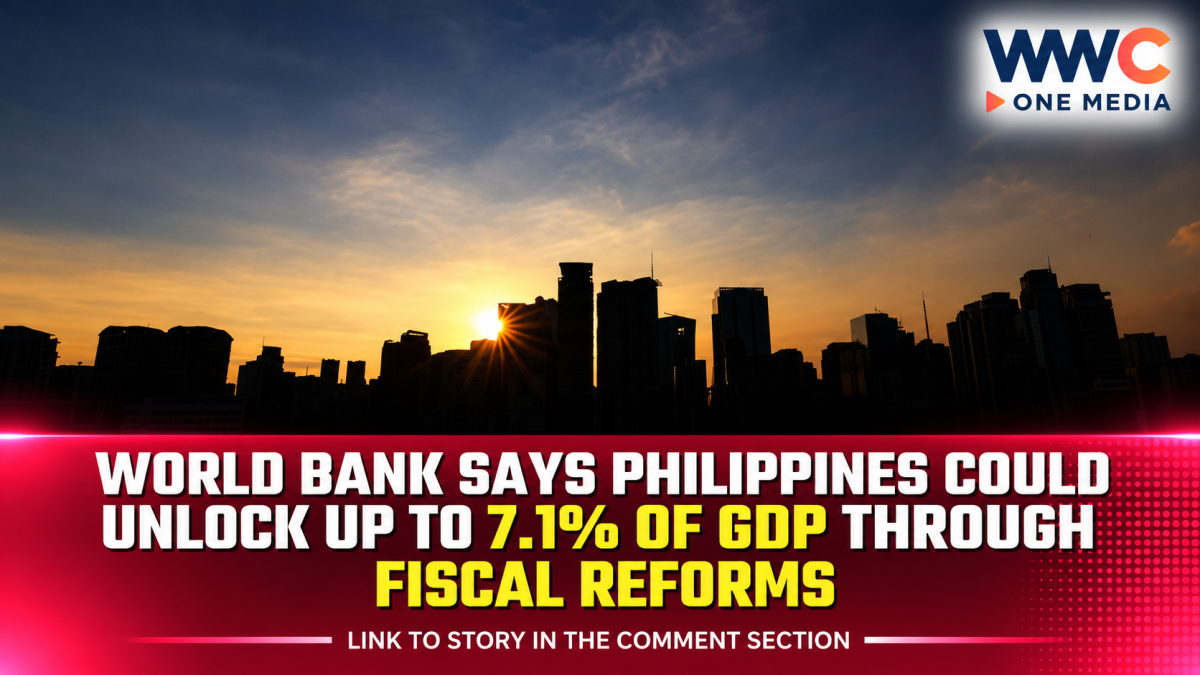
The Philippines could unlock fiscal savings and additional revenue equivalent to between 3.6% and 7.1% of gross domestic product (GDP) every year through reforms aimed at improving tax collection, reducing government inefficiencies and making public spending more effective, according to the World Bank.
The findings are contained in the World Bank’s latest Public Finance Review, which outlines reforms intended to strengthen the country’s fiscal position while supporting economic growth and more inclusive public services.
One of the biggest opportunities identified is government procurement. The World Bank estimates that consolidating purchases and negotiating better prices for commonly used goods and services could save the government as much as P435 billion annually.
The proposed reforms also include simplifying tax payments, broadening the tax base, reviewing corporate tax incentives and strengthening controls over government appropriations. The World Bank estimates that its first package of reforms could create fiscal space equivalent to about 2.2% to 4.4% of GDP.
A second set of measures focuses on closing gaps in revenue collection and public financial management. These include expanding electronic invoicing, improving tax audits, matching taxpayer information across government systems and modernizing financial-management systems. These reforms could generate another 1.4% to 3.1% of GDP in fiscal savings and additional revenue.
The World Bank has also recommended reviewing selected value-added tax exemptions while strengthening assistance for poorer households. The report notes that some tax exemptions can benefit higher-income consumers disproportionately because they generally consume more of the goods and services covered by such exemptions.
Beyond revenue and spending reforms, the World Bank emphasized the need to make existing investments in health, education and social protection more targeted. Recommendations include improving the identification of beneficiaries, strengthening health assistance and directing education resources toward foundational learning, classrooms and teaching materials in underserved communities.
The potential fiscal gains come as the Philippines works to rebuild its fiscal buffers following the pandemic and sustain growth after recently reaching upper-middle-income status.
Finance Secretary Frederick Go said the government would review the recommendations and work with the World Bank to strengthen technical capacity and monitor progress on fiscal reforms.
The World Bank stressed that the estimated 3.6% to 7.1% of GDP represents potential annual fiscal gains if reforms are successfully implemented. It does not mean the government would automatically receive an equivalent amount of new funds.
If carried out, the proposed measures could give the government additional fiscal room for priorities such as health, education, infrastructure, social protection and debt management while improving the efficiency of how public resources are collected and spent.