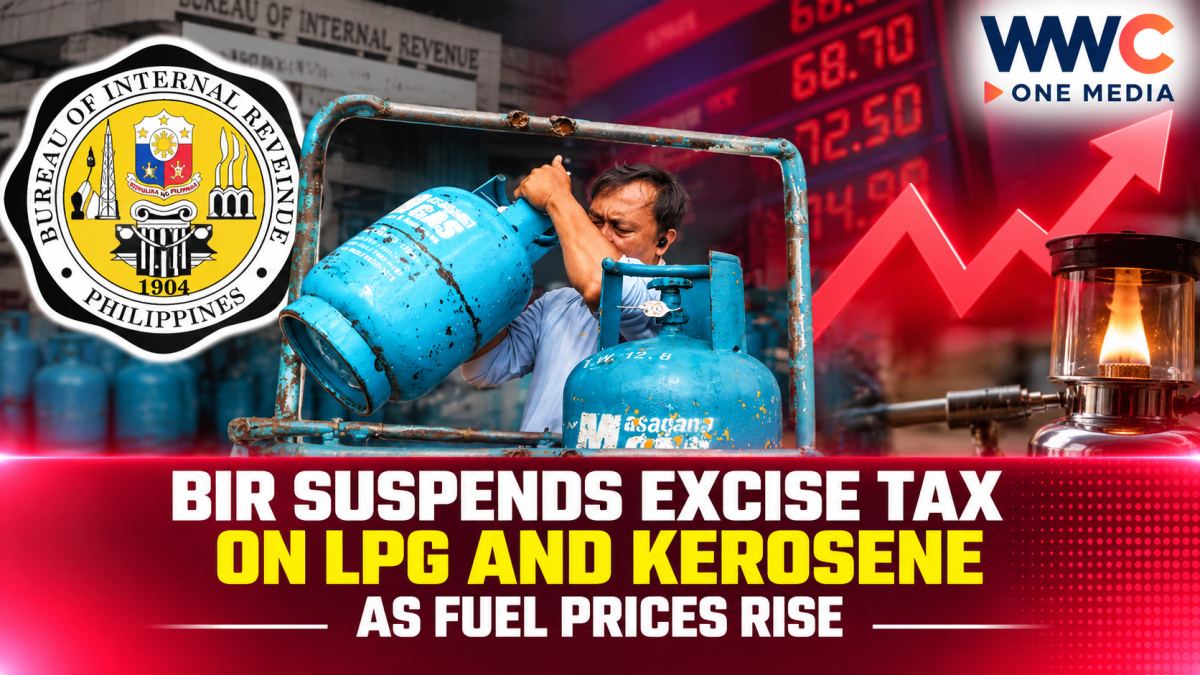
The Bureau of Internal Revenue (BIR) has officially suspended the excise tax on liquefied petroleum gas (LPG) and kerosene as the Philippine government moves to provide relief amid elevated global oil prices.
The suspension was implemented through Revenue Memorandum Circular No. 100-2026 following Executive Order No. 125, which President Ferdinand Marcos Jr. signed on September 25.
The measure took effect after the Department of Energy (DOE) certified that the one-month average price of Dubai crude reached $99.41 per barrel from August 13 to September 11. The figure exceeded the $80-per-barrel threshold set under the country’s fuel-tax relief mechanism.
Under the order, the excise tax on LPG is suspended, except when the product is used as a raw material for petrochemical production or as motive power. The excise tax on kerosene is also suspended, except when it is used as aviation fuel.
The move comes as rising international crude prices have pushed up domestic fuel costs, increasing pressure on households, transport operators and businesses. The government has been monitoring global oil markets as geopolitical developments continue to affect energy prices.
The latest suspension follows an earlier tax break implemented in April. That suspension was lifted in July after the DOE determined that the average Dubai crude price had fallen below the required threshold.
The new suspension is temporary. Regular excise-tax rates will return one week after the one-month average Dubai crude price falls below $80 per barrel, as certified by the DOE, or three months after the executive order takes effect, whichever comes first.
Government agencies have also been ordered to strengthen monitoring of LPG and kerosene supplies. The DOE, Department of Finance, BIR and Bureau of Customs are required to conduct an inventory of covered fuel stocks, while the BIR and BOC must submit monthly information to Congress on declared volumes and values.
The tax suspension will also reduce government revenue. The previous suspension resulted in nearly P3 billion in foregone collections, while officials have estimated that the renewed measure could reduce government revenues by at least P700 million per month.
The latest policy underscores the government’s effort to cushion consumers from higher energy costs while global oil prices remain elevated. Its duration, however, will depend on movements in international crude prices and the conditions established under the executive order.