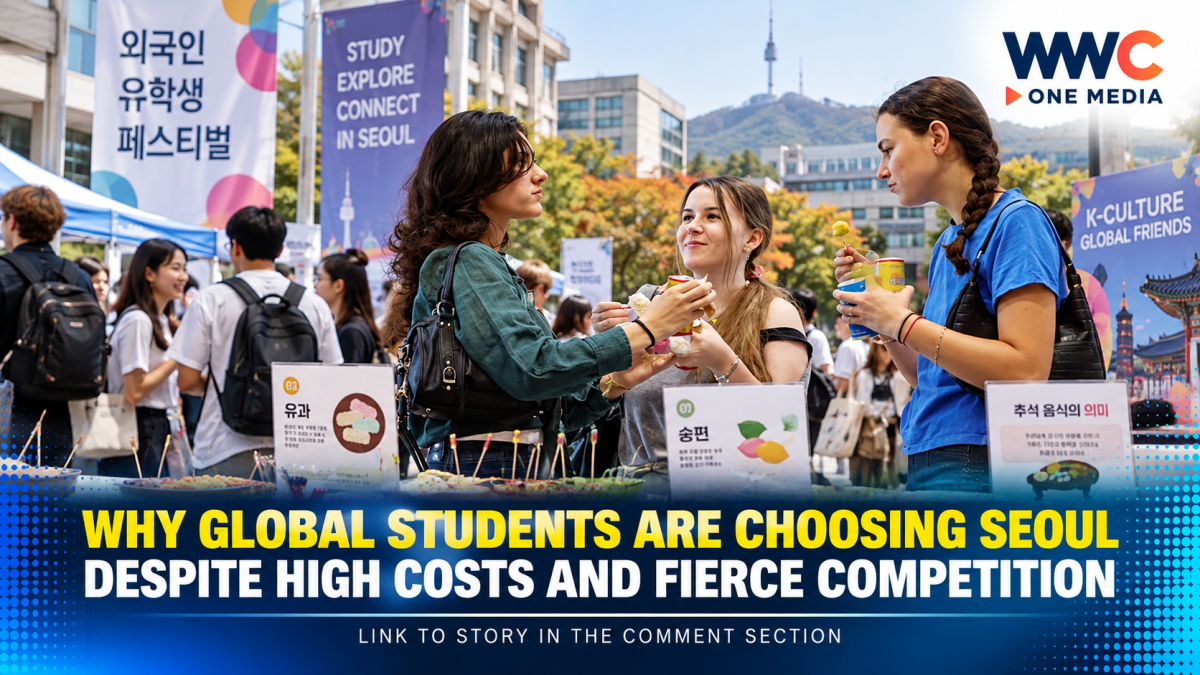
SEOUL — Seoul is becoming an increasingly attractive destination for international students, drawn by the city’s safety, efficient public services, cultural influence and expanding academic and professional opportunities — even as expensive housing, intense competition and gaps in university support create challenges.
A recent survey by The Korea Times Global Supporters found that international students living in Seoul value the capital’s combination of safety, administrative efficiency, education and cultural experiences. Students from Canada, Germany, Vietnam, Cambodia and other countries described Seoul as a place where academic life increasingly overlaps with professional networking, cultural immersion and career opportunities.
Seoul’s Appeal Goes Beyond K-Pop
Korean pop culture remains an important part of the city’s international appeal, but students interviewed by The Korea Times pointed to broader reasons for choosing Seoul.
Canadian student Marie, who studies communication and media at Ewha Womans University, said Korea’s growing role internationally was one reason she wanted to experience life there.
Other students highlighted Seoul’s combination of traditional culture and advanced technology, its entertainment industry and the sheer concentration of educational, professional and cultural resources in the capital.
The Financial Times similarly reported this month that Seoul is gaining ground as an international student destination, with students attracted by its urban culture and lifestyle as well as comparatively manageable costs when measured against some major Western cities.
International Student Numbers Are Surging
The trend is not limited to Seoul.
According to Times Higher Education, South Korea had 314,397 international students as of February 2026, based on Korean Immigration Service data. That figure allowed the country to reach its government target of 300,000 international students two years ahead of the original 2027 deadline.
Earlier Korea Times reporting, based on Financial Times coverage, put university international enrollment at 307,500, a 69% increase over three years. The difference reflects different reporting dates and datasets, rather than necessarily representing a contradiction.
The expansion has made international students an increasingly important part of South Korea’s higher-education landscape.
The Cost of Living Remains a Complication
Seoul’s appeal does not mean life in the capital is inexpensive.
International students interviewed by The Korea Times said housing can be surprisingly small and costly, while some also pointed to limited university support for integration, communication, language assistance and accommodation.
At the same time, reported housing prices can look relatively attractive when compared with some major Western capitals.
Korea Times reporting based on the Financial Times cited monthly rent of roughly 900,000 won ($660) for a one-room apartment and about 600,000 won ($440) for a hasuk, a Korean-style boarding house. Actual costs vary considerably according to location, housing type and deposit requirements.
Safety and Convenience Stand Out
Safety and administrative convenience also emerged as recurring themes among international students.
One German student interviewed by The Korea Times described Korea as safe and praised the speed of administrative processes. Other students cited Seoul’s public services and transportation infrastructure as advantages of living in the capital.
The Seoul Metropolitan Government has also expanded programs aimed at helping international students adjust to life in the city.
Its “30 Days in Seoul” program pairs international students with Korean university students for cultural exchange, everyday-life activities and support during their adjustment to the city. Separate programs provide career-development and settlement support.
But Getting a Future in Seoul Is Another Challenge
For some international residents, studying in Seoul is only the beginning.
The Korea Herald reported in June that 75% of foreign residents surveyed by the Seoul Metropolitan Government said they intended to continue living in Seoul, while 31.1% said finding economic opportunities remained difficult. The city has responded by expanding employment and entrepreneurship programs for foreign residents.
Seoul has also expanded support for foreign entrepreneurs through programs covering Korean business practices, taxation, accounting and legal issues, alongside opportunities to connect with investors.
That reflects a larger challenge facing South Korea’s internationalization strategy: attracting students is one task, but helping graduates integrate into the workforce and society is another.
Times Higher Education reported that experts have urged South Korea to focus not only on enrollment numbers but also on integration, employment and post-graduation retention.
Seoul’s Global Student Boom Enters a New Phase
Seoul’s growing popularity shows how the global study-abroad landscape is changing.
For many students, the decision is no longer based solely on university reputation. Lifestyle, safety, culture, technology, career possibilities, transportation and the opportunity to experience a rapidly changing society are increasingly part of the calculation.
But Seoul’s growing appeal also creates pressure on universities and the city itself to provide adequate housing, language assistance, social integration and pathways into employment.
The result is a more complicated picture than the image of Seoul as simply a K-culture destination.
International students are arriving for the culture — but many are staying for the opportunities.
And as South Korea moves beyond its 300,000-student milestone, the next question may be whether Seoul can turn its growing global popularity into a sustainable international education ecosystem.
WWC ONE MEDIA G,A