
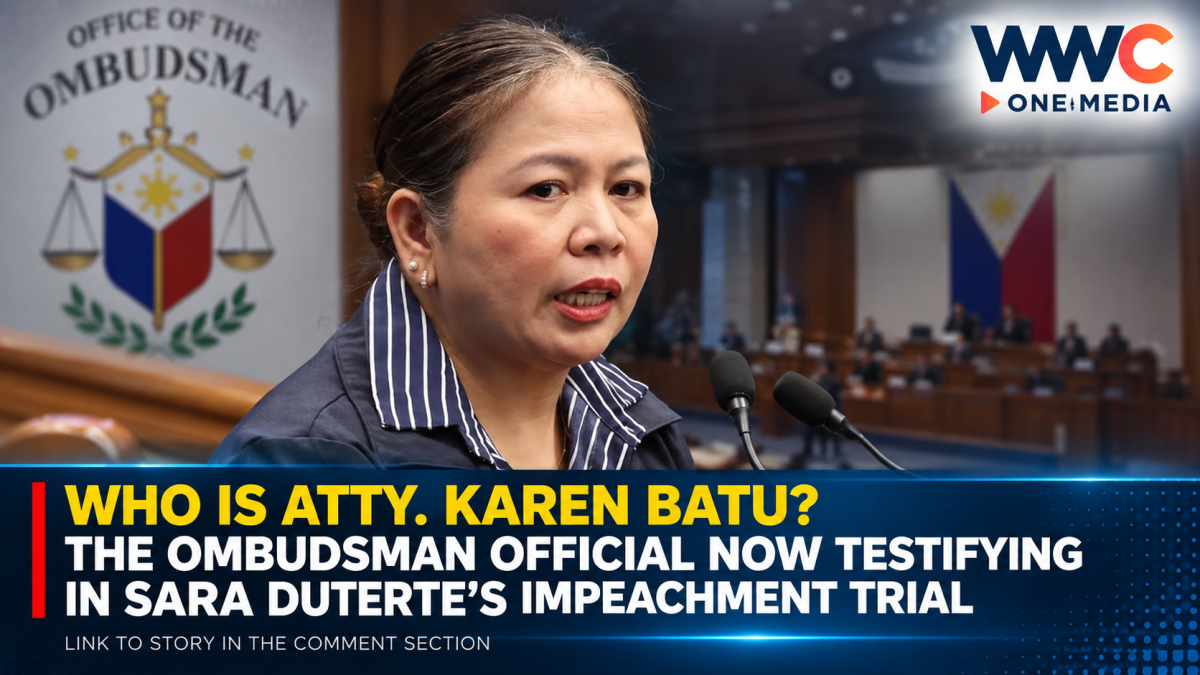
MANILA, Philippines — She is not a politician, a prosecutor, or a member of Vice President Sara Duterte’s defense team. Yet on Tuesday, September 15, 2026, lawyer Karen S. Batu found herself at the center of one of the most closely watched portions of Duterte’s impeachment trial.
Batu, the Officer-in-Charge of the Records Division of the Office of the Ombudsman, took the witness stand as the House prosecution panel began presenting evidence for Article II, which accuses Duterte of, among other allegations, accumulating unexplained wealth and making questionable declarations in her Statements of Assets, Liabilities and Net Worth (SALNs).
But who exactly is Karen Batu — and why did prosecutors choose her for this part of the case?
From graft prevention officer to Ombudsman records chief
Batu has been with the Office of the Ombudsman for years.
According to her testimony reported by GMA News, she first served in 2010 as a graft prevention and control officer with the Ombudsman’s Public Assistance and Corruption Prevention Office.
After passing the Bar Examinations in 2014, she was promoted to Graft Investigation Officer I and assigned to the Ombudsman Proper.
She eventually rose through the agency’s ranks. In 2025, she became a Graft Investigation and Prosecution Officer III, before later serving as officer-in-charge of the Central Records Division. GMA reported that she has held the OIC position since December 2025.
Her earlier government work is also documented in an Office of the Ombudsman order from 2016, which listed Atty. Karen S. Batu among personnel designated as coaches for the agency’s Integrity Management Program.
Why is Batu important to the impeachment case?
The answer lies in the records she handles.
The Ombudsman’s Central Records Division is responsible for managing official case records, including complaints, pleadings, SALNs and other documents filed with the agency.
That makes Batu a key records witness for the prosecution’s presentation of Duterte’s financial declarations.
The House prosecution previously identified her as the witness who would identify and authenticate Duterte’s SALNs and related Ombudsman records. The SEC’s Gerardo del Rosario, meanwhile, was tapped to authenticate corporate records involving companies and business interests linked to Duterte and her husband, lawyer Manases “Mans” Carpio.
In other words, Batu’s role is primarily about establishing what the official government records actually contain.
That distinction is important.
Her testimony about what appears in a SALN does not by itself establish that Duterte acquired unexplained wealth. It establishes what was recorded in the documents. The prosecution still has to prove its allegations using the broader body of evidence.
Batu had already appeared in the Duterte impeachment proceedings
Tuesday’s testimony was not Batu’s first appearance in proceedings involving Duterte.
In April 2026, she testified before the House Committee on Justice about Duterte’s SALNs covering years dating back to her time as a Davao City official.
The Ombudsman official confirmed that the agency had obtained earlier SALNs from its Mindanao area office, where records from Duterte’s years as Davao City vice mayor and mayor were kept.
During that hearing, lawmakers examined how Duterte’s declared net worth changed over the years.
Batu confirmed, based on the documents, a declared net worth of about P7.25 million in 2007 and P88.51 million in 2024.
The cash-declaration issue
One of the most closely scrutinized portions of Batu’s earlier testimony involved Duterte’s declared cash.
According to the SALNs presented during the proceedings, Duterte declared cash on hand and bank deposits in earlier years but no cash on hand or bank deposits were listed from 2019 onward.
Batu confirmed that the submitted SALNs contained no such entries.
On Tuesday, the issue returned to the Senate impeachment court.
Batu testified that Duterte’s SALNs for 2021, 2022, 2023, 2024 and 2025 likewise contained no declared cash on hand or cash in bank. GMA also reported that Duterte’s defense had previously argued that the cash and other assets were lumped under the “others” category.
That explanation has become part of the dispute over how Duterte’s financial declarations should be interpreted.
The numbers prosecutors are examining
The scrutiny goes beyond cash.
Earlier proceedings using the Ombudsman’s records showed Duterte’s declared net worth changing substantially over the years. Manila Bulletin reported figures including approximately:
- 2007: P7.25 million
- 2016: P34.89 million
- 2018: P49.69 million
- 2019: P55.61 million
- 2020: P56.58 million
- 2021: P65.31 million
- 2022: P71.06 million
- 2023: P77.51 million
- 2024: P88.51 million
The prosecution is examining these declarations alongside other financial and corporate records.
The Senate impeachment court is therefore not simply looking at a single SALN. Prosecutors are attempting to build a larger evidentiary picture involving assets, liabilities, cash declarations, business interests and corporate records.
Batu’s testimony is only one piece of the prosecution’s case
The prosecution’s witness lineup underscores that point.
Retired Sandiganbayan Presiding Justice Amparo Cabotaje-Tang opened the Article II presentation by discussing the legal and constitutional principles involving public accountability, unexplained wealth, SALNs, business interests and beneficial ownership.
Batu’s role is different: documentary records and SALNs.
The next witness, SEC official Gerardo del Rosario, is expected to deal with corporate records involving businesses and interests connected to Duterte and Carpio.
The prosecution had also said it had more than 1,800 financial documents to present in connection with the unexplained-wealth allegations.
Why her testimony could become crucial
Batu’s importance in the trial comes down to one word: records.
She is not being presented as someone who personally witnessed Duterte acquire money or assets. Rather, she is being called because of her position and familiarity with records maintained by the Ombudsman.
That means the prosecution can use her testimony to establish the authenticity and contents of Duterte’s official SALNs before attempting to connect those documents with other evidence.
The defense, meanwhile, has the opportunity to challenge the prosecution’s interpretation of those records and explain discrepancies or omissions.
That distinction could become increasingly important as the trial moves deeper into the allegations of unexplained wealth.
The bigger question now
Batu’s appearance marks another major stage in Duterte’s impeachment trial.
What began as a question about documents and financial declarations is now moving toward a broader examination of how Duterte’s declared wealth changed, what she reported, what she did not report, and how those declarations compare with other government and corporate records.
For Batu, the role is relatively straightforward: tell the impeachment court what the Ombudsman’s records show.
For the prosecution, however, those records could become a critical foundation for its Article II case.
And as more financial documents and corporate records are presented, the bigger question confronting the Senate impeachment court will be whether the evidence merely reveals unusual or disputed SALN entries — or ultimately proves the constitutional allegations being made against the Vice President.




Leave a Reply