
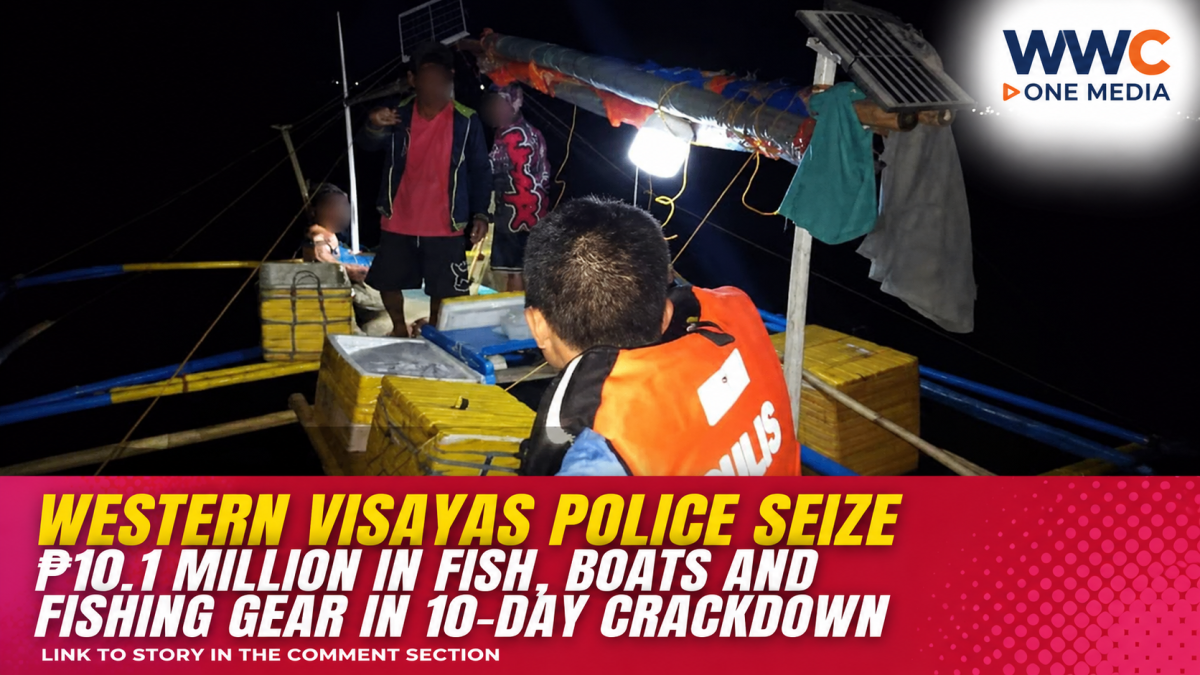
ILOILO CITY, Philippines — Authorities in Western Visayas have intensified their campaign against illegal fishing, confiscating more than ₱10.16 million worth of fish, motorboats and fishing equipment in just 10 days.
The Police Regional Office 6 (PRO-6) said its units conducted 58 anti-illegal fishing operations from July 1 to 10, 2026, resulting in the apprehension of 98 individuals for alleged violations of fisheries laws.
The crackdown covered Iloilo, Antique, Guimaras, Aklan and Capiz, with police coordinating with local governments and other stakeholders to enforce fisheries regulations and protect coastal resources.
More than ₱10 million worth of fishing assets seized
According to PRO-6, the total value of the confiscated items reached ₱10,164,490.
Of that amount, approximately ₱111,360 represented seized fish, while the remaining value came from fishing equipment, motorboats and other fishing paraphernalia.
Iloilo recorded the largest haul, with 23 operations leading to the apprehension of 39 people and the seizure of fishing equipment and motorboats worth about ₱7.56 million.
Antique police conducted another 23 operations and confiscated fishing equipment valued at ₱755,290, while Guimaras units recorded five operations involving items worth approximately ₱1.286 million. Aklan and Capiz police also participated in the regionwide enforcement campaign.
The crackdown is getting bigger
The latest operation is part of a continuing campaign rather than an isolated enforcement action.
Just days later, PRO-6 reported another series of anti-illegal fishing operations that resulted in 32 more arrests and ₱2.68 million worth of fishing equipment and catch seized from July 16 to 18.
Earlier, a separate 24-hour campaign from August 15 to 16 resulted in 33 arrests and more than ₱3 million worth of fish catch and fishing equipment confiscated across Aklan, Antique, Capiz and Iloilo.
By late July, PRO-6 had reported that its broader environmental enforcement campaign from May 22 to July 22 had already resulted in 669 arrests linked to illegal fishing, with fish worth ₱880,605 and fishing equipment, motorboats and related paraphernalia valued at about ₱49 million confiscated.
Why illegal fishing is a major concern
The police say the campaign is about more than catching alleged violators.
Western Visayas has extensive coastal communities whose livelihoods depend on fishing. Authorities argue that destructive and unauthorized fishing practices can damage marine ecosystems while also placing legitimate fisherfolk at a disadvantage.
PRO-6 Acting Regional Director Brig. Gen. Randulf Tuaño said the campaign is intended to protect marine resources, preserve the region’s fisheries and safeguard the livelihoods of law-abiding fishing communities.
The Bureau of Fisheries and Aquatic Resources has likewise continued strengthening fisheries-law enforcement and monitoring efforts, including joint operations with the Philippine National Police, Philippine Coast Guard, maritime units and local governments in other parts of the country.
Philippine fisheries laws carry serious penalties
The country’s fisheries regulations prohibit various forms of destructive, unauthorized and illegal fishing.
Republic Act No. 10654 strengthened the Philippine Fisheries Code and introduced tougher measures against illegal, unreported and unregulated fishing. Authorities have repeatedly reminded fishing operators to secure the required permits and comply with restrictions on prohibited fishing equipment and practices.
The seizures also come as BFAR continues updating and enforcing fisheries regulations. For example, BFAR issued Fisheries Administrative Order No. 277 in July 2026, regulating the use of blue swimming crab gillnets in Philippine waters.
A warning to illegal fishing operators
The latest numbers show that enforcement activity across Western Visayas is intensifying.
For legitimate fisherfolk, authorities say the objective is to protect the waters that provide food and income for coastal communities. For those operating without permits or using prohibited methods, the continuing operations signal that enforcement will remain active across the region.
With repeated seizures running into millions of pesos, the bigger question is how sustained these operations can become — and whether stronger enforcement will translate into healthier marine resources and better protection for legitimate fishermen.
WWC ONE MEDIA J.M.D




Leave a Reply