
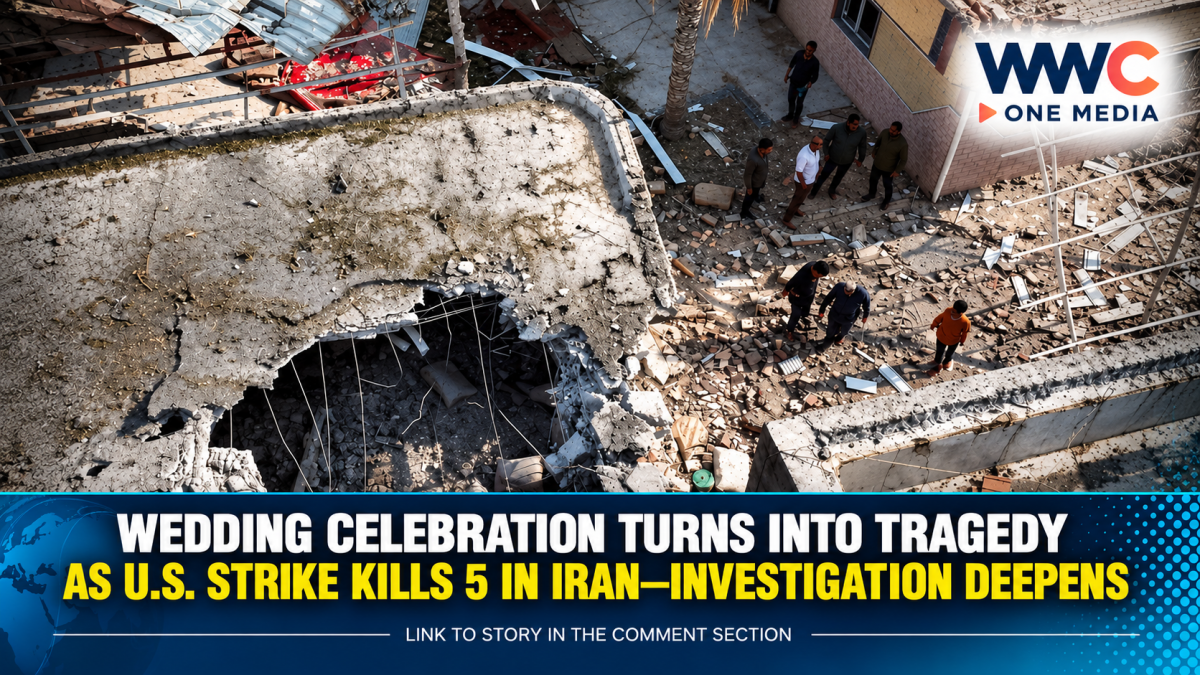
KUHESTAK, Iran — What was supposed to be a joyful wedding celebration in a small southern Iranian town ended in devastation after a strike hit a residential compound where women and children had gathered.
At least five people died, including a 4-year-old boy, a 16-year-old and two women, while more than 60 others were injured, according to Iranian officials and the Associated Press. A fifth victim, a woman who had been wounded in the attack, later died at a hospital.
The strike occurred Tuesday evening in Kuhestak, a town in Sirik County in Iran’s southern Hormozgan province, near the strategically important Strait of Hormuz.
The tragedy has since become one of the most emotionally charged episodes of the latest U.S.-Iran confrontation.
A wedding became a scene of devastation
According to AP reporting from the town, women and children had gathered at a family compound while waiting for the bride and groom to arrive.
Instead of music and celebration, the gathering was interrupted by explosions.
The attack caused extensive damage to the property and surrounding area. Residents described helping injured people from the rubble as emergency workers searched for survivors.
Images and video from the scene showed a heavily damaged home and debris scattered across the area.
Iranian authorities said the strike killed civilians who had been attending the wedding celebration.
The Iranian Red Crescent reported the initial deaths and injuries, making the organization one of the principal sources for casualty information from the scene.
The death toll rose after the attack
Initial reports put the number of dead at four.
That figure later increased to five when another injured woman died from her wounds.
The number of injured has varied between reports as authorities continued assessing casualties. Reuters reported that Iranian officials put the number of wounded at nearly 70, while other Iranian sources have reported different totals.
The changing figures explain why some early reports continue to list four deaths.
For current reporting, however, five deaths is the latest figure reported by AP and Reuters-based coverage.
Was the wedding deliberately targeted?
That remains the critical unanswered question.
Iran has accused the United States of striking a civilian gathering and condemned the attack as evidence of the human cost of the American military campaign.
The United States, however, has denied deliberately targeting civilians.
U.S. officials have said American forces were conducting operations against military-related targets in the area, including infrastructure connected to Iranian military capabilities.
Vice President JD Vance said the U.S. military was investigating what happened and maintained that deliberately attacking civilians is not American policy.
That investigation could determine whether the wedding gathering was struck accidentally, whether the intended target was nearby, and what weapon caused the blast.
Reuters analysis points to a direct U.S. munition
The investigation has gained additional significance because of a Reuters examination of photographs, videos and physical evidence from the scene.
Weapons experts consulted by Reuters concluded that the damage pattern was consistent with a direct strike from a U.S. munition, rather than a ricochet or an Iranian air-defense interception.
Reuters reported that experts believed the weapon may have been a roughly 500-pound air-dropped bomb. The analysis also found that the wedding location was close to a telecommunications tower that U.S. officials said had been targeted.
That finding does not, by itself, establish that the United States intentionally targeted the wedding.
It does, however, strengthen evidence that an American weapon was responsible for the blast and makes the ongoing U.S. investigation particularly consequential.
A telecommunications tower was reportedly the target
Two U.S. officials told Reuters that American forces conducted strikes around Kuhestak on September 1 and that a telecommunications tower in the town was among the intended targets.
The wedding compound was located only a short distance from the tower.
A communications tower was also damaged, temporarily affecting telephone and internet connectivity in the area, according to AP reporting.
The proximity between the reported target and the civilian gathering is now central to questions surrounding the strike.
Iran’s retaliation followed
The wedding tragedy occurred as fighting between the United States and Iran was intensifying again.
Following the U.S. strikes, Iran launched retaliatory attacks against American military positions and other targets across parts of the Middle East.
The confrontation has also centered heavily on the Strait of Hormuz, a crucial international energy and shipping route.
The strategic importance of the area means that military operations around southern Iran carry consequences well beyond the immediate battlefield.
The town is now mourning
In Kuhestak, the aftermath has been deeply personal.
Funeral gatherings brought residents together as the community mourned the people who had been killed while attending what should have been a celebration.
AP reporters who visited the area described a town struggling to process the destruction and loss.
The victims included children, making the emotional impact even greater for residents.
For families in the town, the political arguments surrounding the wider conflict are secondary to the immediate reality: relatives and friends went to a wedding and never came home.
A wider controversy over civilian casualties
The Kuhestak strike is also being viewed in the context of other civilian deaths connected to the broader U.S.-Iran conflict.
Reuters reported that the latest U.S. strikes between August 30 and September 2 killed at least 18 people and injured more than 140, according to Iranian health authorities.
The United States insists that its military operations are directed at military targets and that civilians are not intentionally targeted.
But the deaths in Kuhestak have intensified scrutiny of the gap between intended targets and civilian consequences.
The Pentagon’s investigation is therefore likely to face questions not only about what happened at the wedding but also about the procedures used to identify and strike targets in densely populated areas.
What happens next?
For now, the most important fact is that five people are dead and dozens more were injured.
Iran says civilians were struck during a wedding.
The United States says it does not target civilians and is investigating the incident.
Independent weapons analysis by Reuters indicates that a U.S. munition likely directly struck the area.
Those facts can coexist without establishing that the wedding itself was deliberately targeted.
The investigation will need to answer the questions that residents of Kuhestak are now asking:
Why was the residential compound hit?
What was the intended target?
Was the civilian gathering known to U.S. forces?
And perhaps the most important question of all:
Could the tragedy have been prevented?
Until those answers emerge, Kuhestak will remain a symbol of the human cost of a conflict that is increasingly being fought not only between governments and militaries, but in communities where ordinary families are simply trying to live.
A wedding was supposed to mark a beginning.
Instead, the town is now burying its dead.




Leave a Reply