
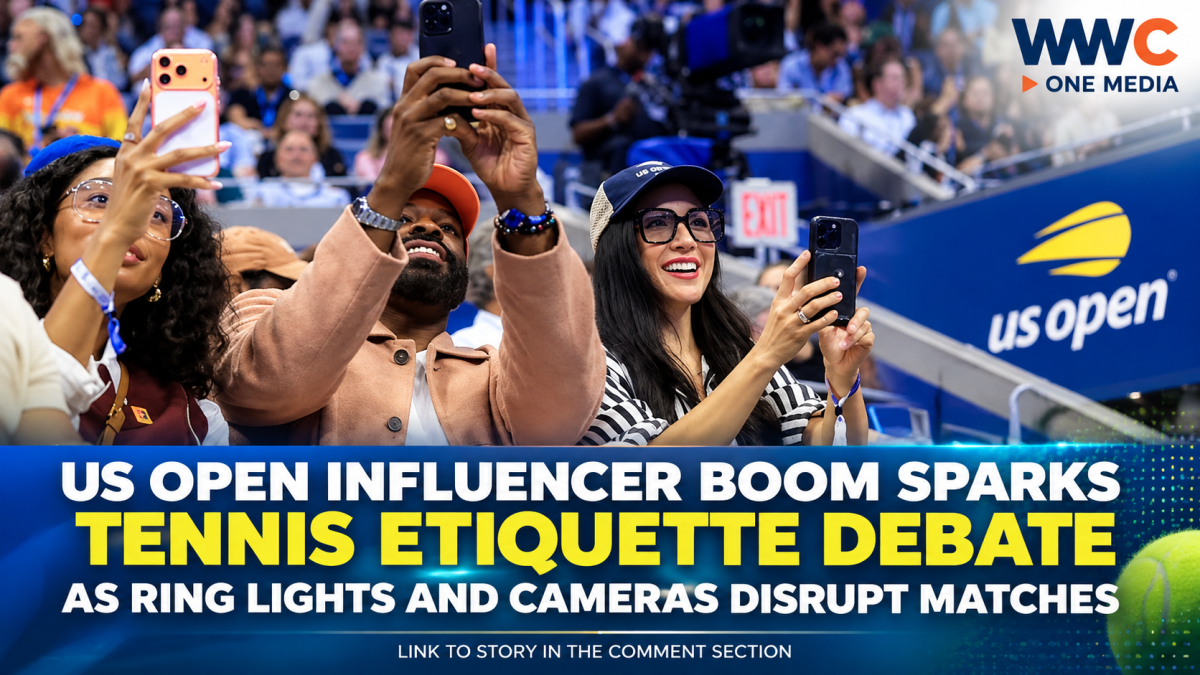
NEW YORK — The U.S. Open is becoming more than a Grand Slam tennis tournament. It is increasingly a social-media spectacle — and that transformation is triggering a growing debate over where content creation ends and basic tennis etiquette begins.
Influencers and content creators armed with smartphones, cameras and ring lights have become a highly visible presence at this year’s tournament in New York. But several incidents involving filming and photography during matches have raised concerns among players and fans about distractions inside the stadium.
The controversy has put the spotlight on a difficult question for modern professional sports: How can major tournaments attract new digital audiences without allowing social-media content to interfere with the competition itself?
Influencers become part of the US Open spectacle
The U.S. Tennis Association has issued approximately 100 creator-media credentials for this year’s US Open, according to ABC News. That is nearly twice the number issued when the creator program was launched in 2025.
The strategy reflects how dramatically social media has changed sports coverage.
Creators can reach audiences that traditional sports media may not reach, while short-form videos can showcase everything from matches and players to food, fashion and the overall US Open experience.
About 20 of the credentialed creators were specifically assigned to cover the tournament’s food and beverage scene, Reuters reported, while thousands of other social-media users attended with their own tickets and phones.
But the increased creator presence has also produced moments that have frustrated players.
Match interrupted during Naomi Osaka’s first round
One of the most widely discussed incidents happened during Naomi Osaka’s first-round match against Anastasia Zakharova at Arthur Ashe Stadium.
A group of spectators in a hospitality suite were taking photographs and using lighting equipment while the match was taking place. Chair umpire Kader Nouni intervened and asked those involved to sit down, briefly interrupting the action.
The incident quickly circulated on social media and intensified the debate over whether the pursuit of viral content is beginning to clash with the traditional expectations of professional tennis spectators.
Other videos showed spectators using ring lights and flash photography while matches were underway.
Jessica Pegula says it may have gone “too much”
World No. 3 Jessica Pegula has emerged as one of the most prominent players to criticize the behavior.
Pegula said she understands why the tournament wants influencers involved because they can showcase the US Open to new audiences. However, she said seeing creators taking photographs with selfie lights while players are competing can cross a line.
She characterized the situation as potentially having gone “a little too much.”
Her comments capture the central tension surrounding the controversy: players and tournament organizers want tennis to reach a larger audience, but players also need an environment where they can compete without unnecessary distractions.
Not every creator was responsible
There is an important distinction that has emerged from the reporting.
The people involved in the incident during Osaka’s match were not attending under official US Open creator credentials, according to tournament spokesman Brendan McIntyre, as reported by Axios.
That means the controversy should not simply be characterized as “credentialed influencers disrupting matches.”
Instead, it reflects a broader phenomenon: the US Open has become an enormous social-media destination, attracting both officially credentialed creators and ordinary spectators who want to produce viral content.
US Open responds with new warnings
The USTA has responded by increasing reminders to spectators about appropriate behavior.
ABC News reported that new signs were placed around the tennis center asking fans to refrain from flash photography and other lighting during matches. The organization also said it had contacted ticket and suite holders with reminders about activities that could interfere with play.
The tournament’s official Guest Code of Conduct also prohibits disruptive behavior and requires spectators to follow instructions from officials and posted signage.
The USTA says disruptions remain infrequent and that chair umpires have the authority to address distractions when they occur.
The US Open has always been different
Part of the debate stems from the personality of the tournament itself.
Unlike the traditionally restrained atmosphere associated with Wimbledon, the US Open has long embraced a louder, more commercial and entertainment-focused environment.
Madison Keys, the 2017 US Open finalist, described the tournament as having a “big-show Grand Slam” identity.
That atmosphere has helped make Flushing Meadows one of the most recognizable sporting events in the United States.
But the expansion of social media has taken that spectacle to another level.
Fans can now instantly publish videos from inside the stadium, document celebrity appearances, review food, create fashion content or produce behind-the-scenes material for millions of followers.
The challenge is ensuring that the content does not become more important than the match.
Tennis needs the social-media audience
There is another side to the argument.
Not every player believes influencers are a problem.
Frances Tiafoe has argued that creators can introduce tennis to people who might otherwise never watch the sport. If someone attends because they follow a creator, discovers an exciting five-set match and becomes a tennis fan, the exposure can ultimately benefit the game.
Daniil Medvedev has similarly emphasized that greater awareness and popularity can be positive for tennis, while acknowledging that lights or other distractions during points can create problems.
The men’s ATP Tour has also expanded its partnership with TikTok, with Reuters reporting that posts using the #tennis hashtag increased by more than 25 percent last year.
That illustrates why tournaments are eager to embrace creators rather than shut them out.
A bigger tournament means a bigger digital footprint
The influencer debate comes as the US Open itself continues to expand.
Growing attendance has contributed to the tournament extending its main-draw schedule to 15 days, while the mixed doubles competition has been staged separately ahead of the singles tournament.
More days, more fans and more content inevitably mean more opportunities for the tournament to become a social-media event.
But the bigger the digital footprint becomes, the more important clear boundaries may be.
The real issue is not influencers — it is disruption
The emerging consensus among players and organizers is more nuanced than simply opposing influencers.
The issue is not whether someone carries a smartphone into Arthur Ashe Stadium.
The issue is whether filming, lighting, talking, movement or staged photography interferes with players who are actively competing.
That distinction could become increasingly important as professional sports organizations compete for younger audiences.
The US Open has demonstrated that social media can bring tennis to millions of people who might not otherwise follow the sport.
But the tournament is also being reminded of an old sporting principle: the show should never become so loud that it overwhelms the competition.
For the players on court, every serve, return and point still matters more than the perfect Instagram shot.
WWC ONE MEDIA J.M.D

Leave a Reply