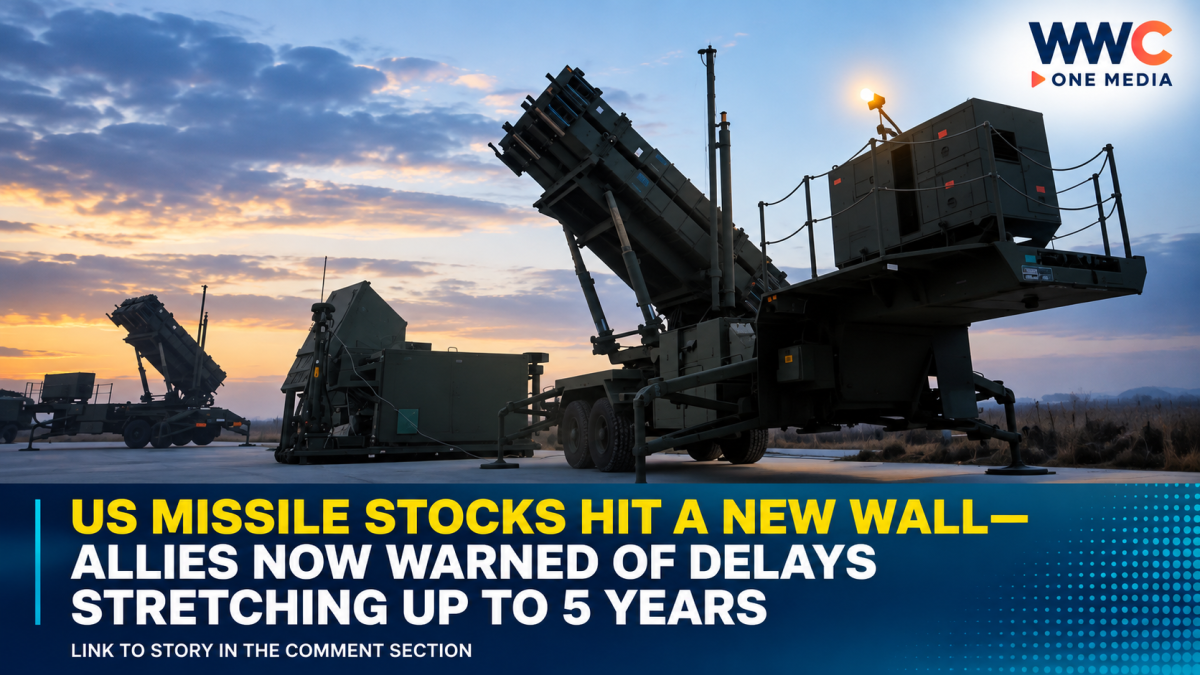
WASHINGTON — The United States has warned several allies that deliveries of critical missiles and air-defence systems could face delays of up to five years as Washington works to rebuild weapons stockpiles depleted during the war with Iran, according to officials cited by Bloomberg and reported by The Straits Times.
The warning highlights a growing pressure point for the US military: the country is simultaneously trying to replenish its own arsenal while meeting weapons commitments to allies and supporting Ukraine.
Germany is among the countries affected. Berlin has been seeking to accelerate deliveries of Tomahawk cruise missiles and Typhon launchers, but depleted US inventories mean Raytheon, a unit of RTX, may not be able to fulfil the Tomahawk order within the next five years, according to the Bloomberg report.
The problem extends beyond Germany.
Officials cited in the reporting said some Eastern European countries that depend heavily on US-made weapons have also experienced delays since the United States and Israel began their war against Iran on February 28.
The Iran war has consumed huge quantities of US missiles
The scale of weapons expenditure has become increasingly clear in recent weeks.
A Pentagon inspector-general report cited by The Straits Times said the heavy use of munitions during the Iran operation had produced strategic inventory shortfalls and exposed bottlenecks in the US defence-industrial base. The Pentagon is now working to secure critical components, build selected stockpiles and shorten production timelines.
The latest US military estimate also shows the financial scale of the conflict. According to the Associated Press, the US military estimated that the Iran war had cost $43.6 billion as of September 3, with weapons expenditures accounting for a substantial portion of the cost. The estimate put US munitions spending at about $28.1 billion.
The shortage is particularly significant for missile-defence weapons.
The United States is estimated to have used more than half of its most advanced Patriot missile variants, about one-third of its Tomahawk missiles and nearly half of its Precision Strike Missiles and THAAD interceptors during the Iran conflict, according to figures cited in the Bloomberg report.
The Congressional Budget Office has also estimated that the US may have used as much as two-thirds of its missile-defence interceptor inventory since June 2025, according to the Straits Times report.
Patriot shortage creates another pressure point
The strain is especially visible in the global demand for Patriot air-defence interceptors.
US Ambassador to NATO Matthew Whitaker said on September 18 that demand for Patriot missiles was outpacing production, warning that the international security environment was contributing to a shortage of interceptors.
The shortage matters directly to Ukraine, which has repeatedly sought additional Patriot interceptors to defend against Russian missile attacks.
European governments are also trying to rebuild their own air-defence inventories after sending systems and interceptors to Ukraine.
The Associated Press reported this week that US and NATO officials had described the shortage of missile interceptors in Europe as extremely serious, while Saudi Arabia has separately sought assistance from other countries as its own interceptor stocks come under pressure amid fighting involving Houthi forces in Yemen.
Japan and Switzerland have also faced delivery problems
The delivery crunch is not limited to Europe.
The United States warned Japan earlier this year that deliveries of 400 Tomahawk missiles could be delayed by as much as two years, according to reporting cited by The Washington Post and defence-industry publications.
Switzerland has faced a separate delay involving its Patriot order. Reuters reported in June that Switzerland’s Patriot deliveries, originally expected during 2026-2028, had been pushed back by four to five years amid competing demand and the effects of the war in Ukraine. Bern subsequently began exploring a second, non-US air-defence system to reduce its dependence on a single supplier and supply chain.
These delays demonstrate that the supply problem predates the latest five-year warning and has been developing across multiple US weapons programmes.
Washington is trying to expand production
The US and its defence contractors are attempting to close the gap, but production cannot be increased instantly.
Lockheed Martin has been working to expand annual production of the advanced PAC-3 MSE Patriot interceptor from roughly 600 missiles to as many as 2,000, according to the Straits Times report.
Germany and the United States have also agreed to deepen cooperation between their defence industries.
A September 16 agreement is intended to expand opportunities for licensed production and joint manufacturing of systems including Patriot interceptors and components of long-range strike weapons. Germany already produces older-generation Patriot interceptors and is preparing to begin production of an upgraded PAC-2 variant.
But expanding manufacturing capacity requires time, specialised components, trained workers and production infrastructure.
That means increased orders today do not necessarily translate into large numbers of additional missiles reaching the battlefield immediately.
Ukraine faces a difficult choice
The stockpile problem is creating a complicated balancing act for Washington and its allies.
Ukraine needs additional Patriot interceptors as Russia continues its missile and drone campaign. At the same time, the Pentagon is prioritising the rebuilding of US inventories after the enormous consumption of missiles during the Iran war.
President Donald Trump said this week that Washington was discussing either providing Ukraine with a less sophisticated version of the Patriot system or allowing European countries to manufacture the weapons under licence, according to the Straits Times report.
European leaders are expected to raise Ukraine’s air-defence needs with Trump during meetings in New York next week, while EU officials are also seeking greater access to US technology and licences that could allow European production of Patriot systems.
A wider warning for the US-led weapons network
The immediate issue is the delivery of individual missile systems. The longer-term question is the resilience of the defence-industrial base behind them.
The Iran war has demonstrated how quickly advanced missile inventories can be consumed during a sustained high-intensity conflict.
A recent Reuters report on NATO readiness similarly highlighted how the Ukraine war has exposed weaknesses in traditional procurement systems and increased European dependence on US missile-defence capabilities. European countries are now accelerating efforts to develop their own systems, including alternatives to US-made weapons.
For Washington, the challenge is therefore no longer simply producing more missiles.
It is rebuilding depleted inventories, maintaining support for Ukraine, meeting existing commitments to allies and ensuring sufficient stocks for potential future conflicts — all while defence manufacturers race to expand production.
The result could reshape the global weapons market: countries that have traditionally relied heavily on US missile systems may increasingly seek European, Asian or domestically produced alternatives as they confront longer delivery timelines and uncertainty over access to American stocks.
For now, the five-year warning is most directly tied to specific weapons and orders rather than every US arms sale. But the underlying problem is broader: demand for some of the world’s most sought-after missile-defence and precision-strike weapons is currently running ahead of the ability of manufacturers to replenish them quickly.