
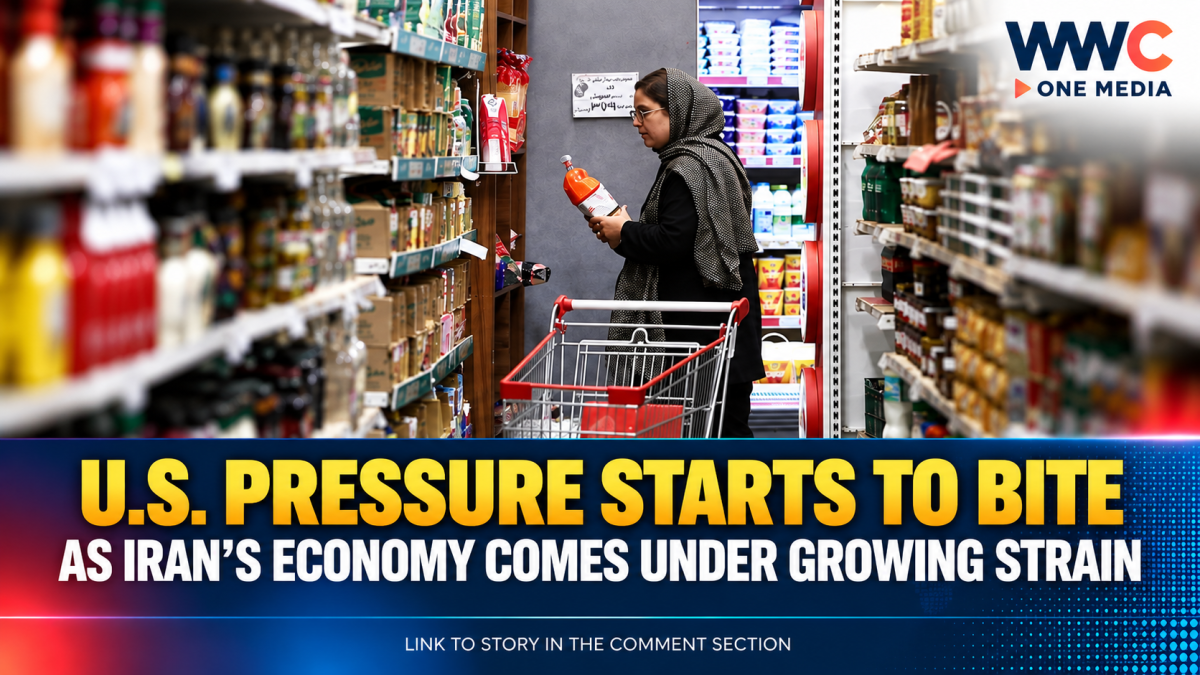
DUBAI — The economic pressure campaign against Iran is beginning to show deeper effects, with collapsing oil exports, a plunging currency and soaring inflation leaving Tehran with fewer options to keep trade and imports flowing.
A Reuters report published by The Korea Times on September 4 said three senior Iranian sources described the latest U.S. sanctions and measures targeting Iranian oil exports and sanctions-evasion networks as increasingly difficult for Tehran to withstand.
The development comes as the nearly six-month U.S.-Iran conflict enters another dangerous phase, with economic pressure running alongside renewed military confrontation around the Persian Gulf and the strategically vital Strait of Hormuz.
But while the pressure is clearly hurting Iran’s economy, analysts and other international reports caution that economic pain has not yet translated into Iranian capitulation or a political breakthrough.
Iran’s oil lifeline is being squeezed
One of the clearest signs of the pressure is Iran’s oil trade.
According to Kpler data cited by Reuters, Iranian crude loadings have fallen to approximately 260,000 barrels per day this month, dramatically below the roughly 1.7 million barrels per day recorded a year earlier.
Oil is critical to Iran because it provides a major source of foreign currency and government revenue.
The U.S. campaign has therefore focused heavily on preventing Tehran from selling crude and accessing the financial channels necessary to turn those sales into usable funds.
Reuters reported that sanctions targeting companies and countries doing business with Iran are also making traditional sanctions-evasion methods—including front companies, unregistered tankers and smuggling networks—more expensive and difficult to maintain.
Iran says it still has significant quantities of oil stored aboard tankers outside the affected area, but intermediaries are reportedly demanding higher premiums or stepping away from transactions because of the increased sanctions risk.
The rial has fallen to another record low
The financial squeeze is also hitting ordinary Iranians.
The Iranian rial has fallen from approximately 1 million rials per U.S. dollar a year ago to more than 2.2 million, according to the Reuters report.
Official figures cited by Reuters put Iran’s 12-month average inflation rate at 69.9%, while prices for food, beverages and tobacco have been rising at nearly twice that rate.
The deterioration is occurring against an economy already weakened before the current conflict.
The war has added enormous costs for rebuilding damaged infrastructure and industrial facilities, while disruptions to trade are making imported goods and raw materials harder and more expensive to obtain.
President Masoud Pezeshkian has said Iran’s overall trade has fallen by between 25% and 35%, with imports suffering particularly heavily.
Gasoline supplies are becoming another concern
Perhaps one of the most immediate risks is fuel.
A senior Iranian source told Reuters that Iran could have only about two months of gasoline supplies remaining.
That vulnerability exists despite Iran being a major oil producer because the country has insufficient refining capacity and therefore relies on imported gasoline to meet part of its domestic demand.
If fuel imports become increasingly difficult, the consequences could extend beyond government finances into transportation, food distribution, industry and everyday life.
The UAE trade channel has also been disrupted
Iran has traditionally relied on regional trading and financial networks to work around U.S. sanctions.
But one of those important channels has been damaged.
The United Arab Emirates announced on August 19 that commercial trade and financial dealings with Iran had been suspended until further notice, according to Reuters reporting. The UAE is a major regional commercial hub and has historically been an important conduit for Iranian trade.
That makes the latest pressure different from previous sanctions campaigns, because Tehran’s ability to simply reroute transactions through neighboring countries is becoming more constrained.
Washington is combining economic pressure with military force
The economic campaign is not happening in isolation.
The United States has simultaneously maintained military pressure against Iran, including operations around the Strait of Hormuz.
Associated Press reported that President Donald Trump is pursuing a combined strategy of economic pressure and military force, seeking to compel Tehran to make concessions while maintaining pressure on its government and nuclear ambitions.
U.S. forces recently struck Iranian rocket launchers on Larak Island near the Strait of Hormuz, according to AP and Financial Times reporting. The U.S. said the operation was intended to prevent Iranian forces from laying mines in the strategically important waterway.
The renewed fighting has also produced Iranian attacks against U.S. allies in the Gulf, further increasing the risk that an economic confrontation could spiral into a broader regional conflict.
Hormuz remains the biggest pressure point
The Strait of Hormuz is particularly important because it is one of the world’s most significant energy shipping routes.
The conflict has sharply reduced commercial traffic through the waterway, while Washington and Tehran continue to dispute the degree of control each side exercises over the strait.
The consequences extend far beyond Iran.
Asian economies are already examining ways to increase oil and gas storage closer to home because of their exposure to the disruption, according to Al Jazeera.
Higher energy costs can feed directly into transportation, electricity, manufacturing and food prices across the global economy.
But economic pressure does not necessarily mean Tehran is ready to surrender
This is where the picture becomes more complicated.
The worsening Iranian economy could increase pressure on Tehran to negotiate, but there is no clear evidence yet that the government is prepared to accept Washington’s demands.
AP reports that Iran’s leadership remains defiant despite the economic damage, while diplomatic negotiations remain stalled.
Iranian officials have also publicly argued that their economy and oil industry can continue operating despite the blockade.
In a September 4 update, Al Jazeera reported that Iranian Petroleum Minister Mohsen Paknejad said Iran’s oil industry was continuing to circumvent the U.S. blockade, describing the situation as difficult but manageable.
That highlights the central uncertainty: How much economic pain can Iran absorb before it changes its negotiating position?
The risk goes beyond economics
The economic deterioration is also creating a potential domestic political problem.
Reuters reported that Iranian officials are increasingly concerned about the consequences of inflation, unemployment and declining living standards. The country experienced major nationwide protests earlier this year, and officials are aware that another severe economic shock could create additional domestic pressure.
Official unemployment reached 9.1% in the spring, while employment fell by roughly 450,000 compared with the previous year, according to figures cited by Reuters.
For many households, the numbers translate into a much simpler reality: wages are struggling to keep pace with the cost of basic necessities.
What happens next?
For Washington, the calculation appears straightforward: tighten the economic vise until Tehran has fewer alternatives and becomes more willing to negotiate.
For Iran, the strategy appears to be survival—maintaining enough trade, energy revenue and regional leverage to prevent the U.S. campaign from achieving its political objective.
And there is another complication.
The harder the economic pressure becomes, the greater the potential incentive for Iran to retaliate militarily or use the Strait of Hormuz as leverage. Recent exchanges around the Gulf demonstrate how quickly economic pressure can become a military escalation.
That leaves the region facing a dangerous choice between economic exhaustion and escalation.
Iran’s economy is clearly under extraordinary pressure—but whether that pressure forces Tehran to negotiate, triggers greater retaliation, or produces a deeper internal crisis remains the question that could determine what happens next.


Leave a Reply