
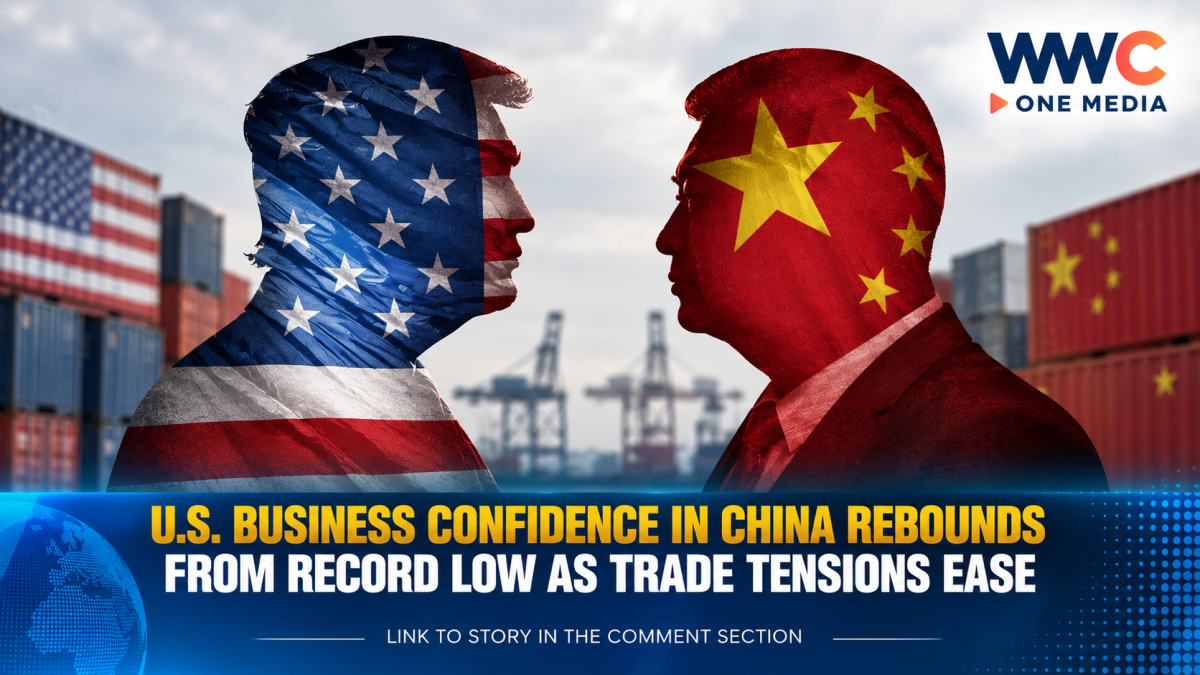
U.S. companies operating in China are becoming noticeably more optimistic about their long-term prospects, marking a sharp reversal from last year’s record-low confidence—but the rebound comes with a major warning.
According to the 2026 China Business Report from the American Chamber of Commerce in Shanghai (AmCham Shanghai), 58% of surveyed U.S. companies said they were optimistic about China’s five-year business outlook. That was up 17 percentage points from the previous year, when confidence had fallen to its lowest level in the survey’s history.
The turnaround comes as Washington and Beijing have taken steps to stabilize their economic relationship following years of tariffs, export restrictions and geopolitical tensions.
Profits Are Improving, Too
The change in sentiment is not simply about diplomacy.
AmCham Shanghai’s survey found that 78% of respondents reported their China operations were profitable, the highest proportion recorded since 2019. That suggests companies are seeing stronger financial performance even as the Chinese market remains highly competitive.
Investment intentions have also improved.
About 31% of surveyed companies said they planned to increase investment in China in 2026, compared with 28% that increased investment in 2025. Only 14% planned to reduce investment this year.
That represents an important shift after years in which many American companies reassessed their exposure to China amid trade restrictions, supply-chain disruptions and worsening U.S.-China relations.
The Big Change: Geopolitical Anxiety Is No Longer the Top Concern
For years, U.S. companies in China have pointed to tensions between Washington and Beijing as one of their biggest business risks.
The latest survey suggests that picture is changing.
Domestic competition inside China has now emerged as the biggest challenge, cited by 68% of respondents.
Chinese companies have become increasingly competitive in industries ranging from electric vehicles and batteries to technology and manufacturing. That creates a different problem for U.S. firms: even if political tensions cool, competing in the Chinese market may become harder.
In other words, better U.S.-China relations do not automatically mean an easier business environment.
Confidence Is Recovering—but Companies Remain Cautious
The rebound should also not be interpreted as a complete return to the optimism seen before the U.S.-China trade relationship deteriorated.
Companies continue to face concerns about China’s regulatory environment, market access and competition.
The survey found that perceptions of regulatory transparency improved somewhat, but expectations that the business environment will become substantially more open actually weakened.
That creates a complicated picture: American businesses appear more willing to stay and invest, while still demanding greater predictability.
A Fragile U.S.-China Economic Reset
The shift in business sentiment comes against the backdrop of a broader attempt by Washington and Beijing to stabilize their economic relationship.
Reuters reported that the improvement followed efforts by the two governments to reduce tensions, including a trade truce and more constructive high-level engagement between U.S. President Donald Trump and Chinese President Xi Jinping.
But the wider relationship remains fragile.
Washington continues to scrutinize China’s role in strategic technologies, supply chains and national security. At the same time, Beijing remains concerned about U.S. restrictions on Chinese technology and other trade barriers.
The result is a business environment in which companies are increasingly trying to operate in China without assuming that political stability will last indefinitely.
China’s Export Strength Adds Another Layer
China’s economic position also remains complicated.
Separate data reported by The Associated Press showed that Chinese exports jumped 25% year over year in August, while exports to the United States rose 34.4%. China’s monthly trade surplus reached about $119.1 billion.
The figures demonstrate the continued strength of China’s manufacturing and export machine, but they also underline why competition with Chinese companies has become such a significant concern for American businesses.
China’s growing dominance in sectors such as electric vehicles, advanced manufacturing and technology is forcing multinational companies to reconsider how they compete—not only inside China but around the world.
Why This Matters Beyond China
The renewed confidence among U.S. companies could have consequences far beyond the Chinese market.
If more American companies decide to expand or maintain operations in China, it could support investment, employment, technology partnerships and trade between the world’s two largest economies.
But companies are also increasingly looking to diversify production and supply chains across other Asian markets.
That means the question isn’t simply whether American companies will return to China.
It is how much of their global business they are willing to keep tied to China while geopolitical risks remain unresolved.
The Bottom Line
The latest AmCham Shanghai survey offers a striking reversal: U.S. business confidence in China’s five-year outlook has climbed from a historic low to 58%, while profitability and investment intentions have also improved.
Yet the rebound has a catch.
The biggest threat to American companies in China may no longer be Washington or Beijing—it may be the increasingly formidable Chinese competitors waiting for them in the market.
And as the world’s two biggest economies attempt to stabilize their relationship, that competition could determine whether today’s fragile confidence becomes a lasting recovery—or another temporary high point before tensions return.
WWC ONE MEDIA G.A




Leave a Reply