
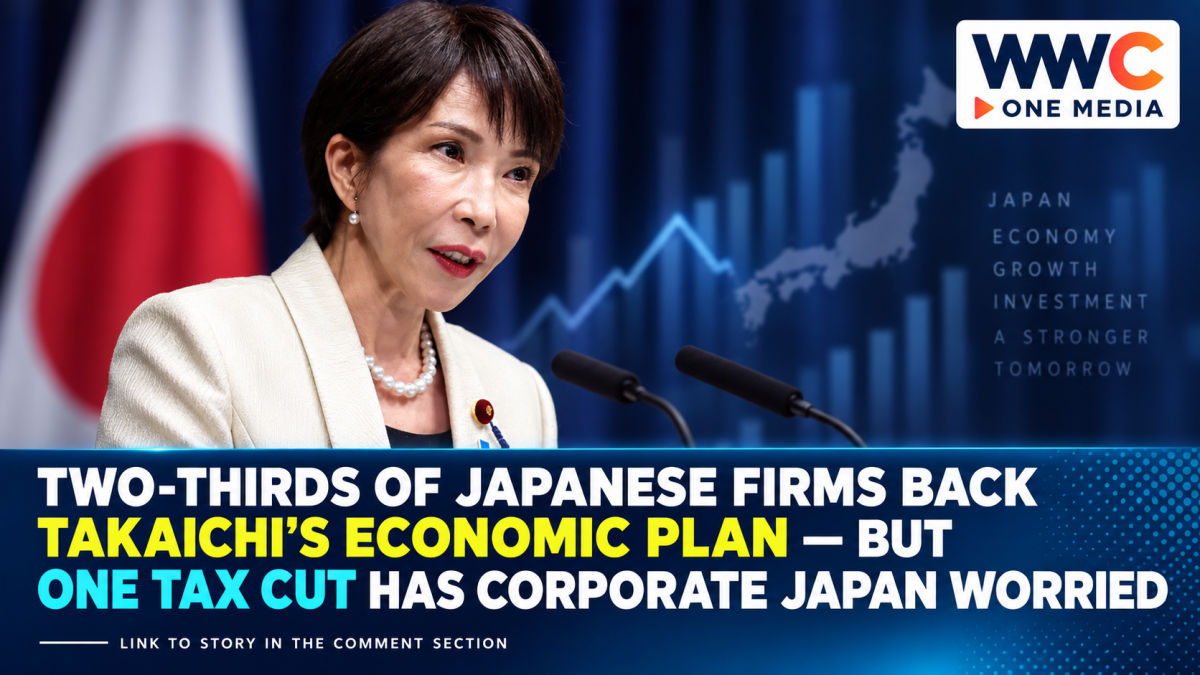
TOKYO — Japanese Prime Minister Sanae Takaichi appears to have won over much of corporate Japan with an aggressive plan to pour investment into artificial intelligence, semiconductors and other strategic industries.
But the policy designed most directly to put money back into consumers’ pockets may be the one making businesses most nervous.
More than two-thirds of Japanese companies surveyed by Reuters said they support Takaichi’s economic policies, providing an important vote of confidence for a government trying to transform Japan from a country long associated with weak domestic investment and deflation into a technology-driven industrial power.
The Reuters Corporate Survey found that 7% of responding companies “strongly” approved of Takaichi’s economic program and another 61% somewhat approved, meaning 68% were broadly supportive. Thirty percent expressed an unfavorable view.
That support, however, comes with a major warning.
Among companies that disapprove of Takaichi’s policies, 68% singled out her plan to cut the consumption tax on food from 8% to 1% for two years as a measure they oppose. Executives cited the potential impact on Japan’s already strained public finances, the yen and inflation.
So while corporate Japan appears enthusiastic about Takaichi’s strategy for creating growth, many companies are far less convinced by the way she intends to ease the cost-of-living squeeze.
And that contradiction may become one of the defining economic battles of her government.
Why Businesses Like Takaichi’s Growth Strategy
Takaichi’s economic program is built around a simple idea: Japan needs to start investing aggressively again.
Her government’s long-term growth strategy envisions more than ¥370 trillion in combined public and private investment through fiscal 2040, spread across strategic technologies and industries considered critical to Japan’s future competitiveness and economic security.
The plan covers 17 strategic sectors and 62 priority products and technologies, with areas including artificial intelligence, advanced semiconductors, robotics, quantum technology, biotechnology, energy, aerospace, cybersecurity and other high-growth fields.
Japan’s Cabinet Office has said projected public and private investment associated with physical AI and semiconductors alone could reach about ¥78.5 trillion by fiscal 2040. The government also wants Japan’s content industries to generate around ¥20 trillion in annual overseas sales.
The scale matters.
For decades, one of Japan’s biggest economic problems was not simply a shortage of technological expertise or capital. It was that companies accumulated cash while domestic investment remained comparatively cautious after the bursting of the country’s asset bubble and years of deflation.
Takaichi is attempting to reverse that behavior by using government policy to encourage businesses to invest before competitors in China, the United States, South Korea and elsewhere capture emerging industries.
That approach appears to be precisely what many executives in the Reuters survey like.
Among companies supportive of Takaichi’s economic agenda, 70% selected her proactive investment-centered growth strategy as a favored policy, while 49% cited energy subsidies and other anti-inflation measures. Respondents were allowed to choose multiple answers.
Japan Wants to Become a Bigger AI and Semiconductor Power
Semiconductors sit near the center of Takaichi’s industrial strategy.
Japan remains a major supplier of semiconductor materials and manufacturing equipment, but it lost much of the dominance it held in chip production decades ago.
Tokyo is now spending heavily to rebuild advanced domestic semiconductor capacity.
Japan’s Ministry of Economy, Trade and Industry has specifically identified AI and semiconductors, quantum computing, biotechnology, aviation and space, energy and green transformation among the areas where it intends to encourage capital investment and research. METI has also outlined continued government investment in Rapidus, Japan’s effort to establish advanced semiconductor manufacturing at home.
That effort is increasingly about more than economic growth.
Japan sees advanced chips, AI infrastructure, critical materials, energy systems and other technologies as matters of economic security, particularly as geopolitical tensions reshape supply chains across Asia.
Those risks are no longer theoretical.
China this week imposed provisional anti-dumping measures on imports of Japanese dichlorosilane, a material used in semiconductor manufacturing, requiring some importers to provide large cash deposits. Japan protested the move.
That dispute illustrates why Tokyo is increasingly willing to intervene directly in strategic industries rather than leaving investment decisions entirely to the market.
But the Food Tax Cut Is Where Corporate Support Starts to Crack
Takaichi’s proposed food-tax reduction has a completely different purpose.
Instead of stimulating long-term investment, it is aimed at households struggling with higher prices.
Japan currently applies a reduced 8% consumption-tax rate to most food products, compared with the standard 10% rate on many other purchases.
Takaichi has pledged to lower the food rate to 1% for two years beginning in April 2027. Her government has also discussed benefits that could offset the remaining 1% burden, effectively making food tax-free for consumers during the period.
For households, the political appeal is obvious.
For Japan’s fiscal watchdogs and many business executives, the mathematics are considerably less comfortable.
Reuters reported that the measure could leave a revenue gap of roughly ¥5 trillion per year, and Japan already carries one of the heaviest public-debt burdens among advanced economies. Takaichi and Finance Minister Satsuki Katayama have said they want to avoid financing the measure through additional deficit-covering government bonds.
But how the government replaces that lost revenue remains one of the most important unanswered questions.
That uncertainty helps explain the unusually strong opposition to the tax proposal among companies that dislike Takaichi’s broader economic program.
Why Businesses Fear a Tax Cut Could Actually Feed Inflation
At first glance, cutting the tax on food should reduce prices.
But critics worry about what happens next.
If the government has to borrow heavily to replace lost tax revenue, investors could become more concerned about Japan’s fiscal position. That could pressure government bonds and potentially weaken the yen.
A weaker yen makes imports more expensive.
Japan imports large quantities of energy and raw materials, so currency weakness can feed directly into fuel, electricity, transportation and food costs.
That concern has become especially relevant as global energy prices rise.
Financial markets are already watching Japan’s fiscal position closely. Japanese ministries recently submitted record budget requests totaling roughly ¥143.1 trillion for the coming fiscal year, while longer-term government bond yields have climbed sharply.
In other words, critics fear an attempt to lower supermarket bills could eventually generate financial pressures that push other costs higher.
That does not mean the tax cut will necessarily have that effect. It means the funding mechanism could determine whether the policy delivers sustainable relief.
Japan’s Consumers Still Have a Problem
Takaichi has a reason for taking that risk.
The Japanese economy is growing, but household finances remain strained.
Japan’s economy expanded at an annualized 1.4% rate in the April-June quarter, slightly stronger than initially reported. Real wages have also improved, giving the Bank of Japan greater confidence that Japan has moved beyond the deflationary environment that dominated much of the past three decades.
But the consumer picture remains uneven.
Inflation-adjusted household spending fell 3.6% year-on-year in July, the eighth consecutive month of decline and the steepest drop in about two and a half years.
Those figures help explain Takaichi’s political calculation.
Industrial investment may create jobs, productivity and economic growth in the future.
Families paying higher grocery and energy bills need relief now.
Her government is trying to do both at once.
Then There Is the Bank of Japan
Takaichi’s fiscal ambitions are also colliding with a major shift in Japanese monetary policy.
The Bank of Japan spent years maintaining extraordinarily low interest rates to defeat deflation.
That era is ending.
The BOJ’s policy rate is currently 1%, its highest level in 31 years, and a Reuters poll of economists found the central bank widely expected to raise it to 1.25% at its September 17-18 policy meeting. Economists increasingly expect additional increases afterward if inflation remains persistent.
That creates a delicate balancing act.
Takaichi wants stronger government-supported investment and fiscal measures that help households.
The BOJ, meanwhile, may have to tighten monetary policy to prevent inflation from becoming entrenched.
Japan could therefore be pressing the accelerator and the brake at the same time.
That tension matters to companies deciding whether to build factories, increase wages or borrow billions of yen for new investments.
Corporate Japan Has a Preferred Yen Level
The Reuters survey also revealed something unusual: where Japanese companies would actually like the yen to trade.
The biggest group—31% of respondents—said a dollar-yen rate between ¥150 and ¥159.99 would be desirable.
Another 25% preferred ¥140 to ¥149.99, while 11% favored ¥130 to ¥139.99.
The yen was around ¥153.58 per dollar on Wednesday, putting it squarely inside the range preferred by the largest group surveyed, although the currency has strengthened sharply recently amid expectations of faster BOJ rate increases.
For exporters, a weaker yen can boost the value of overseas earnings when converted back into Japanese currency.
But excessive weakness also raises import costs.
The corporate response therefore suggests many businesses want something between the extremes: a yen weak enough to support exporters but not so weak that energy and raw-material costs become destabilizing.
Businesses Are Also Giving Takaichi a Political Vote of Confidence
Perhaps the most politically significant result in the survey was not about tax or investment.
It was about Takaichi herself.
Forty-six percent of responding companies said they would like her to remain in power beyond her current Liberal Democratic Party leadership term, which expires in September 2027.
Only 18% said they did not want her to continue, while 36% expressed no clear preference.
Because the LDP controls a strong majority in the lower house of parliament, the party’s leader is overwhelmingly positioned to become or remain prime minister.
For a Japanese leader attempting a strategy extending all the way to 2040, political longevity matters.
Factories are not built in six months.
Semiconductor ecosystems take years.
AI infrastructure, power generation and supply-chain reconstruction can take even longer.
Businesses are much more likely to commit capital if they believe industrial policy will survive beyond the next election or cabinet reshuffle.
But This Is Not a Poll of Japanese Voters
The Reuters findings should not be interpreted as saying two-thirds of Japanese people support Takaichi.
The survey measures corporate sentiment.
Nikkei Research contacted 510 companies between August 26 and September 4, and 224 responded anonymously.
Executives naturally evaluate economic policies differently from households.
A semiconductor manufacturer may focus on subsidies and investment incentives.
An ordinary family may care more about rice prices, electricity bills, wages or taxes.
That distinction becomes particularly important because the very policy troubling many companies—the food-tax cut—could be among the most immediately attractive measures for consumers.
Corporate Japan and Japanese households may therefore agree that prices are a problem while disagreeing about the solution.
Takaichi’s Bigger Gamble
This is ultimately why the Reuters survey is more significant than a simple 68% approval figure.
It suggests Takaichi has convinced a substantial share of Japanese companies that her central economic diagnosis is correct:
Japan needs to invest more.
Her ¥370-trillion vision represents a major attempt to rebuild the country’s industrial capacity around AI, semiconductors, advanced manufacturing and economic security.
Corporate Japan appears willing to participate.
But the same survey exposes the danger lurking underneath that enthusiasm.
Japan has to finance its ambitions while supporting consumers, controlling inflation, managing an enormous public debt, preventing excessive yen volatility and navigating rising interest rates.
Each objective affects the others.
Spend too little, and growth may stall.
Spend too much, and bond markets may punish Japan.
Let the yen weaken too far, and imported inflation rises.
Raise interest rates too quickly, and investment becomes more expensive.
Cut taxes without credible replacement revenue, and fiscal anxiety intensifies.
That means Takaichi’s biggest challenge may no longer be persuading companies to believe in her vision.
It may be proving that Japan can afford it.




Leave a Reply