
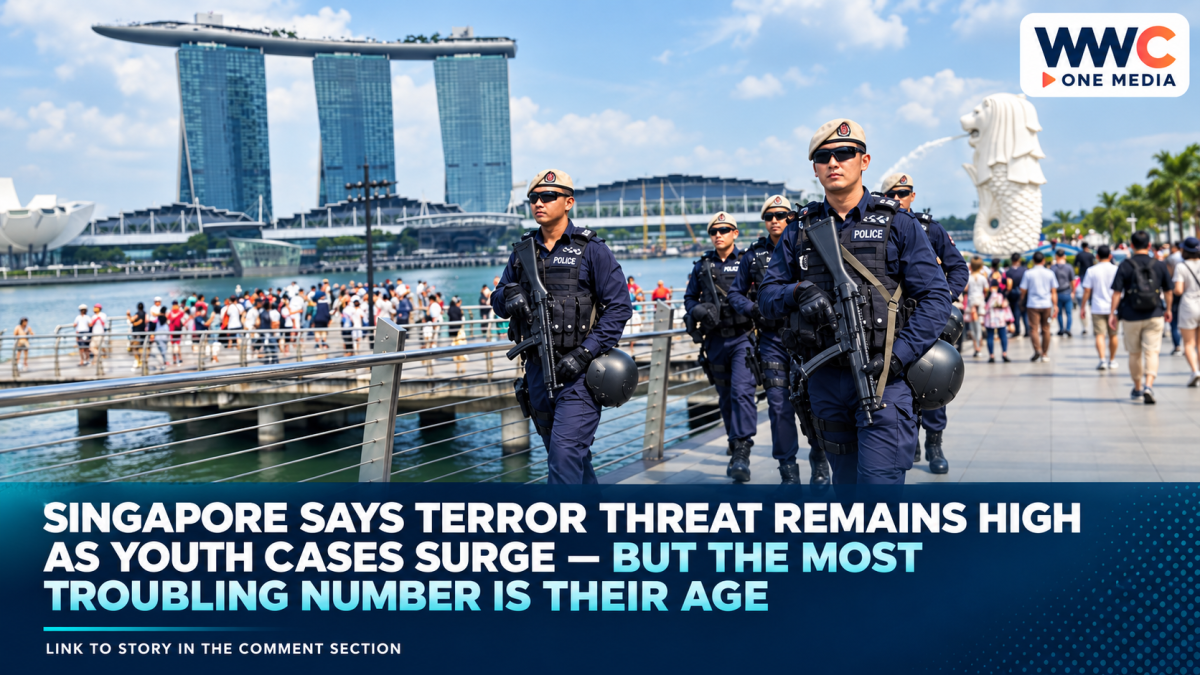
SINGAPORE — Singapore is confronting a terrorism threat that authorities say remains high — but the country’s newest warning is less about a specific imminent attack than about how quickly young people can become radicalised online and how radically the ideology itself is changing.
The Internal Security Department said in its latest Singapore Terrorism Threat Assessment Report that it currently has no specific intelligence of an imminent terrorist attack against Singapore.
Nevertheless, Singapore continues to be viewed as an attractive potential target because of factors including its perceived close ties with Western countries and Israel, its prominent landmarks and its identity as a secular and multicultural society.
The domestic trend attracting the most attention, however, is youth radicalisation.
Of eight Singaporeans dealt with under the Internal Security Act since the previous threat assessment was released in July 2025, six were younger than 21.
Seven of the eight were assessed by ISD to have been self-radicalised.
That means the threat Singapore is watching increasingly does not begin with someone being recruited face-to-face by a terrorist organisation.
It can begin alone, online and at a remarkably young age.
Youth ISA cases have nearly quadrupled
The longer-term numbers illustrate the change.
ISD said four youth cases were dealt with under the ISA between 2017 and 2021.
From 2022 through the present, that figure has risen to 15 — nearly four times as many.
Even more concerning to authorities, four 14-year-olds have been issued ISA orders since June 2024, making them the youngest individuals to have been dealt with under Singapore’s internal-security law.
The trend was already visible before this week’s report. Singapore’s Ministry of Home Affairs said earlier in 2026 that online self-radicalisation remained the primary domestic terrorism threat and that officials were increasingly concerned about younger individuals being drawn into violent extremist material.
The Straits Times also reported in July that Singapore schools have been conducting preparedness exercises and training staff to recognise warning signs and escalate concerns, after three self-radicalised youths were detained for allegedly preparing attacks.
Five Islamic State supporters were all under 21
Islamic State propaganda remains an important part of the problem.
Among the eight Singaporeans dealt with under the ISA over the past year, five were Islamic State supporters — and all five were younger than 21, according to ISD.
Authorities said all five were initially exposed to pro-Islamic State material through social-media platforms.
Three had gone beyond consuming propaganda and were assessed to have been planning Islamic State-inspired attacks in Singapore using readily accessible weapons.
In July, ISD separately disclosed the detention of three self-radicalised Singaporean youths who had made preparations for local attacks. One of them was a 14-year-old student who authorities said had been preparing an attack at his school before he was arrested in May.
The details reinforce a warning Singapore has repeated for several years: the interval between first encountering extremist material and progressing toward violent ideas can become frighteningly short.
Its 2025 terrorism assessment said online exposure could accelerate radicalisation within weeks in some cases.
The ideology itself is becoming harder to classify
Perhaps the biggest change in this year’s report is something Singapore calls Composite Violent Extremism, or CoVE.
It has also been described as “salad bar” extremism because individuals do not necessarily subscribe to one coherent ideology.
Instead, they select pieces from different — sometimes directly contradictory — extremist worldviews and assemble them into a personalised belief system that can be used to rationalise violence.
That can mean combinations involving Islamist extremism, far-right beliefs, antisemitism, racial supremacy, misogynistic incel ideology, hostility toward particular communities or fascination with mass violence.
Singapore has recorded three CoVE cases since September 2025, involving individuals aged 14, 15 and 19.
All were youths.
RSIS researchers said this represents a significant shift away from the traditional model in which authorities could look for adherence to one organised extremist ideology.
Today’s pathway can instead be intensely personal: grievances, identity problems, violent online communities and fragments of multiple ideologies may converge in the same individual.
That creates a much harder problem for parents, schools, security agencies and rehabilitation specialists.
How do you counter an ideology when there isn’t just one ideology to counter?
Gaming and social media are part of the warning — but not the whole explanation
Online gaming platforms have appeared repeatedly in Singapore’s youth-radicalisation cases.
ISD warned that young users can encounter extremist material through online communities as well as algorithmic recommendations, while repeated engagement may create digital echo chambers that reinforce increasingly extreme beliefs.
In some investigated cases, young people also used games to recreate terrorist attacks or mass shootings, which authorities fear can desensitise users to violence or deepen an existing fascination with violent perpetrators.
That does not mean ordinary gaming causes terrorism.
The more serious concern identified by researchers is the combination of large amounts of unsupervised online time, algorithmic exposure, extremist communities, personal grievances and repeated engagement with violent material.
RSIS researchers have described the emerging phenomenon as a move toward increasingly personalised online radicalisation rather than traditional recruitment by established terrorist organisations.
Overseas wars are still shaping what happens online in Singapore
Domestic radicalisation cannot be separated from international events.
ISD said continuing instability in the Middle East — including the Israeli-Palestinian conflict and wider confrontation involving Iran — has intensified the global extremist environment.
Such conflicts provide terrorist and extremist networks with emotionally powerful material that can be repackaged into propaganda, while also fuelling antisemitism, anti-Muslim hatred and other forms of communal hostility internationally.
Singapore faced the same basic risk in its 2025 assessment, when ISD warned that overseas conflicts could act as triggers for people already consuming extremist material online.
What has changed is the increasingly mixed nature of the ideology reaching those individuals.
Singapore is moving prevention closer to schools and families
The government appears to be responding by pushing counter-radicalisation beyond intelligence agencies.
In March, the Ministry of Home Affairs launched its 2026 SGSecure “Play Your Role” campaign, explicitly highlighting online self-radicalisation and youth vulnerability.
Its message is straightforward: relatives, friends, teachers and communities may notice behavioural changes before the authorities do, making early intervention critical.
Schools are also conducting drills and staff training covering threat recognition, reporting and escalation procedures, according to The Straits Times.
That broader strategy matters because several past cases involved youths whose radicalisation largely occurred privately online.
But “high threat” does not mean an attack is imminent
This is perhaps the most important distinction for readers.
Singapore’s description of the terrorism threat as “high” should not be interpreted as a warning that authorities believe an attack is about to occur.
ISD explicitly says there is no specific intelligence of an imminent terrorist attack against Singapore.
The assessment is instead about the overall risk environment: global conflicts remain volatile, extremist material moves rapidly across borders, terrorist organisations remain active, and locally self-radicalised individuals can become dangerous without belonging to a conventional terrorist cell.
Singapore has been using similar high-threat language for several years, while repeatedly making the same distinction about the absence of intelligence pointing to an immediate attack.
And that may be why the numbers involving teenagers are now receiving so much attention.
The emerging security challenge is not simply whether an organised terrorist group can penetrate Singapore.
It is whether a teenager sitting alone with a phone can move from curiosity, to an algorithmic rabbit hole, to a personalised extremist worldview — before anyone around them realises how far things have gone.
That is the warning behind the latest terrorism assessment.
And unlike a conventional extremist organisation, the next ideology authorities have to confront may not even have a name yet.




Leave a Reply