
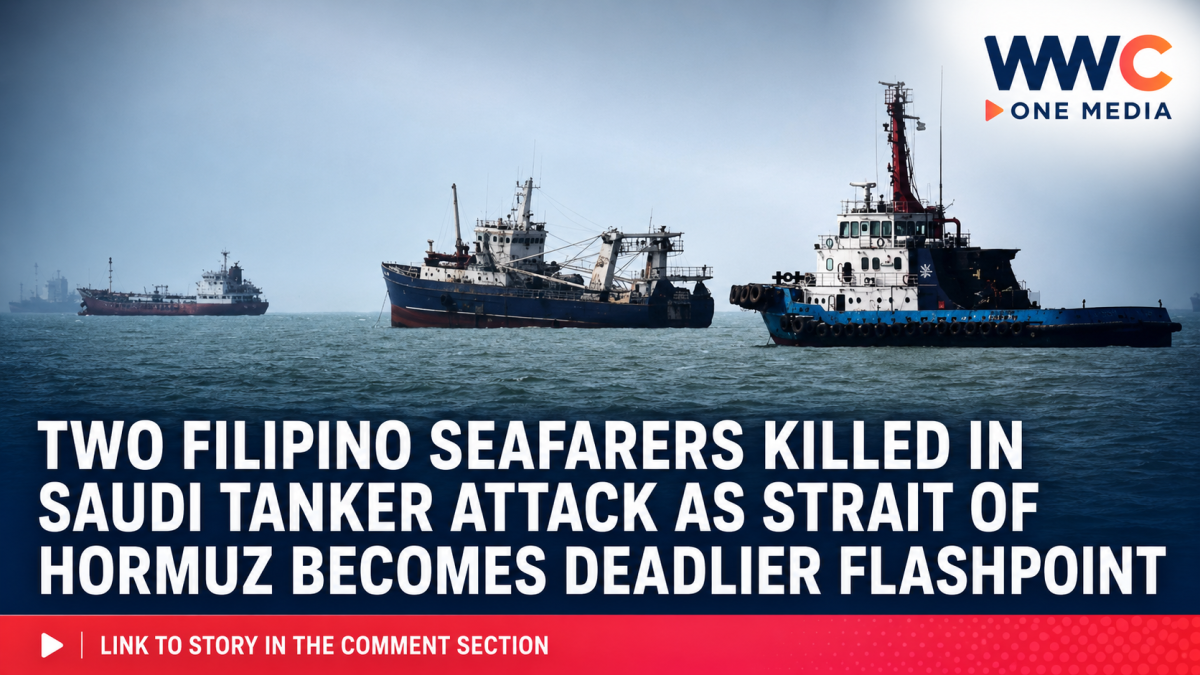
MANILA — Two Filipino seafarers have been killed aboard a Saudi oil tanker in the Strait of Hormuz, turning another attack on commercial shipping into a deadly reminder of how rapidly one of the world’s most important energy corridors is becoming a frontline in the widening Middle East conflict.
Saudi Arabia’s national shipping company Bahri confirmed Wednesday, September 2, that its Saudi-flagged tanker SIDR was involved in a security incident while transiting the Strait of Hormuz on the night of August 31.
The company confirmed that two Filipino crew members died as a result of the incident, but did not publicly release their identities or provide detailed circumstances surrounding their deaths.
The attack raises an increasingly urgent question for the thousands of seafarers still navigating the Gulf: how safe is commercial shipping when vessels carrying millions of barrels of oil can be hit with little warning?
SIDR Was Hit Near Oman as Two Tankers Came Under Attack
Maritime intelligence and tracking firms reported that SIDR was struck by unknown projectiles while sailing outbound through the Strait of Hormuz.
According to Reuters, citing maritime risk firm Marisks, the Saudi-flagged very large crude carrier was hit about 16.6 nautical miles northeast of Khasab, Oman, at around 7:52 p.m. UTC on August 31.
Just minutes later, another supertanker, the Liberian-flagged Senegal Prosperity, was reportedly struck by three unknown projectiles roughly 17 nautical miles east of Khasab.
The two vessels had each loaded approximately 2 million barrels of Saudi crude at the Juaymah terminal the previous week, according to Kpler shipping data.
The United Kingdom Maritime Trade Operations agency separately reported that a tanker in the area had been hit by three unidentified projectiles while sailing out of the Strait of Hormuz.
Early reports on September 1 did not identify fatalities associated with the attacks. Bahri’s subsequent statement on September 2 provided the crucial update: two Filipino members of SIDR’s crew had died.
Who Attacked the Tanker? That Remains Unconfirmed
Despite the broader confrontation involving Iran and the United States, no party has been conclusively identified as responsible for the attack on SIDR in the confirmed reports reviewed for this article.
That distinction matters.
Iran has threatened vessels attempting to pass through the strategic waterway without authorization, and Iranian authorities have sought to exert greater control over traffic through the strait. But attributing the SIDR attack directly to Tehran would go beyond what has so far been independently confirmed.
Iran’s Revolutionary Guards separately said Wednesday that two tankers had caught fire after striking mines while transiting the strait. That claim adds another layer of uncertainty but does not, by itself, establish who fired the projectiles reported in the SIDR incident.
The Associated Press likewise reported the deaths of the two Filipino sailors while noting that no responsibility had been claimed for the Saudi tanker attack.
Strait of Hormuz Is More Than Just Another Shipping Lane
The location of the attack makes the deaths especially significant.
The Strait of Hormuz, positioned between Iran and Oman, connects the Persian Gulf with the Gulf of Oman and Arabian Sea. It is one of the most strategically important maritime chokepoints on Earth.
U.S. Energy Information Administration data show that oil flows through the strait averaged approximately 20.9 million barrels per day during the first half of 2025, equal to about 20% of global petroleum liquids consumption and roughly one-quarter of the world’s maritime-traded oil.
That means violence involving even a handful of tankers can have consequences far beyond the immediate danger to their crews.
Shipping disruptions can affect oil supplies, freight rates, insurance costs and ultimately fuel prices in economies thousands of kilometers away — including energy-importing countries in Asia.
The security situation has deteriorated sharply during the continuing confrontation in the region, with shipping traffic through Hormuz falling far below normal levels amid attacks, blockades and military operations.
Filipino Seafarers Again Caught in the World’s Conflict Zones
For the Philippines, the SIDR deaths carry another painful dimension.
Filipino seafarers form a major part of the international maritime workforce, putting them aboard commercial ships operating through some of the world’s most dangerous waters.
The latest deaths come after other Filipino mariners were caught in attacks this year.
In June, Philippine authorities said 40 Filipino crew members aboard two commercial vessels attacked near the Strait of Hormuz were unharmed. The sailors were aboard the MV Ever Lovely and MT Kiku.
Filipino sailors have also been affected by attacks in the Black Sea linked to the Russia-Ukraine conflict, reinforcing concerns over the exposure of civilian crews to increasingly militarized shipping routes.
Bahri Says It Is Coordinating With Authorities
Bahri said it remained in contact with SIDR and was coordinating with authorities and maritime industry stakeholders following the incident.
The Saudi company said the safety and welfare of its personnel remained its priority and expressed condolences to the families and colleagues of the two Filipino sailors.
But major questions remain unanswered.
The identities of the Filipino victims have not been publicly disclosed in the sources reviewed. Details about exactly how they were killed, the extent of damage to SIDR and the origin of the projectiles also remain unclear.
Most importantly, responsibility for the deadly attack has yet to be conclusively established.
What is already clear is that the Strait of Hormuz is no longer simply an oil-market risk measured in barrels, shipping rates and crude prices.
For two Filipino families, the escalating battle over one of the world’s most valuable waterways has now carried a far more devastating cost.
WWC ONE MEDIA MJE




Leave a Reply