
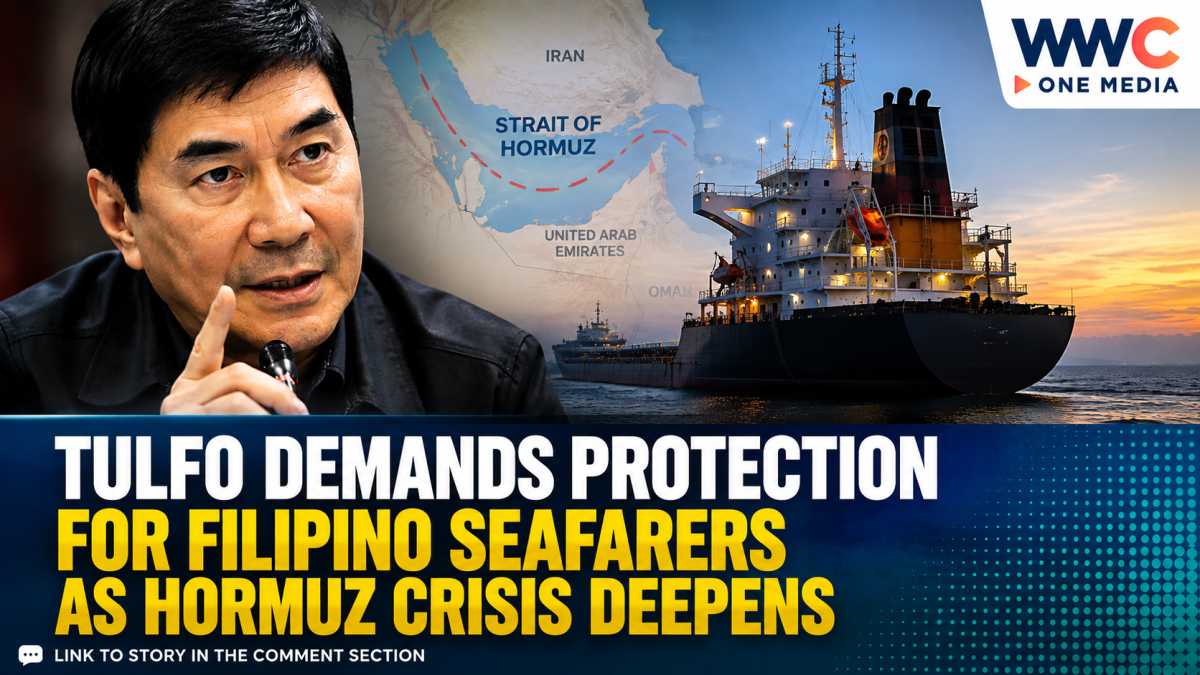
MANILA — Senator Raffy Tulfo is calling for stronger protection for Filipino seafarers amid continuing security risks in and around the Strait of Hormuz, saying workers should have the right to refuse voyages through the high-risk waterway without fear of losing their jobs.
The call comes as maritime traffic through the Strait of Hormuz remains under intense pressure because of the continuing conflict involving Iran and the United States. The strategic waterway is one of the world’s most important shipping routes, making any disruption there a concern not only for seafarers but also for global energy supplies and international trade. Reuters reported that the conflict has sharply reduced shipping activity through the strait, while tensions have continued to affect commercial vessels operating in the Gulf.
Tulfo said Filipino seafarers should not be forced to choose between their livelihood and their personal safety. According to the Philippine News Agency, the senator urged authorities and maritime stakeholders to ensure that Filipino crew members can decline assignments involving the Strait of Hormuz when they believe the voyage presents unacceptable risks.
The issue has taken on greater urgency following the deaths of two Filipino seafarers aboard a Saudi Arabia-flagged crude oil tanker that was attacked near the Strait of Hormuz. The incident was reported by several international and Philippine news organizations, with the Associated Press reporting that the tanker came under attack and caught fire while preparing to cross the waterway. No group had claimed responsibility for the attack at the time of reporting.
The deaths have renewed questions over how governments, shipowners and recruitment agencies should protect Filipino workers deployed in conflict-affected maritime areas. The Philippine government has already taken steps to assist Filipino seafarers affected by the crisis, including efforts to move crews away from areas considered unsafe.
The Department of Migrant Workers has previously warned about sending Filipino seafarers through the Strait of Hormuz, while government agencies have coordinated measures involving affected vessels and crews. In July, authorities reported that 81 Filipino seafarers aboard four Philippine-registered vessels had safely exited the conflict area.
The danger, however, has not disappeared.
Reporting from Al Jazeera in August highlighted the difficult choices facing Filipino sailors who continue to seek employment at sea despite the risks created by conflicts in areas such as the Strait of Hormuz and the Black Sea. The report noted that Filipino seafarers continue to work in dangerous maritime environments even as security concerns complicate international shipping.
Other international reporting has shown the wider human cost. The Guardian reported that thousands of seafarers have remained stranded in the Gulf amid the disruption, with crews facing prolonged uncertainty over when they can safely leave the region. The publication also noted that the disruption has sharply reduced commercial shipping through the waterway.
For the Philippines, the stakes are particularly high. The country is one of the world’s leading sources of maritime workers, meaning instability along major international shipping routes can have direct consequences for Filipino families and the country’s overseas employment sector.
The Strait of Hormuz is also critical to the global economy because a substantial share of internationally traded oil and gas traditionally passes through the waterway. Any prolonged disruption can therefore have consequences far beyond the Gulf, potentially affecting fuel prices, transportation costs, supply chains and economies that depend on energy imports.
The latest crisis has already demonstrated how quickly a regional conflict can become a global maritime problem. Commercial vessels are facing difficult decisions about routing, while crews must operate under heightened security concerns.
Tulfo’s appeal therefore goes beyond a single shipping route. It raises a broader question about the rights of Filipino workers who are sent into areas affected by armed conflict: How much risk should a worker be expected to accept simply to keep a job?
The senator’s position is that personal safety must come first.
For Filipino seafarers and their families, the debate is no longer theoretical. Recent attacks have shown that commercial crews can become victims even when they are not participants in a conflict.
The Philippine government now faces the challenge of balancing the country’s role as a major supplier of maritime workers with its responsibility to protect those workers when international security conditions deteriorate.
And as fighting continues to disrupt one of the world’s most important shipping corridors, one question is becoming increasingly difficult to ignore:
If the Strait of Hormuz remains dangerous, will protecting Filipino seafarers require more than simply giving them the option to say no?
WWC ONE MEDIA G.A



Leave a Reply