
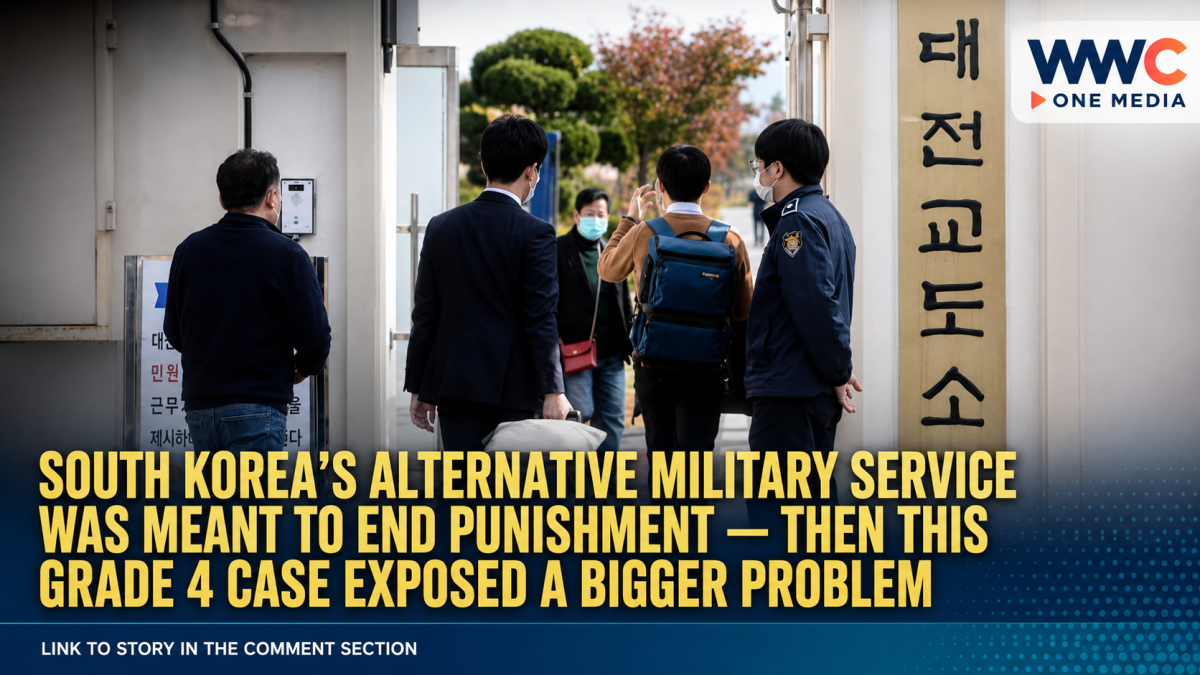
SEOUL — South Korea created an alternative military-service system to stop conscientious objectors from being sent to prison for refusing to bear arms.
Six years after the program began, however, a new case is reviving an uncomfortable question: Did South Korea end the punishment — or simply redesign it?
A conscientious objector identified as Lee told The Korea Herald that he spent three years performing alternative service in correctional facilities despite having previously received a Grade 4 physical classification because of recurrent rheumatism. He said strenuous duties, including carrying boxes, bottled water and wet laundry, aggravated inflammation in his hands and feet and at times left him relying on painkillers.
The case is significant because many South Korean men classified as Grade 4 fulfill their military obligations through supplementary forms of service, including jobs that allow them to commute. Conscientious objectors, however, enter a separate system: 36 months of residential service at correctional facilities.
That means an alternative-service worker currently serves twice as long as a typical Army conscript.
South Korea’s Defense Ministry lists current active-duty terms at 18 months for the Army and Marine Corps, 20 months for the Navy and 21 months for the Air Force.
From Prison Sentences to Prison-Based Service
For decades, hundreds of South Korean conscientious objectors — historically many of them Jehovah’s Witnesses — were prosecuted and imprisoned after refusing compulsory military service because of their religious or moral beliefs.
That began changing after landmark court decisions in 2018.
South Korea subsequently enacted legislation establishing alternative service, and the first group entered the new program in October 2020. Instead of joining the armed forces, approved conscientious objectors were assigned to correctional facilities for 36 months, performing work including meal preparation, laundry, cleaning and supply management.
The program represented a major shift: refusing military service on legitimate conscientious grounds would no longer automatically mean a criminal conviction.
But the design of the replacement system immediately generated controversy.
Critics argued that requiring conscientious objectors to spend three years living and working inside correctional institutions risked replacing an 18-month prison sentence with something that, while legally different, could still feel punitive.
TIME reported similar concerns in 2022, including alternative-service workers who described discomfort and anxiety about working inside prisons and interacting with inmates. Amnesty International has likewise repeatedly argued that the length and prison-based structure make the system disproportionately burdensome.
Nearly 3,000 Have Been Called Up
According to figures provided by the Military Manpower Administration to The Korea Herald, 2,931 conscientious objectors had been called up for alternative service between the program’s launch in October 2020 and July 2026.
Lee served from April 2022 until April 2025 at Gongju Prison and Yeoju Prison, according to the newspaper.
He said he informed officials about his health condition when he began service but was nevertheless assigned physically demanding work. He also described crowded accommodation, leaks, mold and drainage problems at one facility, as well as occasions when alternative-service workers interacted directly with inmates.
The Justice Ministry told The Korea Herald that institutions are required to consider an alternative-service worker’s illness and physical condition when assigning duties. It also said work involving interaction with inmates is supposed to occur under the supervision of correctional officers and that living conditions can differ according to facility size, staffing and funding.
That distinction is important: Lee’s account describes his individual experience, while authorities maintain that regulations require health conditions and workplace safety to be considered.
Constitutional Court Upheld the System — By Just One Vote
The legal battle over the system has already reached South Korea’s Constitutional Court.
In May 2024, the court upheld the 36-month service period, residential requirement and restriction of alternative service to correctional facilities.
But the decision was extraordinarily close: 5–4.
The majority concluded that the system pursued a legitimate objective by balancing freedom of conscience with fairness toward active-duty conscripts and maintaining confidence in South Korea’s conscription system.
The four dissenting justices reached a starkly different conclusion.
They argued that the burden imposed on conscientious objectors exceeded what was necessary to maintain fairness and could make alternative service so difficult that it effectively discouraged people from exercising their right to conscientious objection — in other words, functioning as punishment.
That narrow split remains crucial to the debate today.
The UN Has Also Raised Concerns
International human-rights bodies have challenged South Korea’s approach as well.
The UN Human Rights Committee said in its 2023 findings on South Korea that the 36-month alternative-service period appeared “discriminatory and punitive” compared with active-duty terms of 18 to 21 months and expressed concern that service was limited to correctional facilities.
The committee recommended reducing the duration and expanding alternative-service opportunities beyond prisons.
A UN human-rights report published in April 2026 again discussed South Korea’s treatment of conscientious objection, including remaining questions surrounding people who rejected the existing alternative-service arrangement.
South Korea’s National Human Rights Commission has also pushed for reform, saying the government should reconsider the length of service and establish alternative-service institutions outside correctional facilities.
A 27-Month Compromise Has Already Been Floated
Perhaps the most important detail is that South Korean authorities have already studied alternatives to the existing system.
Weekly Kyunghyang reported that the Alternative Service Commission proposed reforms including reducing service to 27 months, permitting commuting in exceptional circumstances and expanding eligible workplaces beyond prisons.
The 27-month figure is significant because it equals 1.5 times the Army’s current 18-month term — a ratio frequently discussed by human-rights advocates as a more proportionate alternative.
Yet the 36-month system remains in force.
The Military Manpower Administration told The Korea Herald that it is aware of differing views and is considering the future direction of the program, while emphasizing that any changes involving fairness in military obligations require careful review and broad public consensus.
The Bigger Question Facing South Korea
South Korea’s dilemma goes beyond one worker, one religion or one correctional facility.
The government has a legitimate interest in preventing alternative service from becoming an easy route around conscription — particularly in a country where military duty remains a major social obligation and security tensions with North Korea persist.
But a system designed to respect freedom of conscience also has to remain meaningfully different from punishment.
That is why Lee’s case could prove consequential.
The controversy is no longer simply about whether 36 months is too long.
It is now about whether a one-size-fits-all, residential, prison-based system can adequately accommodate people whose health, physical capabilities and circumstances may differ sharply — and whether South Korea can preserve fairness for soldiers without turning the alternative into a deterrent.
The courts have said the current arrangement is constitutional.
Human-rights organizations say it remains excessive.
And South Korea itself has already considered a shorter, broader model.
The next question is whether Seoul will actually change it — or whether conscientious objectors will continue spending three years behind prison walls without ever being prisoners.
WWC ONE MEIA MJE



Leave a Reply